Colombians are at the Polls and Voting for President Petro’s Successor
People set up ballot boxes at the Corferias fairgrounds this Saturday in Bogotá, Colombia. Elections abroad for 1.4 million citizens began last Monday.
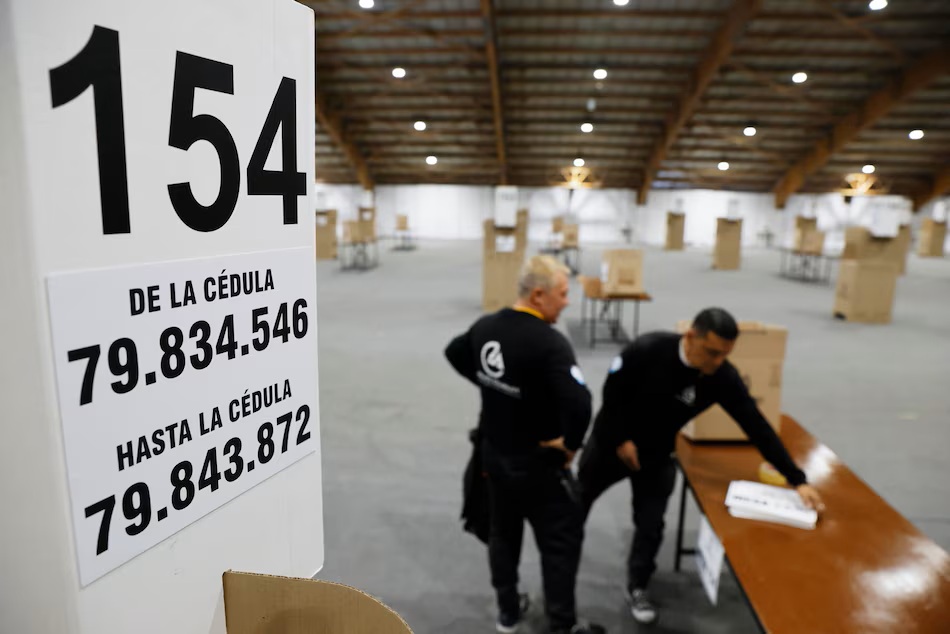
Colombian authorities are finalizing preparations this Saturday for the first round of the presidential elections on Sunday, in which the successor to the current president, Gustavo Petro , will be elected, and for which 41,421,973 citizens are eligible to vote , including those residing abroad. At the Corferias fairgrounds in Bogotá, the country’s largest polling center, officials from the National Registry, the entity that organizes the elections, were working on Saturday morning to assemble the cardboard booths where citizens will be able to vote. “The electoral material is already in all the municipalities of Colombia we have no new information that indicates the need to move any table or voting station during tomorrow’s election day,” said the national registrar, Hernán Penagos.
For these elections, the Registrar’s Office adopted the slogan “Give your vote of confidence to the electoral process,” in response to the doubts that President Petro and members of his party, the Historical Pact, have sown about the transparency of the elections, alleging that there are no guarantees that the vote count will not be altered. In response to Petro’s criticism, Penagos said this week that “there is no way that software can disseminate information different” from that physically recorded at the polling stations. Elections abroad for 1.4 million citizens began last Monday and, according to the Registry, of the 40,007,312 Colombians eligible to vote tomorrow in the country, 20.5 million are women and 19.4 million are men. Throughout the country, 118,346 polling stations were set up in 13,489 locations, of which 6,010 are in urban areas and 7,479 in rural areas, whose surveillance and security will be handled by some 248,000 members of the Military and Police Forces.
Eleven Candidates in the Running
Of the thirteen candidates who appear on the ballot, only eleven remain in the presidential race because in recent weeks former minister Luis Gilberto Murillo and former mayor Carlos Caicedo, both from the left, withdrew to join the candidacy of Senator Iván Cepeda, who leads all the polls on voting intention. “Tomorrow we have a date with history, I invite you to go massively to the polls to strengthen our democracy,” Cepeda said today in a message to the country. His biggest rivals are the far-right lawyer Abelardo de la Espriella, from the Defenders of the Homeland movement, who appears in second place, and the Uribista senator Paloma Valencia, from the right-wing Democratic Center party, who is in third place.
Barring a surprise at the polls tomorrow, none of them appear in the surveys with enough votes to win in the first round, which requires half plus one of the votes in an election where participation is around 54%. If the predictions are confirmed, a second round will be necessary on June 21 between the two most voted candidates who, according to the polls, will be the leftist Cepeda and the far-right De la Espriella, whose candidacy has grown steadily in recent weeks with a populist discourse.
De la Espriella’s rise has coincided with the setbacks of Paloma Valencia, who represents a moderate right wing that, in its attempt to attract the center, ended up losing support within the Uribista party to which it belongs, where a radical sector opted to go with the far-right candidate. The elections will be closely monitored by national and international organizations, which, according to the Registrar’s Office, will be “one of the main mechanisms for supporting and strengthening democracy in the country.” “In total, 26 international organizations and missions, with 1,500 observers, will monitor the election day on May 31,” said registrar Penagos.