Panama is Seeking a Green Card for Fishing: The European Union will Audit Panama this Year
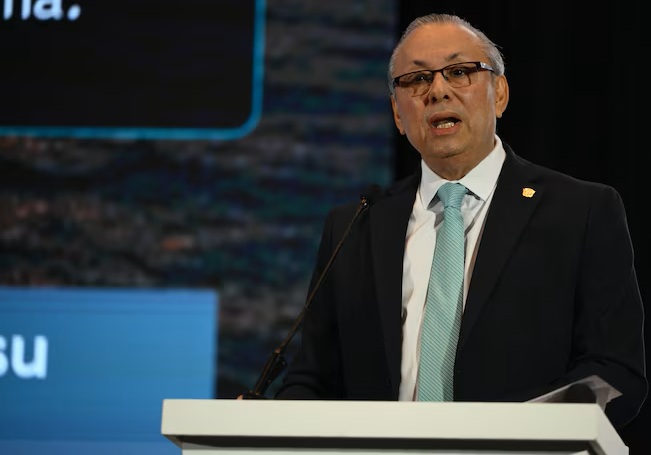
Eduardo Carrasquilla pictured below, administrator of the Aquatic Resources Authority of Panama (ARAP), detailed the country’s progress in fisheries control, traceability and exports and announced that the next audit will be between September and October.
Panama has had a yellow card from the European Union for fishing issues since 2019, which makes it difficult for seafood products to reach that market. Furthermore, the safety measures applied to the Panamanian-flagged fleet are being questioned due to non-compliance with regulations against illegal, unreported and unregulated (IUU) fishing, a global problem that threatens ocean ecosystems and sustainable fishing. The country has to undergo a new audit this year by the European Commission’s Directorate-General for Maritime Affairs and Fisheries (DG MARE).
The agency must verify whether, after several measures applied to monitor the fleet, Panama is complying with international standards of traceability and control in fisheries matters, in order to give it the green card or, if not, maintain the yellow card or sanction it with the red card, which would totally block the Panamanian-flagged fishing fleet and exporters from accessing the European market. In an interview with the media, Eduardo Carrasquilla, administrator of the Aquatic Resources Authority of Panama (ARAP), revealed the progress they have made and the timeline for achieving a better evaluation by the European bloc.

During the Maritime Convention of the Americas, he affirmed that Panama has already completed the regulatory update process required by the European Union to qualify for the so-called green card against illegal fishing. “We are already 100% compliant in terms of regulations. We also have 100% control of our fishing fleet with the implemented observer program,” he stated.
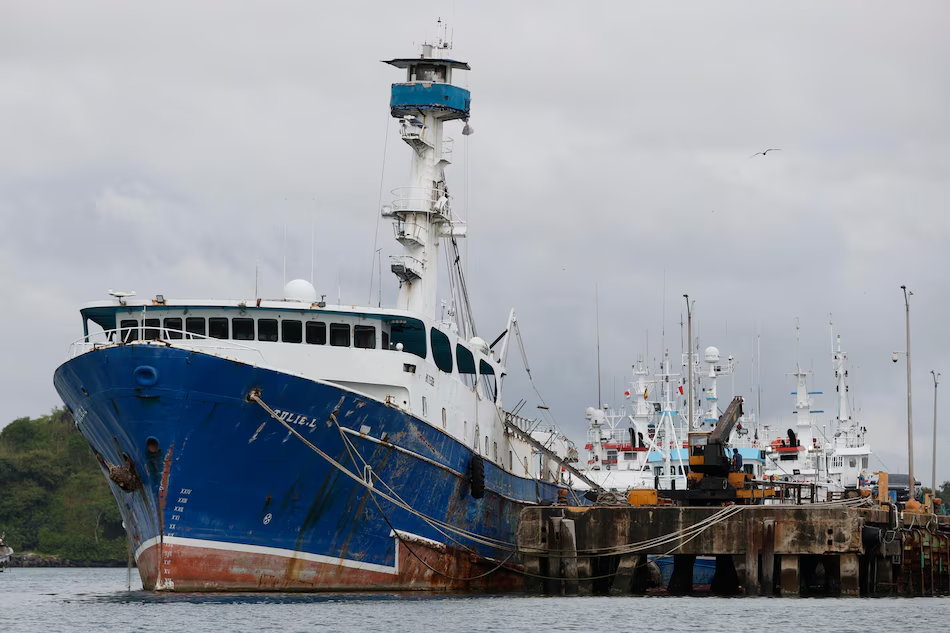
Panama currently maintains an international fishing fleet made up of about 160 vessels, of which about 30 carry out fishing activities, mainly tuna fishing, in both the Pacific and Atlantic Oceans. In addition, the country has approximately 80 refrigerated ships or “reefers”, dedicated to the transport and storage of fishery products. “Today, Panama has an observer on 100% of its fleet,” said Eduardo Carrasquilla, highlighting that these observers are connected in real time with the ARAP monitoring center to monitor loading, unloading, and transshipment operations.
The Key Step for the Green Card
The ARAP administrator indicated that the last pending step is to consolidate the national fisheries traceability system, to guarantee the monitoring of exports to the European market. As part of that process, Carrasquilla explained that ARAP plans to complete the “Trazar Agro Panamá” computer system in June, which will allow tracking the product from capture to export. The system will cover approximately 450 industrial vessels and around 3,800 artisanal fishing vessels. “We should be in the pilot testing phase by the end of June,” the official stated, adding that Panama expects to receive the European Union audit between September and October of this year. “We estimate that by the beginning of next year we could achieve green card status,” he indicated.
In economic matters, Carrasquilla revealed that Panamanian fishing exports closed 2025 with about 275 million dollars, driven mainly by shrimp, which generated more than 130 million dollars. The main export markets for Panamanian fish products continue to be the United States and Taiwan. He explained that the fishing industry grew by 18% last year. “We want to export more to the European market, where last year we only exported 8% of our fish production,” he stated. The official also emphasized that obtaining the green card would open new investment and expansion opportunities for the national fishing industry.
He mentioned that the new port of Puerto Armuelles, whose inauguration is scheduled for February of next year, could become a “tuna hub for the Eastern Pacific.” “This entire international fishing ecosystem can come to Panama to settle, generate employment, generate foreign exchange, and increase our participation in the European market,” said Carrasquilla, who also announced that peripheral seafood markets will be established and the fuel subsidy will be reinforced to support artisanal fishing and maintain affordable prices for the local consumer. He explained that more than 1,400 artisanal boats have been registered within the subsidy program, out of an estimated universe of 3,800 boats throughout the country.