Panama President Mulino Welcomes his Israeli Counterpart Isaac Herzog
Pictured below is the President of Israel, Isaac Herzog, along with his wife Michal Herzog, and the President of Panama, José Raúl Mulino, along with the First Lady, Maricel de Mulino.
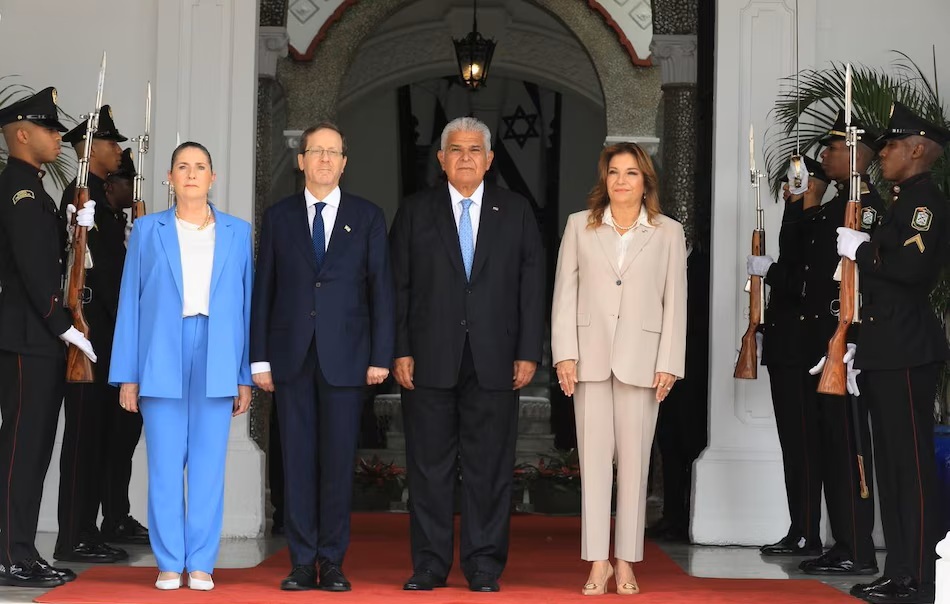
President José Raúl Mulino received his Israeli counterpart, Isaac Herzog, at the Presidential Palace on Wednesday morning, May 6, marking the first official visit to the country by an Israeli leader and proposes an agreement with Israel to address the water crisis (more below on that topic). Israeli President Isaac Herzog is visiting Panama for a historic, first-ever presidential trip to bolster strategic ties with a key ally. The visit aims to strengthen bilateral cooperation in technology, agriculture, and security, and to shore up support in Latin America during regional conflicts. This visit follows up on discussions between the two leaders at the World Economic Forum in Davos.
Key Reasons for the Visit Include:
- Strengthening Strategic Alliances: Herzog is meeting with President Jose Raul Mulino to deepen partnerships with Panama, which is considered a “true friend” of Israel and a current member of the UN Security Council.
- Regional Cooperation: The visit focuses on expanding cooperation in areas like technology, innovation, water management, health, and agriculture.
- Strengthening Ties with Latin America: The trip is part of a larger, four-day effort to boost relations with Central American nations, including attending the upcoming inauguration in Costa Rica.
- Connecting with the Jewish Community: Herzog plans to meet with the local Jewish community in Panama, which is described as a “special bridge” between the two nations.
Panama’s biggest water headache right now is too little fresh water in the wrong place, at the wrong time. Here’s the rundown:
# 1. The Panama Canal drought crisis
– What’s happening: Gatún Lake feeds the Panama Canal’s locks. Each ship needs ∼26 million gallons to pass through. In 2023-2024 Panama had one of its worst droughts on record, dropping Gatún Lake ∼6 feet lower than the year prior.
– Impact: The Canal Authority cut daily transits from 38 ships to as low as 22. Ships also had to carry lighter cargo. The authority raised prices and auctioned slots, estimating losses of $100M/month without those measures.
– Why it’s happening: El Niño delayed rains and increased evaporation. Climate models show that under high-emissions scenarios, these “disruptive low water conditions” could become the norm by end of century. More warming = less wet-season rainfall + more evaporation.
– The fix being debated: A new dam on the Río Indio + 5-mile tunnel to feed the canal. Cost: ∼$1.6B, 6 years to build. Problem: it would flood farmland and displace 2,000+ people.
# 2. Competing demands for the same water
Gatún Lake doesn’t just run the canal. It supplies drinking water for ∼2 million Panamanians in Panama City and Colón. So drought creates conflict between:
– Global trade: Canal = 7% of world trade and 4.2% of Panama’s GDP.
– Local needs: Drinking water, Indigenous communities, farmers, and hydropower. de1e
Authorities say without more capacity, they can’t guarantee water for citizens in ∼10 years.
# 3. Rural water access & quality
Outside the canal watershed, Panama still struggles:
– Access gaps: 7.5-31% of Panamanians live in isolated rural areas with minimal potable water or sewage treatment.
– Rainfall paradox: Panama gets up to 3000mm rain/year, but urbanization, climate change, and development cut availability.
– Quality issues: Rainwater harvesting is common, but collected water often has coliforms/fecal coliforms from animal droppings on roofs.
– Example: Bocas del Toro: Gets water from Big Creek, but treatment plants are undersized. Waterborne diseases like diarrhea and intestinal parasites are leading causes of infant mortality there.
# 4. Service problems in cities like Colón
The national water agency IDAAN has capacity issues. In Colón around 2008:
– 30% of residents lacked reliable service.
– Only 38% got 18-24 hrs/day of water vs 70% national average.
– Nonrevenue water was 54%, and tariffs hadn’t risen since 1982.
# 5. Climate variability cuts both ways
Too little rain causes drought. Too much rain also hurts: a 2010 storm caused $150M in damage and halted canal transits. Rising temps also change forest composition around Gatún Lake.
Bottom line: Panama’s water issues are a three-way squeeze — climate-driven drought hitting the canal, growing urban demand, and rural areas that never had solid infrastructure to begin with. The Río Indio dam is the main proposed solution, but it’s controversial.