Why Did the ‘Seismic Doublet’ that Shook Venezuela Cause So Much Damage?
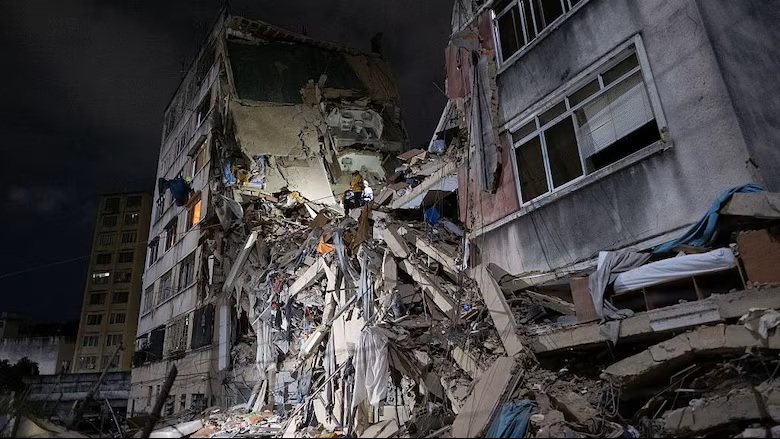
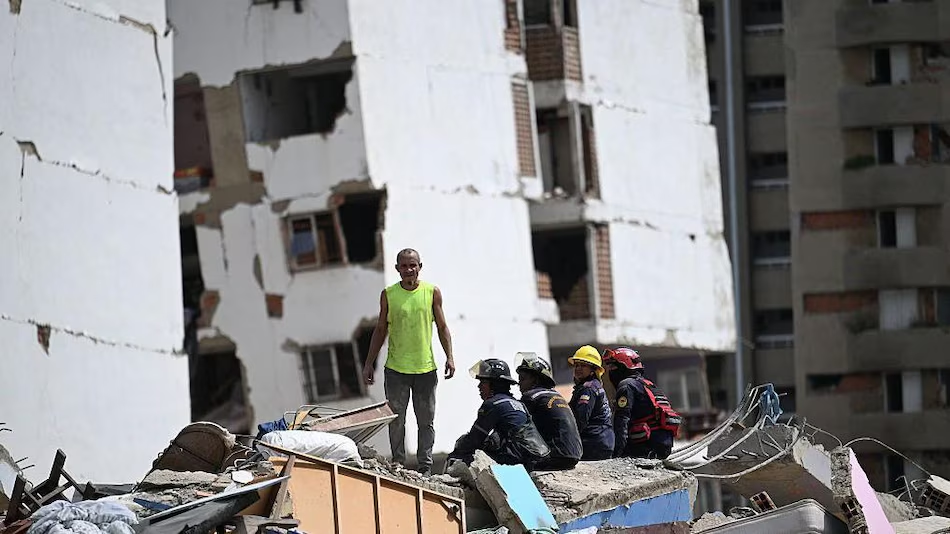
Above are buildings in Caracas Venezuela. The powerful earthquakes that struck northern Venezuela on Wednesday, June 24, leaving dozens dead, hundreds injured, and thousands homeless, have caught the attention of scientists. According to physicists, geologists and seismology experts, the two consecutive earthquakes that affected the northern part of the Caribbean country, and which were separated by only 39 seconds, would constitute what is known as a “seismic doublet. This phenomenon is especially unusual. The most typical sequence is that there is a main earthquake, followed by a series of aftershocks of lesser intensity. But what happened in Venezuela was different.
What is a ‘Seismic Doublet’?
In simple terms, a “seismic doublet” occurs when two main earthquakes take place, but the second cannot be considered a mere aftershock of the first, either because both earthquakes have a similar intensity or because their epicenters are close to each other. And this is precisely what happened in Venezuela. The first earthquake, which occurred in the central coastal area at 6:04 p.m., had a magnitude of 7.2 and its epicenter was near the city of San Felipe, in the state of Yaracuy, about 280 km west of Caracas. The second earthquake struck 39 seconds later, just 45 kilometers away, with its epicenter near the municipality of Yumare.
This quake was even more powerful than the first, reaching a magnitude of 7.5. “We understand that we are facing a seismic doublet: two earthquakes that occurred very close together in both time and space,” William Barnhart, deputy coordinator of the Seismic Hazards Program at the United States Geological Survey (USGS), explains to BBC Mundo. “The second one was approximately three times more powerful than the first, and it is very likely that the magnitude 7.2 earthquake triggered the magnitude 7.5 one,” he adds. The time factor separating the two earthquakes is also relevant, although there is less scientific consensus on that.
Some researchers point out that for the “doublet” to occur, the second earthquake must happen in a short subsequent period, on the order of seconds, minutes, hours or days. Others, however, claim that the second event can occur even years after the first and that the key is their physical connection. For a “seismic doublet” to occur, both earthquakes must also be linked to the same tectonic rupture process, where one favors or triggers the occurrence of the other.
How it is Triggered
The first earthquake causes a redistribution of tectonic stresses that accumulate over years and even centuries. That movement can be enough to trigger a second earthquake in a fault or zone that was already at its breaking point. “If there is a fault that breaks close to another that is about to break, then the rupture can be triggered and brought forward by years or decades,” says Antonio Villaseñor, a researcher at the Spanish National Research Council in Barcelona, Spain. “This is usually the explanation: that there is an earthquake that occurs naturally and it just so happens that there is an area that is also close to the rupture and it is this disturbance that causes the second fault to rupture as well,” he adds.
The researcher, who has particularly studied the area of Venezuela and the Caribbean, states that there are many elements that require further study to understand what happened. “There is still much to clarify about the first earthquake, above all. The second one is clear; it is a typical, ordinary rupture mechanism. But the first one still needs to be unraveled: what fault did it originate on, and what mechanism did it have?” he emphasizes.
Plate Boundary
According to experts, what happened in Venezuela was to be expected. The country is located in a particularly sensitive area. Right where the earthquakes occurred, two tectonic plates converge, the Caribbean and the South American, making it a seismically active area. The last earthquake of a similar magnitude in that area occurred more than 100 years ago, on October 29, 1900, so scientists had been expecting a strong seismic event for some time. “What has happened is not surprising because that area of northern Venezuela is on the boundary of tectonic plates and large earthquakes occur there periodically, though not very frequently,” says Villaseñor. “This area already had the potential to generate earthquakes of these magnitudes,” adds Marisol Monterrubio Velasco, computational physicist and researcher of seismic processes at the Barcelona Supercomputing Center (BSC).
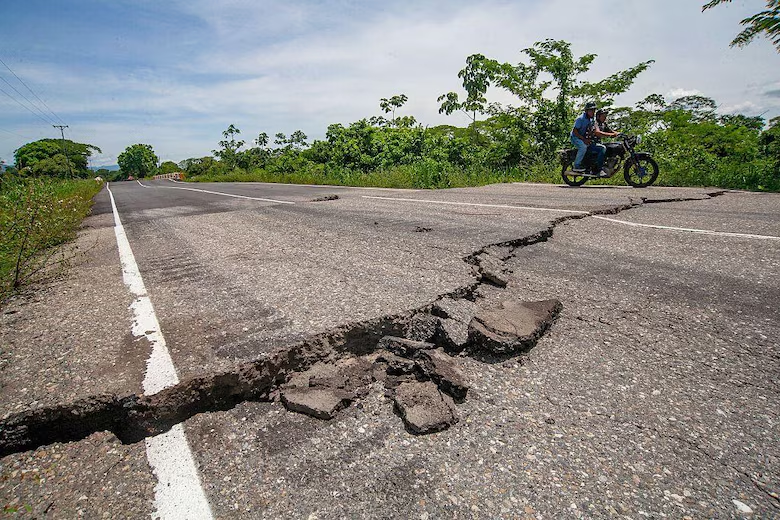
According to the United States Geological Survey (USGS), the second and larger of the two earthquakes that occurred this Wednesday was triggered by a “shallow strike-slip fault”, right near the boundary of both plates. A surface slip occurs when faults or fractures in these plates move horizontally. The area where the earthquakes occurred is part of a fault system. It is a kind of network of tectonic fractures that are responsible for absorbing the movement between the two plates. Among them are the Boconó, El Pilar and San Sebastián fallas. According to the USGS, the two earthquakes that occurred in Venezuela “likely indicate a complex process of interaction and rupture.”
Other ‘Doubles’
Although this type of event is rare, it has historical precedents both in the region and in the rest of the world. One of the best-known cases is the double earthquake that occurred in Ometepec, Guerrero state, in Mexico, in 1982. On June 7 of that year, an earthquake of magnitude 6.9 was followed 4 hours later by one of magnitude 7.0. Much more recent is the “seismic double” that also affected Venezuela in 2025, when the western part of the Caribbean country was hit by two consecutive earthquakes. The earthquakes had their epicenter near Mene Grande, in the state of Zulia, although they were of much lower intensity, around 6.2 magnitude.
In any case, one death was reported, along with hundreds of injuries and casualties. One of the paradigmatic cases for the scientific study of this phenomenon occurred two years earlier in Türkiye and Syria. On February 6, 2023, the two strongest earthquakes to occur in that region in almost a century — magnitude 7.8 and 7.7 — were separated by 9 hours. According to experts such as seismologists Luca Dal Zilio and Jean-Paul Ampuero, who studied the event and published studies in journals of the Nature group, both milestones were linked to the rupture of nearby but distinct faults within the same tectonic system, with the second being favored by the first.
Destructive Power
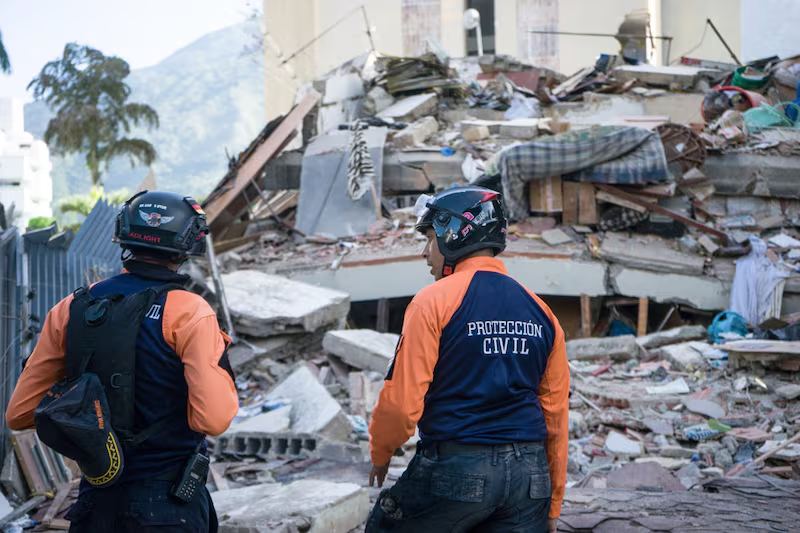
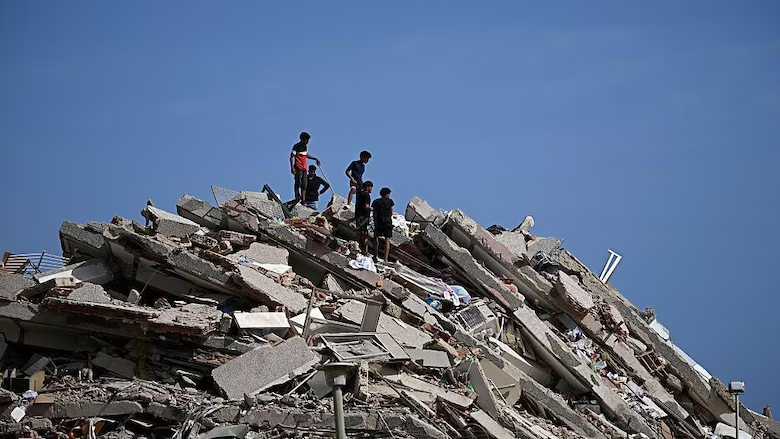
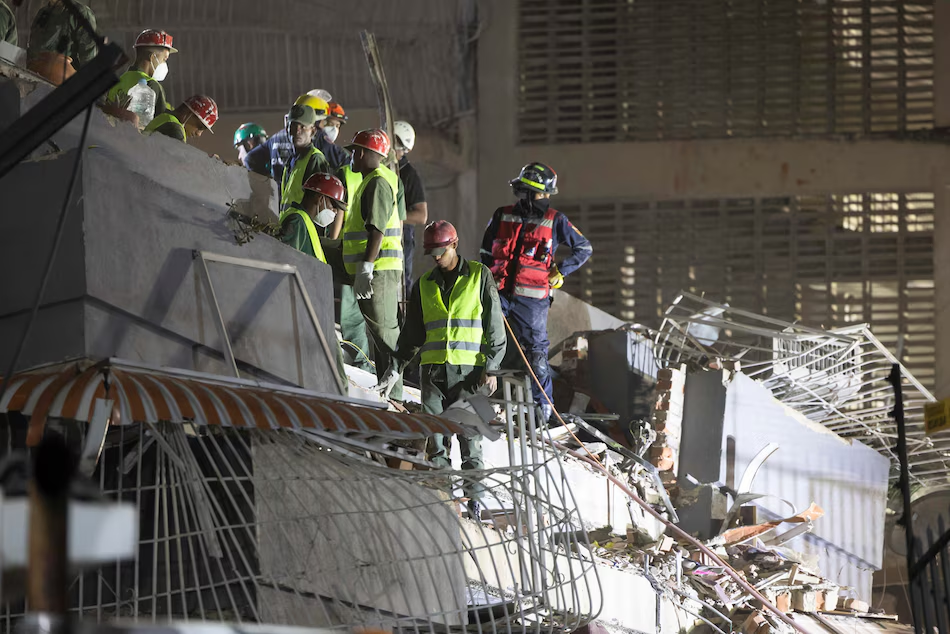
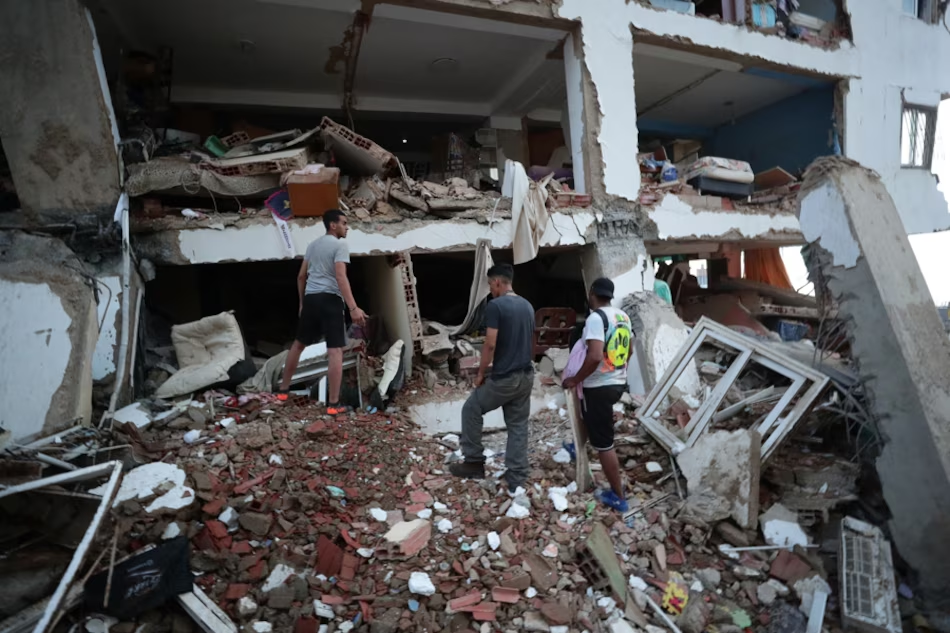
A “seismic doublet” can increase the potential for damage. When two high-magnitude earthquakes occur in succession, the first can weaken buildings and infrastructure, making it possible for the second to completely destroy them. Following Wednesday’s earthquakes, entire buildings were reduced to rubble in cities like Caracas and La Guaira. This is precisely what has had a significant impact on the high number of deaths that have already been recorded, a figure that authorities expect will continue to rise. The destructive level of the earthquakes is also explained by the shallowness at which they occurred.
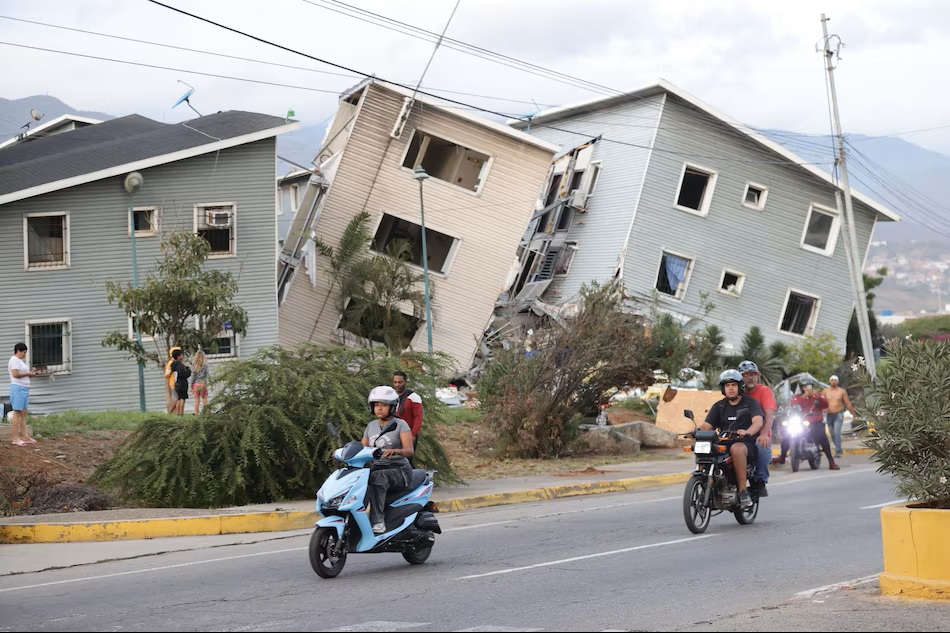
According to the USGS, the earthquakes occurred at depths of 22 and 10 km, that is, very close to the surface, which increases their potential for damage. Monterrubio explains that another relevant factor in understanding the destructive power of these earthquakes is that much of Caracas is built on alluvial sediments and soft deposits, which amplify seismic waves. Villaseñor asserts that there are areas in Venezuela where the potential damage from an earthquake can be predicted. The precedent is the 1967 earthquake, which also affected part of the capital and demonstrated that areas with higher sediment levels tended to amplify seismic energy, and therefore suffered greater devastation. Another key factor is the vulnerability of Venezuelan infrastructure.
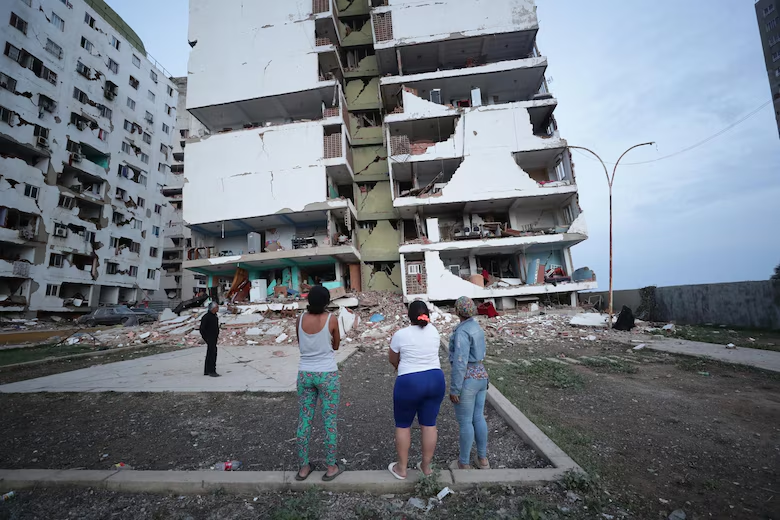
“The earthquake doesn’t destroy, what destroys is the building that collapses. Earthquakes are natural phenomena and we live with them, with the infrastructure we have,” says Monterrubio. The expert adds that, in that sense, the political and social context of Venezuela has an impact on the consequences that this type of disaster can have. “And Venezuela has gone through a significant economic decline, so the issue of infrastructure is certainly not the most crucial on the political agenda.”