Panama Receives a Copy of Iran’s Proposal to End the War with the US and What the 14-Point Plan Includes
A group of people pictured below walk past a poster of Iran’s Supreme Leader Mukhta Khamenei in central Tehran.
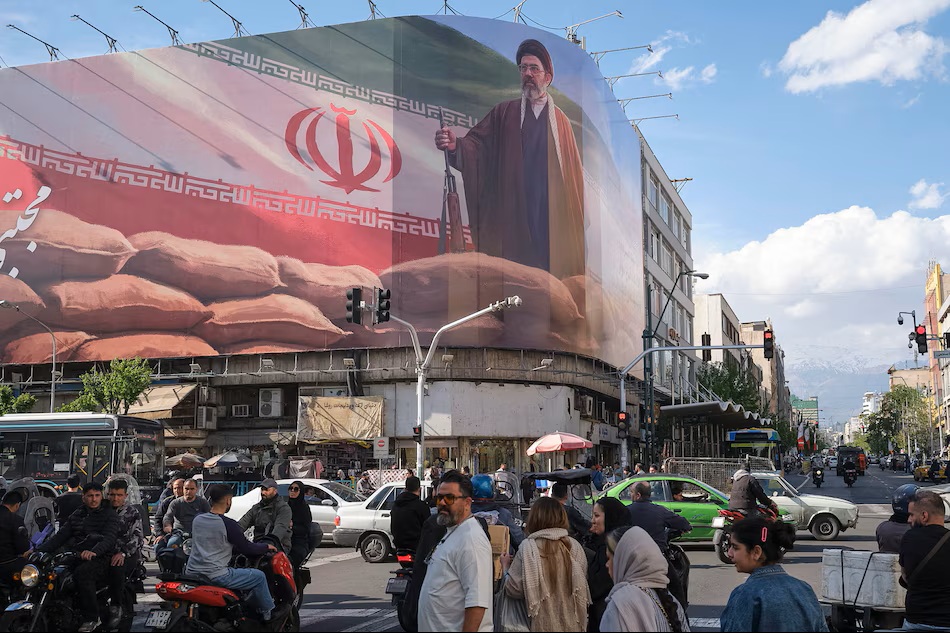
Iran presented the United States with a 14-point proposal to permanently end the war, focusing on lifting the naval blockade, guarantees of non-aggression, withdrawal of US forces, and sanctions relief, according to Iranian media, which did not mention the country’s nuclear program. The plan, formulated in response to a nine-point US proposal, seeks to resolve conflict-related issues within 30 days and prioritizes “ending the war” over simply extending the ceasefire. The Tasnim news agency, linked to the Iranian Revolutionary Guard, revealed some of the 14 points sent by Tehran to Washington through Pakistan, the mediating country in the talks.
Definitive End of the War
The main focus of the Iranian proposal is to formally end the conflict and reject the US offer to extend the current ceasefire, in effect since April 8 and extended indefinitely, for two months. Tehran proposes to resolve all issues related to the war, which began on February 28 and was suspended after an initial two-week truce, within 30 days.
End of the Naval Blockade
Another key point is the lifting of the US naval blockade imposed on Iranian ports and ships since April 13. According to the U.S. Central Command, Washington has since intercepted 45 Iranian vessels attempting to circumvent the maritime blockade.
New Mechanism for Ormuz
The proposal also sets out a new management framework for the Strait of Hormuz, a strategic route through which 20% of the world’s crude oil passes. Iran has maintained operational control of the passage since the early days of the war, restricting the transit of oil tankers and raising the price of oil above $110 per barrel. This new mechanism could be linked to a law being debated by the Iranian Parliament, which, according to the Vice President of the Parliament, Hamidreza Haji Babaei, would prevent the passage of ships from enemy countries unless war reparations are paid. Iranian authorities have also discussed imposing tolls on maritime traffic along that route.
Guarantees of Non-Aggression
The Islamic Republic demands verifiable guarantees that the United States and Israel will not launch new military actions against Iranian territory. However, Iranian media have not detailed the format or scope of those guarantees.
Withdrawal of US forces
Iran also demands the withdrawal of US military personnel deployed in countries in the region. For years, Tehran has called on its neighbors to expel US troops and has criticized regional governments for hosting US military bases. During the war, Iran launched attacks against facilities linked to Washington in Saudi Arabia, Bahrain, the United Arab Emirates, Qatar, and Kuwait, among other countries.
Sanctions and Frozen Assets
The lifting of economic sanctions is another central requirement of the Iranian plan. Tehran demands an end to the measures imposed by Washington after abandoning the nuclear agreement signed three years earlier in 2018. It also demands the release of frozen assets, including $6 billion unblocked in 2023 as part of a prisoner exchange between the two countries, but subsequently frozen again in Qatar following Hamas’s attack on Israel on October 7 of that year.
War Reparations
The proposal includes financial compensation for the damage suffered during 39 days of Israeli and American bombing. According to Iranian figures, the offensive left more than 3,400 dead and destroyed homes, hospitals, schools and industrial facilities.
End of Hostilities on all Fronts
Iran insists that the end of the conflict must encompass all war-related scenarios, including Lebanon, where Hezbollah, Tehran’s main regional ally, is engaged in clashes with Israel. Since the beginning of the conflict, the Shiite group has launched missiles against Israeli territory and has been the target of Israeli bombings that have caused more than 2,600 deaths in Lebanese territory, according to regional sources.
A Core Issue for a Later Phase
Tasnim does not mention the Iranian nuclear program in the plan. However, US media have reported that Tehran is seeking to postpone these negotiations to a second phase, once a definitive end to the war and the Hormuz issue have been agreed upon. The nuclear program remains the main sticking point between the two sides, as Washington demands a halt to uranium enrichment and the delivery of 440 kilograms of highly enriched uranium, something Iran rejects. Trump stated on Friday that he would review the plan, although he reiterated that the previously submitted Iranian proposal was not satisfactory to him. For its part, Tehran maintains that it is now up to the United States to choose between diplomacy or confrontation and asserts that it is prepared for both paths “in order to guarantee its interests and national security.”
US President Trump has already stated that this proposal is not acceptable.
US President Donald Trump threatened on Monday to “wipe Iran off the face of the Earth” if the Islamic Republic attacks US ships in the Strait of Hormuz or the Persian Gulf. The president issued this warning during a telephone interview with Fox News, as reported on air by the network’s correspondent in Israel, Trey Yingst. “We have more weapons and ammunition of a much higher grade than before,” warned Trump, who said that the US operation in the Strait of Hormuz is “one of the largest military maneuvers ever undertaken.” The president also asserted that the Islamic Republic has become “much more malleable” throughout the peace negotiations.
Trump announced on Sunday the launch of an operation to escort ships through the Strait of Hormuz, which is blocked by Iran in retaliation for the war. The United States Central Command reported on Monday that it facilitated the passage of two merchant ships through the strait and destroyed six Iranian speedboats that attempted to prevent it. On April 7, Trump threatened that “an entire civilization” would die if Iran did not reach an agreement with the United States to end the war, hours before Washington agreed to a two-week ceasefire in the offensive.