Multilateralism, Democracy, and Venezuela Set the Agenda: OAS General Assembly in Panama
Opening conference of the OAS sessions in Panama: Albert Ramdin, OAS Secretary General; Javier Martinez Acha, Panamanian Foreign Minister; and Laura Gil, OAS Assistant Secretary General.
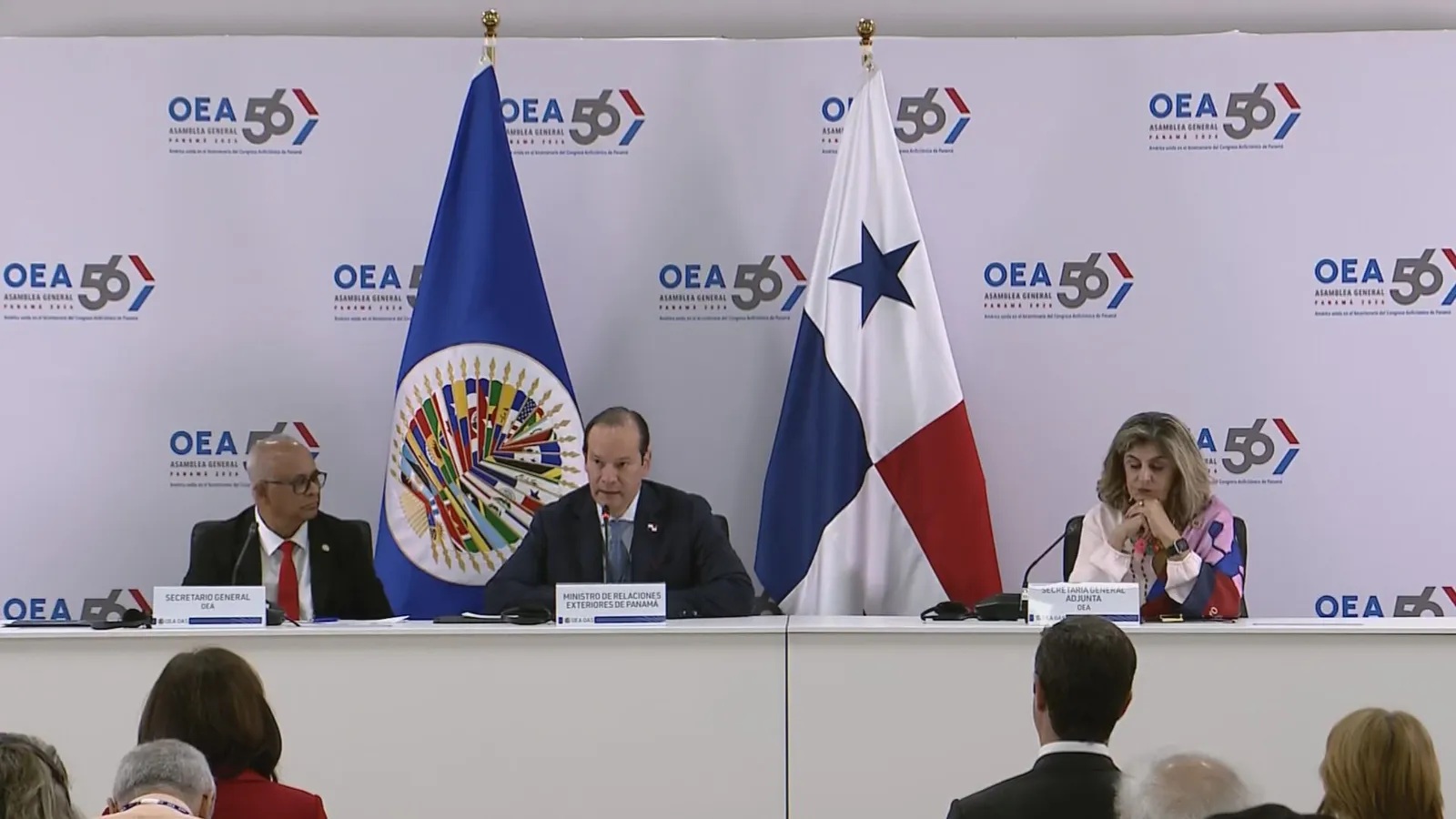
Panama: With 94 delegations, five confirmed heads of state and an agenda marked by issues such as democracy, the situation in Venezuela and Haiti, hemispheric security and organized crime , Panama once again becomes the center of continental dialogue during the 56th General Assembly of the Organization of American States (OAS), which takes place from June 20 to 27.
Foreign Minister Javier Martínez-Acha defended the need for “useful multilateralism” to face the challenges of the region, while the organization’s secretary general, Albert Ramdin , highlighted that “Panama demonstrates the commitment of a country small in size but big in impact,” by becoming the venue for one of the main political meetings in the hemisphere.
This event marks the third time the country has hosted an OAS General Assembly, following those held in 1996 and 2007, solidifying its position as a frequent venue for the continent’s main political forum. Furthermore, it coincides with the commemoration of the 200th anniversary of the Amphictyonic Congress of Panama. Foreign Minister Martínez-Acha Vásquez emphasized that “Panama is once again becoming a point of convergence for hemispheric and extra-continental dialogue,” he stated. The head of Panamanian diplomacy noted that the current context necessitates strengthening cooperation among the countries of the region.
The world, as we are seeing, needs multilateralism. And as our president says, as this foreign minister says, it needs effective multilateralism,” he stated.
He added that the Americas face challenges related to democracy, migration, security, sustainable development, and technological innovation. “Faced with these challenges, cooperation remains our most effective tool,” he stated. For his part, Albert Ramdin praised Panama’s role as host of the hemispheric meeting. “Panama demonstrates the commitment of a country small in size but big in impact,” he said.
The Secretary General of the organization emphasized that the spirit of the Amphictyonic Congress, promoted by Simón Bolívar two centuries ago, remains relevant. “The inspiration now should be to follow them, not to seek conflict, but through open and frank dialogue,” he noted. Ramdin also defended the importance of the multilateral system. “We need each other; we do not live isolated on this planet, we live together,” he stated.
16 Proposals will be Discussed
The OAS Deputy Secretary General, Laura Gil , explained that the Permanent Council, meeting on June 17 in Washington, concluded the preparatory work for the Assembly.
“We have 16 proposed resolutions and declarations to be adopted here in Panama. Fourteen of them come with prior consensus from Washington,” he explained.
Among the four declarations, the following stand out: the declaration concerning the Falkland Islands, the Panama Declaration on multilateralism in defense of democracy, hemispheric security and the stability of the American States, a declaration on the situation in Nicaragua and another on the occasion of the 30th anniversary of the Inter-American Council for Integral Development. Regarding resolutions, Laura Gil highlighted initiatives on mental health and on the inclusion of people with disabilities. “We have one on mental health, another on expanding design for people with disabilities, which indicates our membership’s interest in social agenda and inclusion projects,” he stated. The official indicated that among the thematic priorities are Nicaragua and Haiti, in addition to the commemoration of the 25th anniversary of the Inter-American Democratic Charter.
Four Plenary Sessions and Election of Officials on the Agenda
The Assembly will begin with an opening session, followed by four plenary sessions. During the meeting, new members will also be elected to the Inter-American Juridical Committee, the Administrative Tribunal, the Audit Committee, and the Justice Studies Center of the Americas. The organization’s budget for 2027 is also scheduled for approval. The final plenary session will include the participation of specialized bodies, including the Inter-American Commission on Human Rights, the Inter-American Court of Human Rights, the Inter-American Commission of Women, the Pan American Health Organization, the Inter-American Drug Abuse Control Commission, and the Inter-American Committee against Terrorism.
Civil Society and a New Format of Participation
As part of the parallel activities, a dialogue with civil society organizations will take place this Monday at 2:00 pm. “We are going to test a new format here in Panama. It’s a format that we will later evaluate together with the member states and civil society. We want to make it more dynamic,” Laura Gil explained.
Venezuela and Democracy
Regarding Venezuela, Martínez-Acha Vásquez expressed his confidence that a democratic solution would emerge. “We are optimistic and hope that a path toward free and fair elections will soon be established in Venezuela. The solution must come from Venezuelans, but always with democracy,” he stated. Meanwhile, Ramdin indicated that the organization is prepared to support any potential electoral process. “We are ready to support the transition process toward elections in Venezuela,” he stated. He also reiterated that democracy must remain the foundation of the continent’s political systems. “Countries that do not have a democratic government should adopt one. Democracy is the model that should be the basis for governance,” he stated.
Panama is once again the epicenter of hemispheric dialogue with an OAS General Assembly focused on democracy, security and the crises in Venezuela, Nicaragua and Haiti.