Barrio Norte and David are Without Representatives in Panama and in Legal Limbo with Thousands Affected.
In both cases, the municipalities of Colón and David have raised concerns with the Attorney General’s Office to determine how they should proceed in these situations.
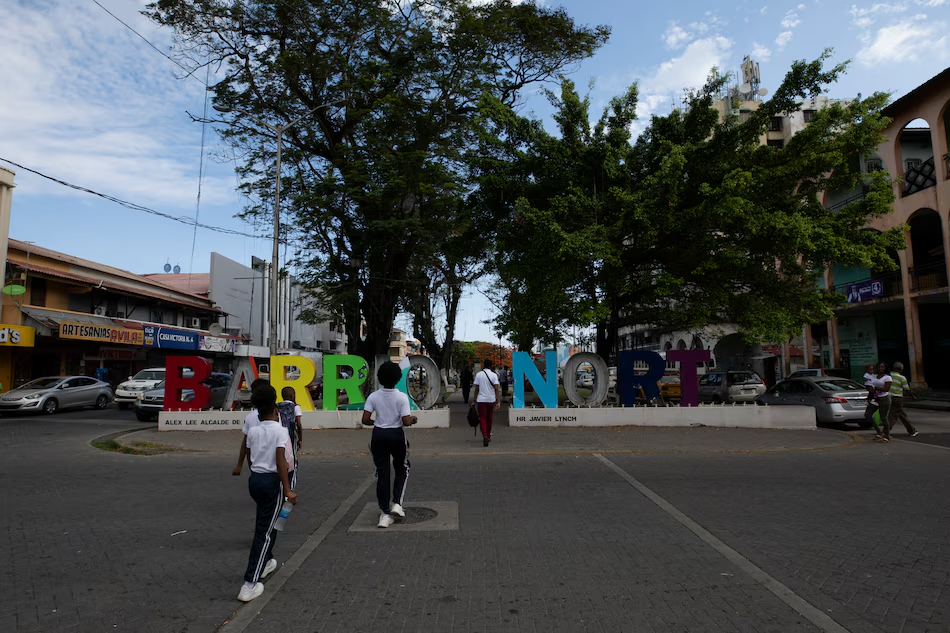
Several community boards have been caught in legal and administrative limbo following the preventive detention, death, or legal incapacity of their representatives. The absence of a duly authorized figure to hold the position has raised doubts about who can assume their duties and, in some cases, has prevented access to public funds. Two of the most striking cases, currently in legal limbo, are those of Barrio Norte, in the province of Colón, and David Cabecera, in Chiriquí. In both cases, the municipalities of Colón and David have consulted the Attorney General’s Office to determine how to proceed in these situations. As you may recall, in the 2024 elections, Jairo Salazar, candidate for the Democratic Revolutionary Party (PRD), was elected representative of Barrio Norte and deputy to the National Assembly. Salazar chose to serve as a deputy, and, in accordance with electoral regulations, the seat was filled by his alternate, Javier Lynch.
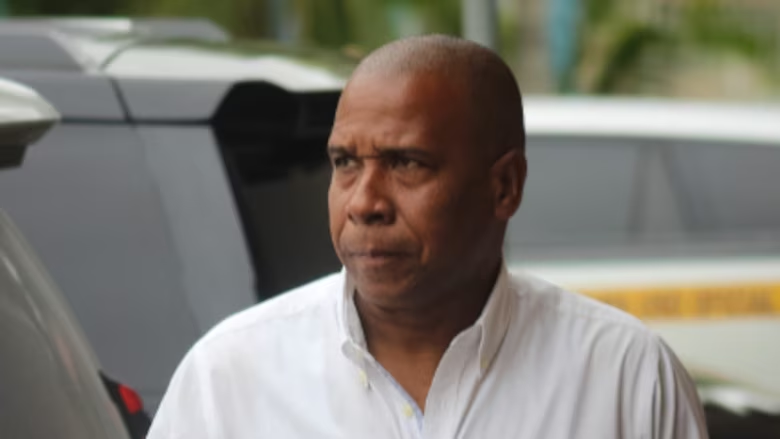
Javier Lynch, Councilman for Barrio Norte.
However, the situation changed last April, when Judge Ángel Santos charged Lynch with the alleged crime of embezzlement and ordered his provisional detention. Lynch was recently transferred to the Coiba Island prison while the legal proceedings against him continue, leaving the community board without an elected authority capable of performing its duties. Regarding the status of the community board, the mayor of Colón, Diógenes Galván, explained that, given the arrest of the district representative and the absence of a substitute, the Mayor’s Office maintains operational control of the board. He noted that the officials are under municipal jurisdiction and that the administration continues to coordinate beautification and cleaning efforts. He added that the Municipality maintains communication with the National Decentralization Authority (AND) to determine how the Mayor’s Office can directly assume the necessary citizen consultations for the development of works and projects, as established by the regulations on the use of decentralization funds.
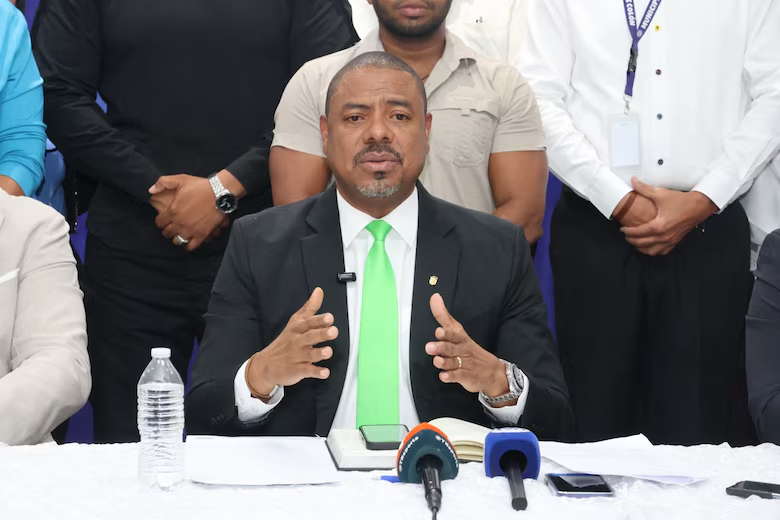
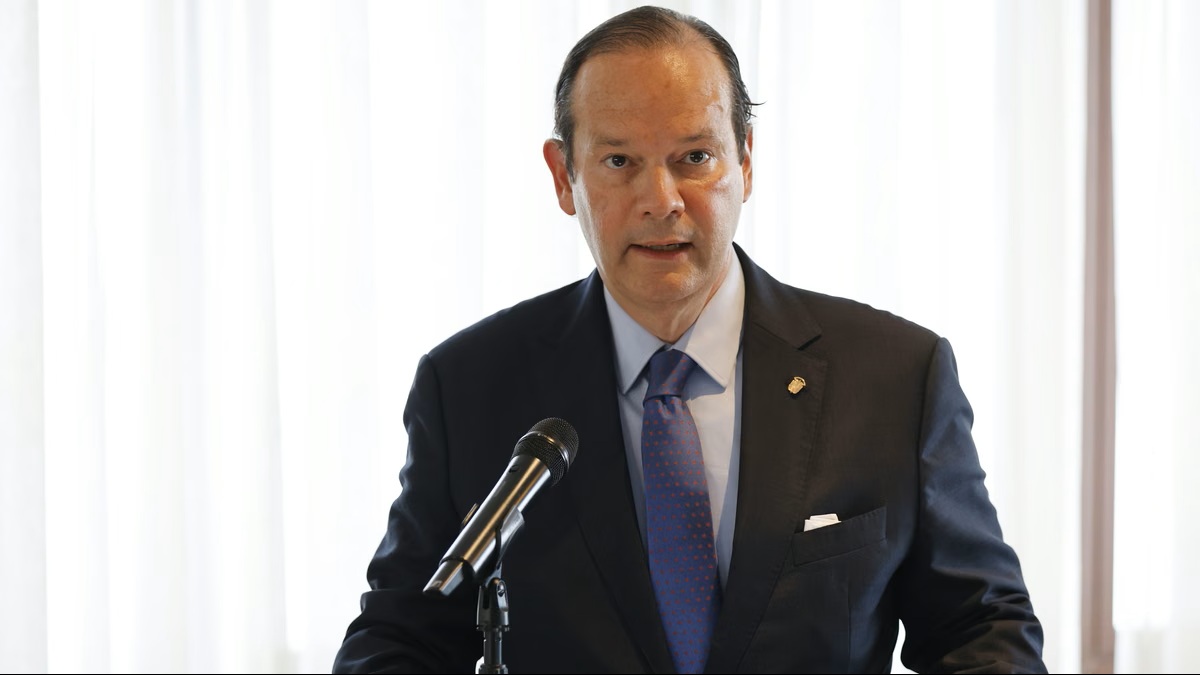
Mayor of Colón, Diógenes Galván.
Recently, the Attorney General’s Office responded to an inquiry from the Municipality of Colón, stating that it lacks the authority to resolve disputes related to elected positions, the definition of which falls under the purview of the constitutionally empowered authorities. However, the response left unanswered the main question raised by the Municipality of Colón.
David’s Case
The David Cabecera Community Board was left without an elected authority able to perform its functions, after representative Jorge Eduardo Montenegro Vallarino remained under provisional detention and his alternate, Sandra Jiménez, served house arrest. There, the Mayor’s office is also seeking a legal solution to the problem. Mayor Joaquín De León recently indicated that he will consult with the Attorney General’s Office regarding how the community board should operate, after both the representative and his alternate were prevented from performing their duties due to the precautionary measures they face. The intention is to define who can temporarily assume the responsibilities of the board and ensure the continuity of services, without disregarding the presumption of innocence or due process of the officials involved.
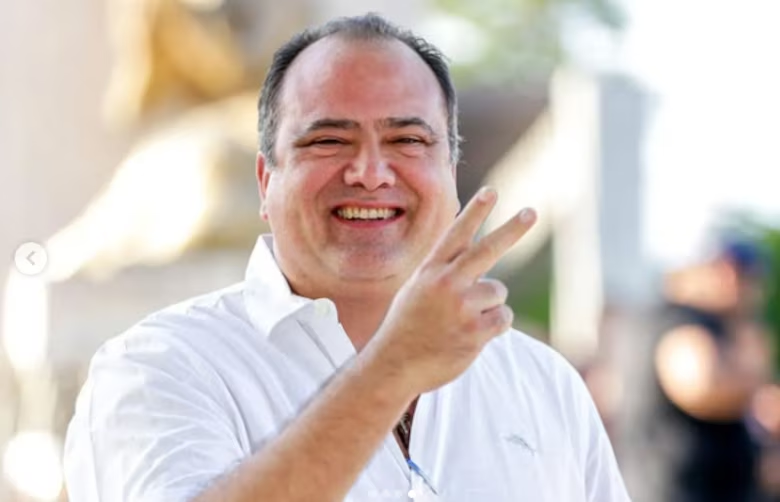
Jorge Eduardo Montenegro Vallarino, Representative of the David District.
In both Barrio Norte and David Cabecera, their authorities are being prosecuted for the alleged irregular handling of millions of dollars from the so-called parallel decentralization or the Social Development and Interest Programs (PDIS). In its latest report, the Public Prosecutor’s Office indicated that, within the PDIS investigations, charges have been filed against 118 people. Of these, 17 remain in pretrial detention, 16 are under house arrest, and 82 have been ordered to report periodically; no precautionary measures were imposed on the rest. Among the community boards that received the most funding were Belisario Porras in San Miguelito, with $8 million, and Barrio Norte in Colón, with $6.9 million. These were followed by Amelia Denis de Icaza in San Miguelito, with $5.5 million; Salud in Colón, with $4.6 million; and David Cabecera in Chiriquí, with $4.4 million. In all of these community boards, the representatives belonged to the PRD party.
The Consequences.
The problem becomes more complex when community boards are left without an authorized leader to carry out their functions. For example, Barrio Norte has 12,320 inhabitants, while David Cabecera has 16,051, according to the 2023 Census. That’s more than 28,000 people whose communities depend on local structures that, in these cases, face a vacuum regarding who can make decisions, manage resources, and ensure the continuity of projects. Narciso Machuca, legal advisor to the Association of Municipalities of Panama (Amupa), explained that the legislation contemplates what happens when there is a permanent absence of the representative and his alternate, but does not clearly establish what to do when both face precautionary measures and maintain the ownership of the positions for which they were elected.
“There is a gap in the law,” Machuca summarized when explaining the situation of the community boards of Barrio Norte and David. According to Machuca, in these cases it is not appropriate to call new elections because the representatives have not been removed from office nor have they lost their credentials. Electoral legislation contemplates permanent absence, but not a temporary absence like the one these two community boards are facing. The situation is different in other community boards where the primary representatives have been removed from their positions, but the alternates remain authorized to serve. Machuca indicated that, in those cases, the alternates have taken office, have their signatures legalized by the Comptroller’s Office, and can operate the boards’ bank accounts.
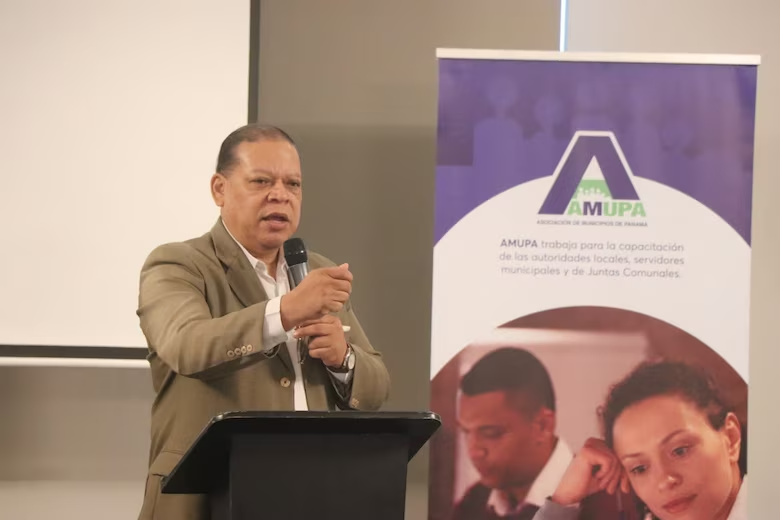
Narciso Machuca pictured above, legal advisor to the Association of Municipalities of Panama (Amupa).
He estimated that the inquiries of this type received by Amupa correspond to about 15 community boards.
The Deaths.
There are also community boards that have been left without their representatives due to definitive circumstances: the death of their incumbents. On May 18, Juan Ruperto De Gracia Murill, representative of Veladero, in Tolé, Chiriquí, who had been re-elected in 2024, was shot and killed. Weeks later, Héctor Sambrano, representative of Barrio Colón, in La Chorrera, was found dead in an apartment in Panama City. In addition, Víctor Peñalba, representative of the corregimiento of San Juan, in the district of San Francisco, Veraguas, passed away last year after experiencing health problems. In these cases, Machuca explained, the alternates assume the functions of the deceased representatives, in accordance with the established procedure. However, the local government specialist emphasized that another type of gap also exists: access to public resources. Machuca cited the case of the Naso region as an example , where community boards have allocated funds but face difficulties receiving the resources corresponding to their operations and property tax (IBI) because the region does not have a mayor.
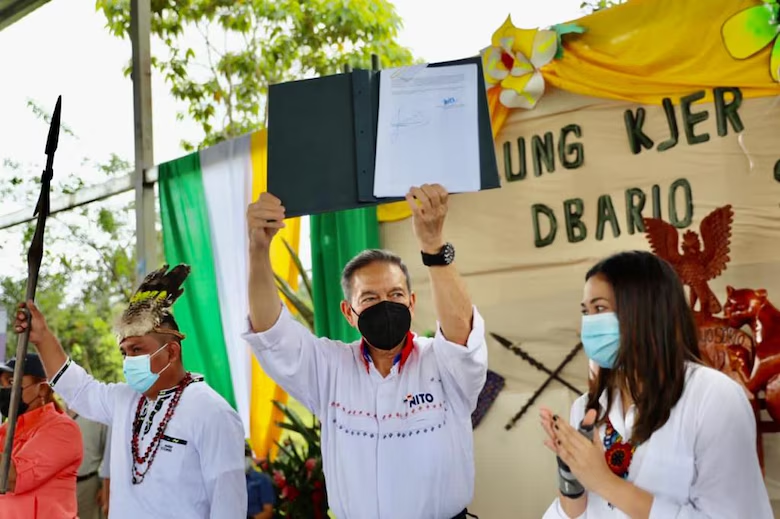
The Naso region was created during the administration of Laurentino Cortizo (centenarian).
According to him, the Comptroller General’s Office and the Ministry of Economy and Finance have approved the administration of the funds through a mechanism similar to that used in Guna Yala, where there is also no municipality and resources are channeled through the Provincial Coordination Council. He noted that Amupa has requested the transfer of the funds from the National Decentralization Authority, but so far this has not been finalized. The origin of this latest problem dates back to the creation of the Naso region during the administration of Laurentino Cortizo (2019-2024), whose legal structure stipulated the election of a mayor, council members, and representatives. Machuca explained that the law was challenged before the Supreme Court of Justice and that, during that process, the Electoral Tribunal called for elections for representatives and council members, but not for mayor. Following the court ruling, it is argued that the structure for the municipality is now in place and that a mayor should finally be elected in the 2029 elections. Meanwhile, the absence of this authority continues to create an administrative problem affecting some 5,000 residents of the Naso region, as municipalities are responsible for transferring resources to community boards.