Sherina Latorraca has Resigned However Panama’s ANTAI Continues its Investigation.
Despite the resignation of Sherina Latorraca as director of Legal Advice for Public Procurement, daughter of Zaira Santamaría de Latorraca, presiding magistrate of the Procurement Tribunal, the administrative investigation for a possible conflict of interest remains open. Nepotism is always an issue.

Despite the resignation of Sherina Latorraca as director of Legal Advice of the General Directorate of Public Procurement (DGCP), daughter of Zaira Santamaría de Latorraca, presiding magistrate of the Administrative Court of Public Procurement, the administrative investigation for a possible conflict of interest remains open. The National Authority for Transparency and Access to Information (Antai) confirmed that it is “reviewing” the file it opened after it became known that the magistrate and her daughter worked in entities that are part of the same state contracting system. The entity indicated that it is carrying out the corresponding procedures, including certifying whether, in fact, Latorraca no longer works at the institution.

Last Monday, Judge Santamaría de Latorraca stated, during her presentation of the Court’s budget to the National Assembly’s Budget Committee, that she had consulted with the National Authority for Transparency and Access to Information (ANTAI) and the Attorney General’s Office before her daughter accepted the position at the General Directorate of Public Procurement (DGCP). A day later, both entities confirmed they had not received any such consultation. Some voices believe that this case should have consequences. “What happened with Sherina Latorraca and her mother, Judge Zaira de Latorraca, is an example of the frivolity with which officials treat the ethical standards that govern their behavior,” said Lina Vega Abad, president of the Foundation for the Development of Citizen Freedom, the Panamanian chapter of Transparency International (TI).
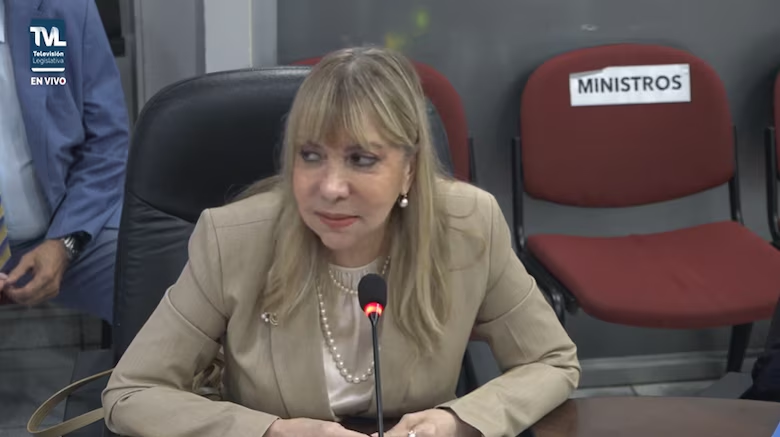
Zaira Santamaría de Latorraca, Magistrate of the Contracting Tribunal.
Vega Abad said that, although public opinion succeeded in correcting a situation of “evident nepotism and conflict of interest”, after Sherina’s resignation, the indisputable fact remains that a magistrate “lied to the country”. “That is serious and should have consequences. Now we have learned of the case of the Minister of Labor. Everything indicates that Antai must strengthen its preventative work,” he stated. Independent congressman Jhonathan Vega echoed this sentiment. He stated that the judge “lied to the Budget Committee and to the entire country,” and therefore considered it “an extremely serious matter that cannot go unpunished.” Furthermore, Representative Vega stated that a clear question remains: “What actions will the relevant institutions take now?”
Can Mulino Dismiss Her?
Zaira de Latorraca arrived at the Administrative Court of Public Procurement in January of this year, after President José Raúl Mulino appointed her at the end of December 2025. Her term will extend until December 2029. Since his appointment is an exclusive power of the President of the Republic, according to Law 22 of 2006, which regulates public contracts, his designation was not submitted to ratification by the National Assembly. That same law establishes the grounds for suspension, removal, dismissal, and the disciplinary measures applicable to judges. Paragraph 4 of Article 150 states that these measures may be applied “for serious, duly proven violations of the Code of Ethics for Public Servants.”
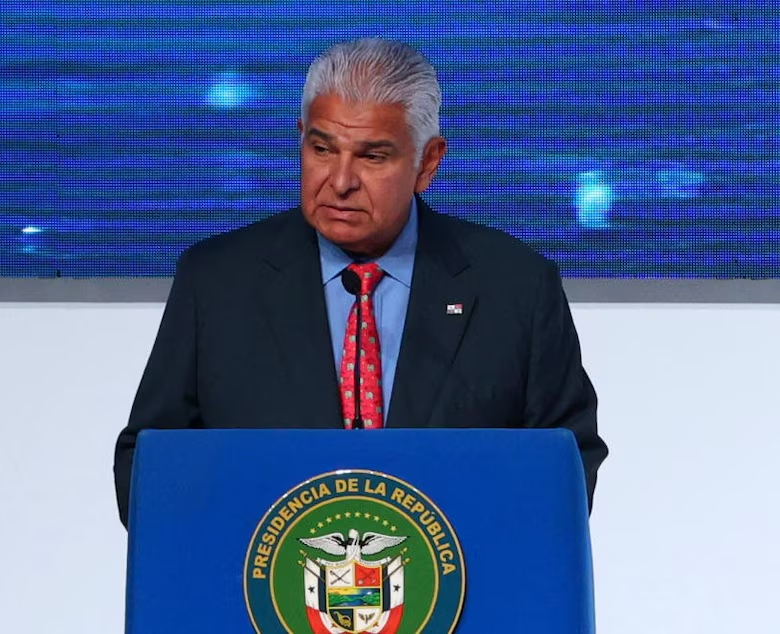
Some point out that the case of the judge and her daughter could conflict with the provisions of the Code of Ethics for Public Servants. Article 41 of the code establishes that public servants must refrain from exercising functions “in the same administrative unit or in administrative units that maintain control or oversight relationships with each other, and in which persons included in the aforementioned kinship ties work.” Zaira de Latorraca had previously held positions within the Judicial Branch and served as interim director of the Judicial School. During Ricardo Martinelli’s administration (2009-2014), she was appointed as an alternate magistrate of the Supreme Court of Justice, but her appointment was not ratified by the National Assembly. This occurred in 2010.
ANTAI is the National Authority for Transparency and Access to Information, which is the Panama government agency responsible for promoting transparency, ethics, and public integrity.
Key Functions.
- Public Information: Ensures citizens can access public government data and records.
- Ethics Enforcement: Investigates and penalizes public servants for code of ethics violations, nepotism, and misuse of office.
- Data Protection: Supervises compliance with personal data protection laws in public and private sectors.
- Anti-Corruption: Develops policies and monitors national compliance with international anti-corruption treaties.