Panama City’s Multicultural Kaleidoscope
By Tanya Goyal
Venturing into Casco Viejo on a bright sunny afternoon, I found myself in the midst of swathes of pastel hues, eclectic sounds, and dense traffic filling narrow labyrinthine streets. Magnificent historic colonial buildings interspersed with enticing shop-window displays of colourful trinkets and souvenirs greeted me from every direction. The sidewalks were laced with busy locals and holidaymakers alike. Cheerful flowerpots, seemingly playfully winking at passersby, hung in balconies of homes dotting the vibrant neighbourhood. The architecture of Casco Viejo featuring an impressive mélange of Spanish and French colonial, Afro-Caribbean, neoclassical, and art nouveau styles makes walking through its tight streets a sensory treat.
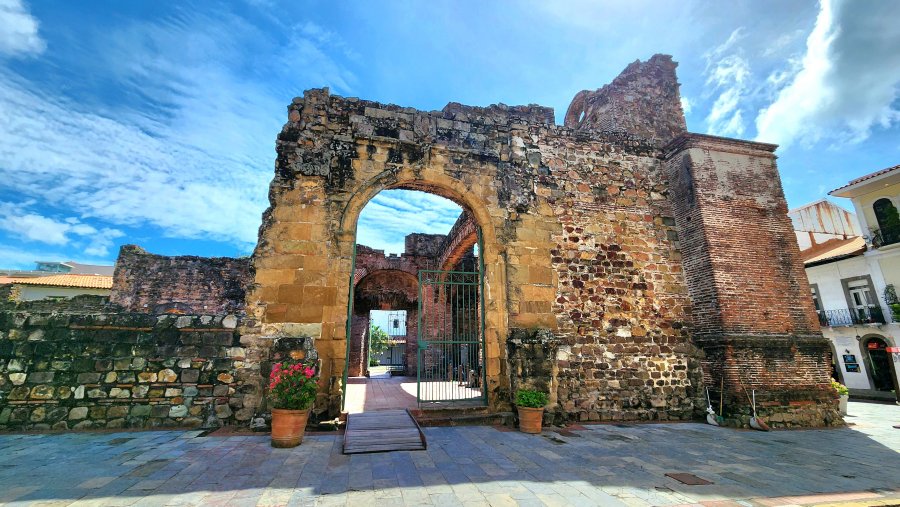
Pausing a moment in Plaza Simón Bolívar, I marvelled at the tranquility I experienced surrounded by lush greenery and an array of cultural landmarks, such as Simón Bolívar Monument, Iglesia San Francisco de Asis, and the striking Palacio Bolívar. Sunshine, tropical air, a cool beverage in hand, and a 360-degree view of historic architecture – this was sheer bliss. Equally impressive was the colossal Metropolitan Cathedral, the Arco Chato ruins, and Iglesia de San José.
Soaking up every sight, my leisurely stroll then took me to Plaza de Francia. Here, the Obelisk, flanked by bronze busts, facing the French embassy and the scenic waterfront promenade Paseo Esteban Huertas just steps away offered a different but just as immersive ambience. Tourism Police on bicycles patrolling the area were visible on this waterfront walkway. One minute I was looking at the classical white columns of the French embassy, and the next minute, with one quick turn, I came face to face with an assortment of about a thousand brightly-coloured hats strung high across the street by thin cables. This was La Calle de Los Sombreros or the hat street. I felt as if I had wandered into a lively neighbourhood fiesta.
A sweeping glance at Casco Viejo makes it patently obvious why this UNESCO World Heritage Site draws crowds year-round. With its historic architecture, churches, museums, cafes, souvenir and other stores, and street vendors, it features highly on many tourism destination guides. Although this spectacular historic area is a popular visit, often overlooked in the broader Panama City tourism conversation is the multicultural spaces and culinary variety it offers as a consequence of its diverse international diaspora. Afro-Antillean, Indian, Jewish, Colombian, Chinese, and other communities call Panama City home. The city has a Hindu temple, a Gurdwara, a Baha’i temple, and synagogues in addition to churches – an example of thriving multicultural diversity in this small Central American nation.
My breezy walk along Amador Causeway with panoramic views of ships and the city’s modern skyline had just ended. Having recently discovered the city has a Hindu temple, I decided to visit it from there before heading over to catch a nighttime glimpse of Casco Viejo. What I thought would be a relatively short drive to the temple turned into a standstill of well over an hour in the city’s apparently well-known gridlocked traffic. But the beauty of travel lies in taking it all in one’s stride. The rideshare driver told me a little about the city’s history and important institutions, including the University of Panama that we passed enroute.
A little later than anticipated, I made it to the ornate Hindu temple situated atop a hill. The sun had set and the surrounding area was illuminated by city lights. An Indo-Panamanian devotee spoke to me briefly at the entrance in Spanish. It was a lovely reminder of the plurality of members of diaspora communities. As soon as I entered the temple, the sounds of the city became a distant memory. Standing in the spacious main hall with high ceilings and a row of statues of Hindu deities, I was instantly met with serenity. It granted me both external and internal space for quiet reflection. After a little while, the priest conducted the daily evening prayer rituals and I felt very welcome. Later, on talking to the priest, I learned about the various services the temple offers the long-standing diaspora community.
Just prior to leaving, I decided to spend a few quiet moments in the corridor soaking up the atmosphere. I was stunned by the view that greeted me. Due to the temple’s elevated location, this spot was a fantastic vantage point from which I saw the floodlit neon-studded cityscape that appeared to stretch endlessly. The glittering lights of skyscrapers looked futuristic. As I walked away from the quiet spiritual sanctuary of the temple and the thousands of city lights twinkling like stars in a clear night sky, the mesmerizing duality of the urban landscape stayed with me.
The rich demographic diversity in Panama City has made possible the existence of another type of multicultural space – restaurants featuring a range of cuisines. I enjoyed a quick snack at La Tapa Del Coco restaurant. With its Afro-Panamanian menu, it is an example of the melding of cultures. From fine dining to small family-owned restaurants, there is something for everyone. El Chuzo de Alejo, an unassuming Colombian grill restaurant, is another example where diners can find authentic international cuisine and friendly service. Establishments like these are not confined to any one corregimiento. Rather, like the diverse communities, they are peppered throughout the city. A dollop of good food with a sprinkling of friendly service can often become a trip highlight.
From electrifying nightlife to tranquil sanctuaries, from colossal skyscrapers to pristine nature, Panama City is a place of pluralities. The capital of a small Central American nation, it packs a punch. The contrast between the historic buildings in Casco Viejo and the numerous modern ships lined up for passage through the famous Panama Canal, like the contrast between the spacious serene temple and the glittering dense skyline, is a sensory rollercoaster. To write Panama and consequently its capital off as merely a transit hub would be a missed opportunity. Fashioned by history and woven with intricacy, its rich tapestry of people, languages, architecture, and cuisine is a brilliant multicultural kaleidoscope.
About the Author: Tanya Goyal is a Canada-based independent writer and narrative analyst focusing on the intersection of travel, cultural identity, and storytelling.
https://tanyagoyal.carrd.co