
Machinery Arrives with the Hope of Saving Lives: The Death Toll in Venezuela Rises to 1430
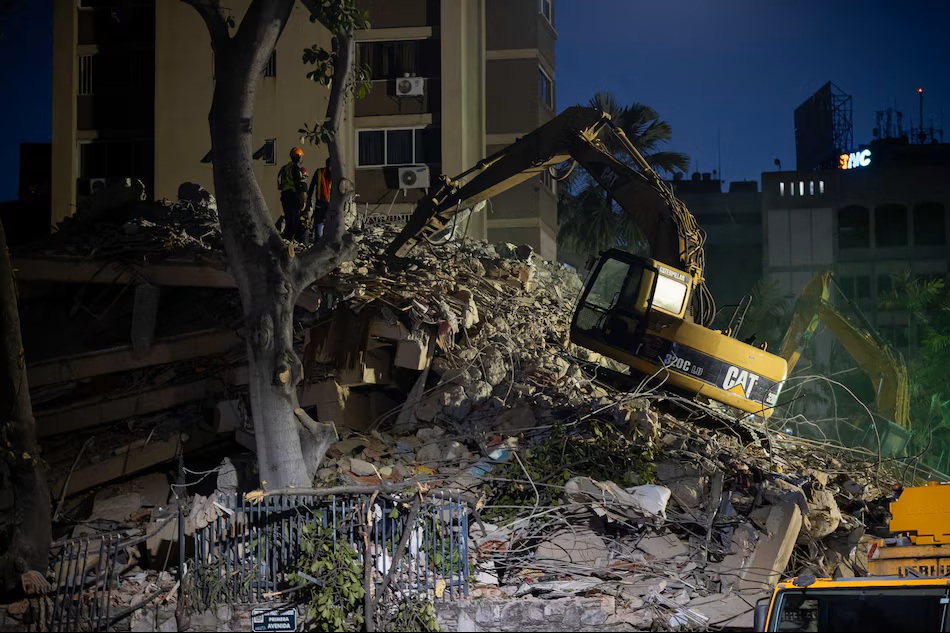
Venezuela has now recorded 1,430 deaths from the double earthquake of magnitude 7.2 and 7.5 that struck the coastal area of the South American country last Wednesday, where after almost 72 hours a greater number of machinery and international rescuers were deployed, increasing the hope of finding more survivors of the disaster. The latest casualty report was made by the President of Parliament, Jorge Rodríguez, who also reported that there are 3,238 injured and 3,142 affected families, mostly in the state of La Guaira, the most affected by the earthquakes, which is why it was declared a disaster zone and militarized by the Government.
There are 68,900 People Missing
He also said that as of Saturday, 73,736 families had been assisted with the deployment of more than 30,000 officials, including Venezuelan firefighters, police officers, military personnel, doctors, paramedics, and psychologists. The legislator asked all citizens not to travel to La Guaira in private to facilitate the transfer of heavy machinery for debris removal, as well as the transport of the injured to different health centers in the coastal region and Caracas, and invited them to make donations directly at the collection centers.
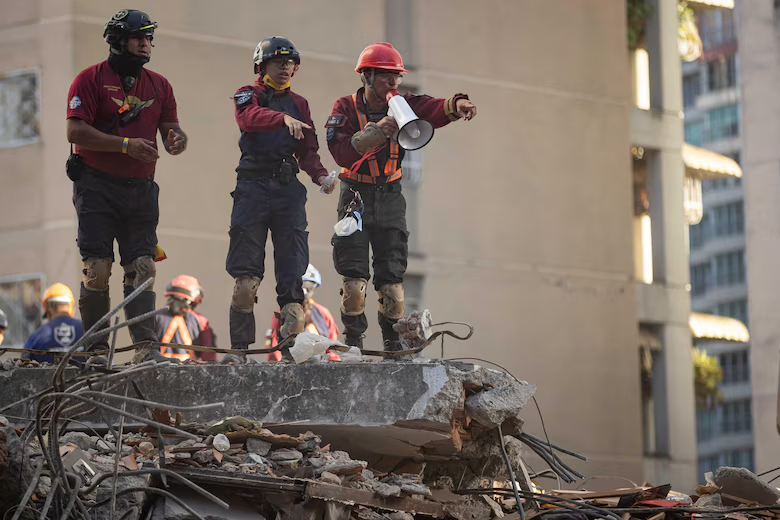
Rescuers carry out rescue operations at a building damaged by the earthquake this Saturday in Caracas, Venezuela.
Increase Aid
Venezuela has received more than 1,600 rescuers to assist victims of the earthquakes, according to Venezuelan Deputy Minister for Europe and North America, Oliver Blanco, who spoke on Saturday. In his X account, the official said that in the last few hours Venezuela has received 17 flights with rescuers and in the next 24 hours the arrival of 25 additional flights is expected. Rescuers from El Salvador, Mexico, the Dominican Republic, Switzerland, Ecuador, Spain, Chile, Panama, Colombia, the Netherlands, Italy, and the United States arrived in Venezuela this week, and 10 more countries are expected to join, said acting president Delcy Rodríguez, without giving further details, in a message early this morning.
Dozens of machines entered several areas of La Guaira this Saturday to boost rescue efforts reinforced by these search and rescue teams that have arrived in the country since Friday. The celebration at the arrival of the aid spread among the residents of the Caraballeda parish and the surrounding areas who until Friday had been complaining that the machinery was taking a long time to arrive. “Today the machinery has been seen with greater intensity and it has indeed arrived,” Randy Mijares, 37, told reporters, adding that this situation “is worse than the tragedy” of the 1999 landslide that occurred in this coastal state, leaving thousands dead. US rescue teams were able to save a baby from the rubble, while various Spanish organizations have been deployed in La Guaira to help with these efforts.
Field Hospitals and Shelters
Similarly, the resident coordinator of the United Nations System in Venezuela, Gianluca Rampolla, informed news media this Saturday that the organization has installed three field hospitals in the state of La Guaira. Rampolla explained that the goal is to be able to treat those most affected on-site with these hospitals because he believes it is not sustainable to transfer them all to health centers in Caracas. He also said that they are coordinating with Venezuelan authorities to set up “multi-service shelters”—with bathrooms and dining areas—to assist all those who lost their homes due to the earthquake.
These shelters, Rampolla explained, will be installed as close as possible to the affected communities so that citizens do not have to make long journeys. He also reported that a plane carrying 20 tons of humanitarian aid of all kinds, including supplies for water purification, had already arrived. Rampolla described the situation in La Guaira as serious, highlighting the work of the rescuers who have arrived from various countries around the world, as well as Venezuelans, but warned that there are still “many” buildings to reach to check if there are any people trapped and alive.
$6.7 Billion in Losses
According to a satellite assessment based on the Rapid Digital Analysis (RAPIDA) of the United Nations Development Programme (UNDP), the damage caused to homes and economic assets, such as vehicles, buildings or businesses, after the two earthquakes has a preliminary estimate of $6.7 billion. According to a UNDP statement, the assessment is based on seismic models, satellite images and population data and was carried out in the hours following the June 24 earthquakes, of magnitudes 7.2 and 7.5, which occurred near the northern coast of Venezuela.
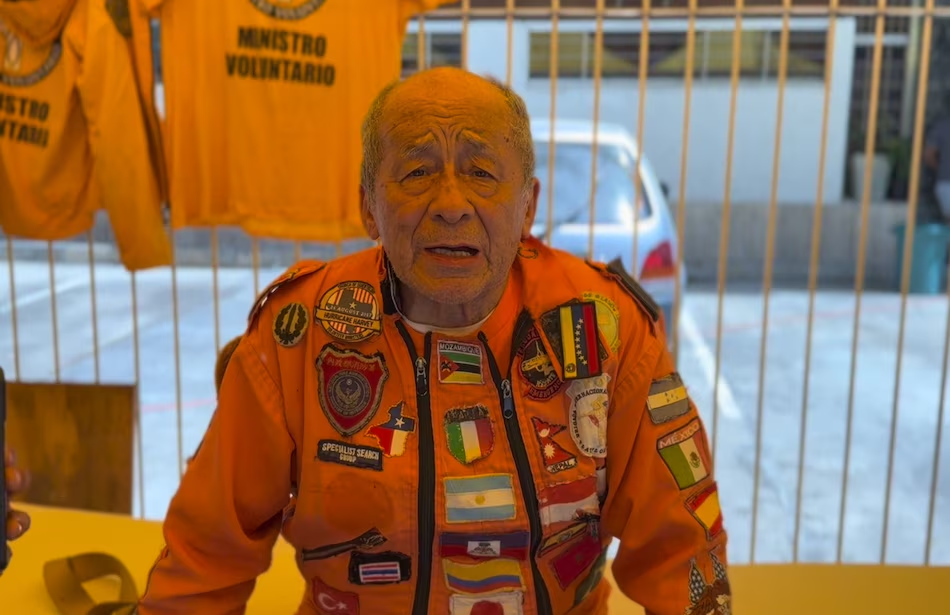
Responding to a Disaster in Venezuela for the Third Time Meet Hector Mendez an 80-Year-Old Mexican Rescuer
Hector Mendez, the founder of Topos Aztecas, a renowned international rescue group, is an 80-year-old Mexican rescuer, who claims to have been present at the most catastrophic events in Venezuela in the last 30 years: the Cariaco earthquake (1997), the Vargas landslide (1999), and now he is in Caracas, where he is working in the search for survivors after Wednesday’s double earthquake that has caused the death of at least 1,430 people.
Founder of Topos Aztecas, an international rescue group, Méndez chose this profession after the 1985 Mexico earthquake, when he had to search for his brother and found him alive, as he tells reporters. He arrived in Venezuela this Friday, thanks to the support of the Panamanian airline Copa, accompanied by other people and a group of dogs trained to search for survivors.
Méndez wears flags of different countries on his uniform, which he considers “signs of fraternity,” and represent places he has visited in his 40 years as a rescuer: Haiti, Mexico, Italy, Argentina, the United States, and others. He rests on a stretcher to continue the search efforts in Los Palos Grandes, a dynamic residential and commercial area in the Chacao municipality, the most affected in Caracas by the recent earthquakes. Around them, a whole chain of emergency response: firefighters who refuse to give interviews to journalists, volunteers, people receiving water and non-perishable food in tents.
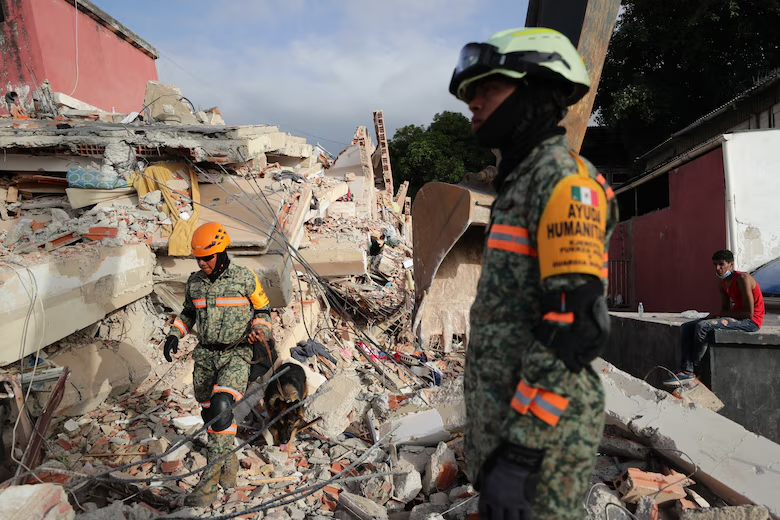
Mexican Army rescuers and a canine unit are searching for survivors in a building collapsed by earthquakes in La Guaira.
In the background, amidst the dust raised by shovels and excavators, lies a ruined building, and on the ruins, the Aztec Moles assess whether there are any survivors. Méndez explains to the media that dogs have a greater sense of smell and can detect if there are people alive or dead under the rubble. “(Today) what we detected were deceased people,” he says, referring to the Petunia apartment building, which was left in ruins after the 7.2 and 7.5 magnitude earthquakes last Wednesday. A few steps away, the mayor of Chacao, Gustavo Duque, told reporters that this was one of three buildings that completely collapsed in the municipality, while another 80 suffered damage. In addition, there are 35 dead and 28 rescued in Chacao. “We haven’t lost hope. We’re excited that the rescue team is doing this search again, and we hope they can find someone alive,” the mayor added.
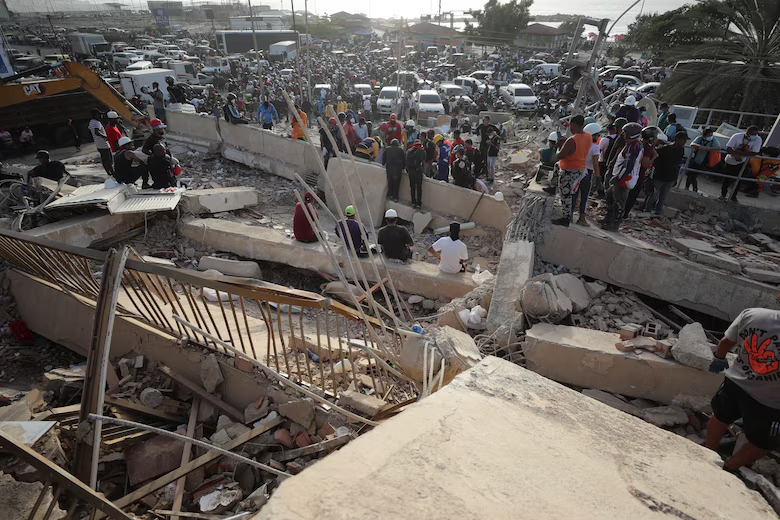
This scene is repeated in Venezuela: people search for survivors among collapsed buildings after the earthquakes.
In this regard, Méndez says that he and his group are focused on finding the bodies of the deceased and handing them over to the families for a dignified burial. “We dedicate ourselves to working to free them whole. It can take several hours to remove a piece of concrete from an arm to extract the body with dignity, complete, to hand it over to the family,” the rescuer concludes. The Aztec Moles – so named because, like these animals, they dig through rubble to locate trapped people – are one of the rescue groups that arrived in Venezuela as part of international aid from more than 10 countries, including El Salvador, Italy, the United States, and Panama. In parallel, groups of civilians have joined the rescue efforts, as well as the collection and distribution of supplies.
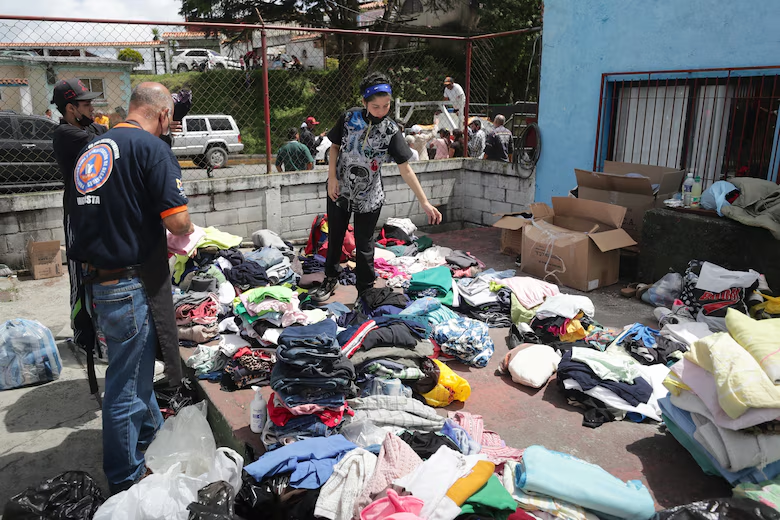
People are organizing clothing donations for those affected by the earthquakes in El Junquito, on the outskirts of Caracas.
Machinery and Rescue Workers Arrive at Ground Zero of the Venezuelan Earthquakes
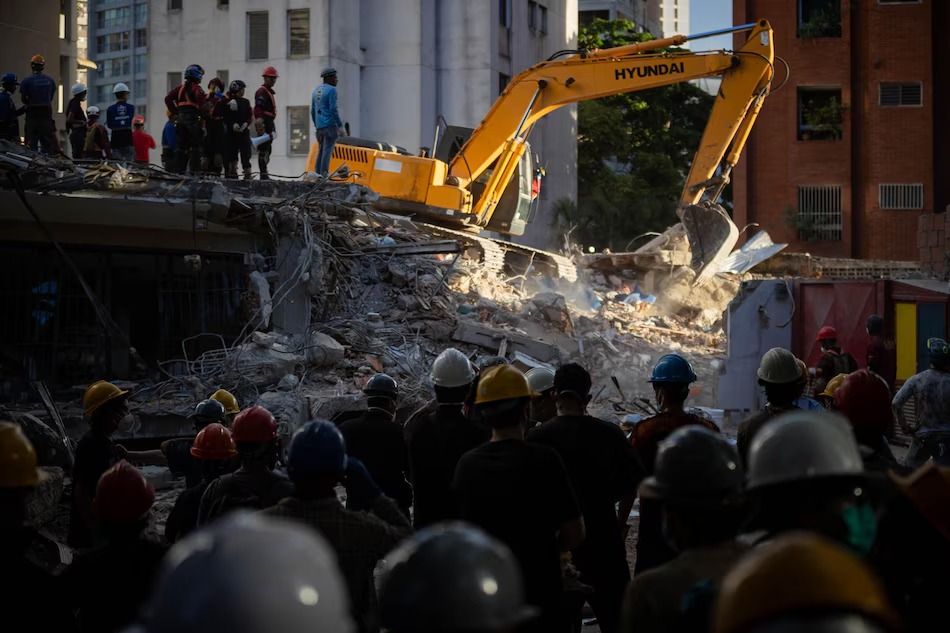
With the Support of Specialized Machinery, Rescuers are Carrying Out Rescue Operations.
Dozens of machines entered several areas of La Guaira, the state most affected by the earthquakes that occurred on Wednesday in Venezuela, on Saturday to boost rescue efforts reinforced by international rescuers who have arrived in the country since Friday. In the Caraballeda and Los Corales sectors, at the very epicenter of the devastation, bulldozers were present today, while various helicopters flew over the area, after almost three days of very precarious rescue activities carried out by volunteers after the 7.2 and 7.5 magnitude earthquakes that have left at least 1,430 dead. Rescuers from Argentina, about thirty of them, disembarked today from some of those aircraft, two of them from the United States, and they plan to stay for about 10 days for rescue work in Venezuela.
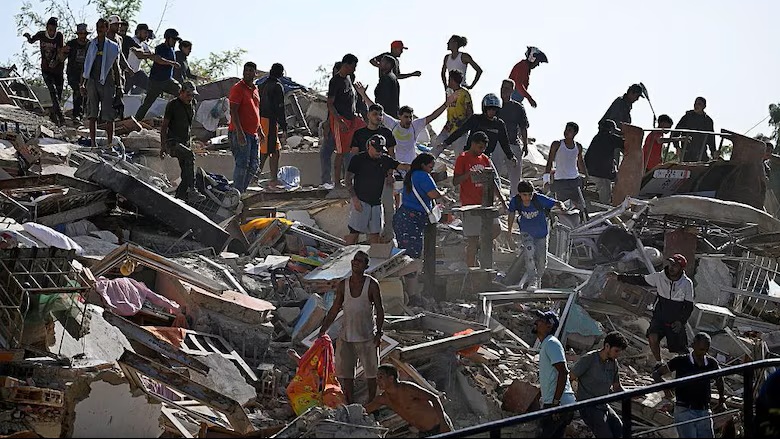
On Friday, news media were able to confirm the presence of rescuers from Mexico, Ecuador, and El Salvador. “The planes are keeping an eye on us. That’s the good thing,” Xiomara Bloon, a 45-year-old neighbor, told reporters with relief, while looking for some clothes among the piles crowded in the streets. Bloon also celebrated the humanitarian aid they have received in recent hours. “I’ve been looking for food for three days now, and now I’m looking for clothes because I really lost all my clothes,” she said. The celebration at the arrival of the aid spread among the residents of Caraballeda and the surrounding areas who until Friday had complained that the machinery was taking a long time to arrive.
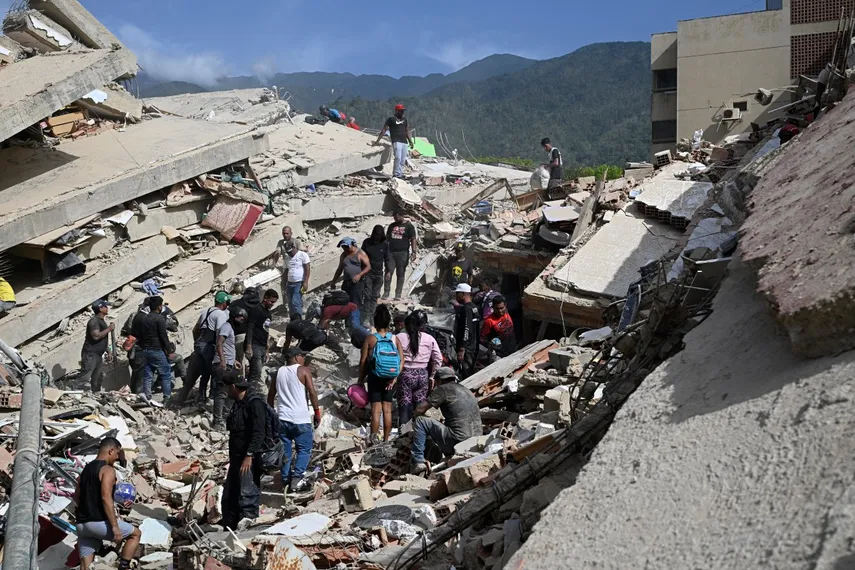
“Lara, the machine has arrived there, come on!” a man in Caraballeda said, sounding both exhausted and hopeful, to a woman about an excavator that had arrived to remove debris from a completely collapsed building. “The help has been very good, a little late, but it has arrived,” José Luis Acosta, 51, reiterated to reporters this Saturday while waiting in line to receive food. On the road from Caracas to La Guaira, dozens of machines and trucks carrying specialized equipment can be seen this Saturday. The government puts the number of injured at 3,238, and the number of missing persons was 157 last Thursday. Authorities have not updated this figure, despite reports of people disappearing from hospitals and morgues.
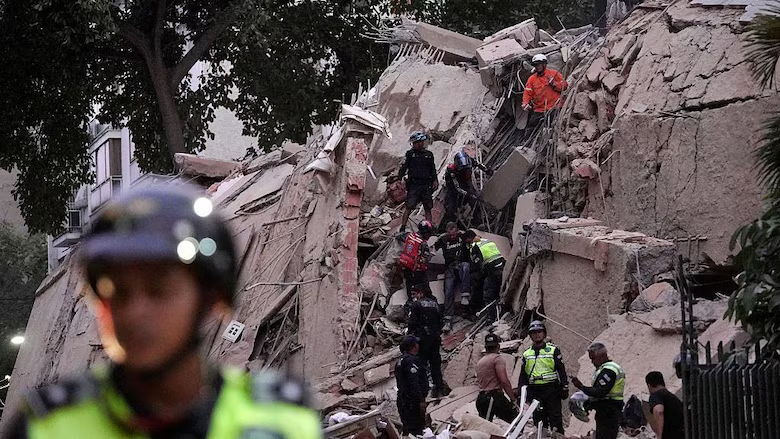
In the last few hours, Venezuela has received 17 flights with more than 1,600 members of rescue teams, and in the next 24 hours, the arrival of 25 additional flights is expected. Venezuela’s interim president, Delcy Rodríguez, said that rescuers from El Salvador, Mexico, the Dominican Republic, Panama, Switzerland, Ecuador, Spain, Chile, Colombia, the Netherlands, Italy, and the United States arrived in Venezuela this week, and 10 more countries are expected to join. The United States plans to send a second economic aid package to the South American country this week, after contributing $100 million to the UN Office for the Coordination of Humanitarian Affairs (OCHA) and $50 million to organizations operating on the ground.
After the Devastating Earthquakes, Caracas Seems to be Experiencing the Worst Moment in its Recent History
Each morning that Venezuelans wake up after the earthquakes, the outlook becomes a little darker and more desolate. It comes after another night in which prayers for the miraculous recovery of missing relatives went unanswered, in which the restless sleep of the survivors is interrupted by nightmares of collapsed buildings and moments of absolute panic. For former police officer Jan Carlos Roa García and his family, it was another night sleeping outdoors. Their building in Caracas didn’t collapse, but it’s too dangerous to return. With tears in her eyes, she says she doesn’t even know where to begin to rebuild her family’s life.
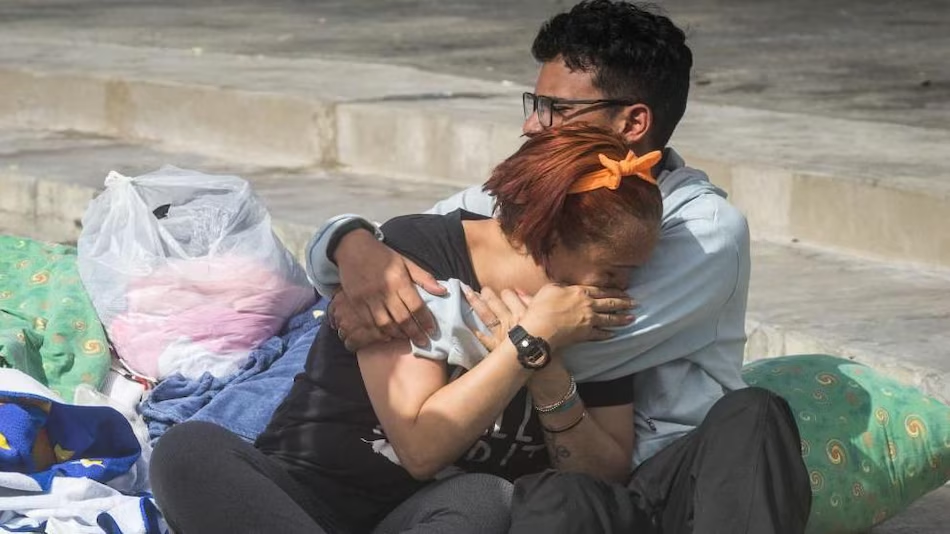
The lives of Venezuelans have been completely disrupted by the earthquake.
“If I were 30 instead of 50, maybe. But I don’t know where to begin. And so far, no one from the authorities has contacted us.” As a loyal public servant, Jan Carlos was careful not to over-criticize the government’s response, despite the tiredness and anger he felt. Zaira Castro, who is dedicated to music, did not have the same caution. “We are all quite frustrated because the government is not showing what it should: serious help,” he says in a square just one block from two collapsed buildings. “In reality, it is we Venezuelans who help each other. We live in a society that has learned to help one another. We don’t depend on the government: for us, it no longer exists.”
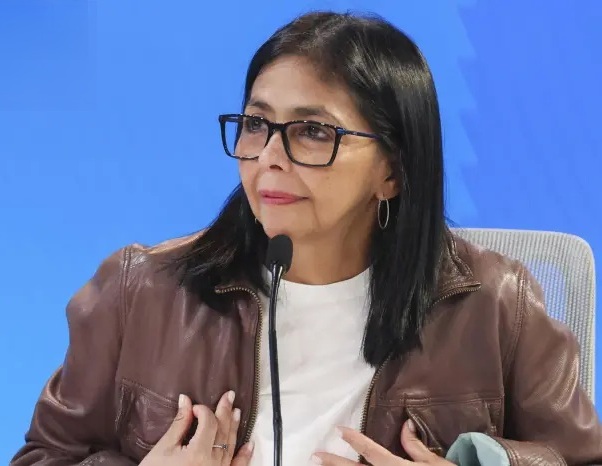
In the same area, called Chacao, the interim president, Delcy Rodríguez pictured above, made a visit together with the mayor and received criticism from the residents. “They’re campaigning in the middle of a tragedy! The government is doing nothing for the people,” a woman shouted. I know these streets well. When I was a BBC correspondent in Venezuela, I lived for several years in the Los Palos Grandes neighborhood in Chacao, one of the hardest hit. My old house was just a few meters from the now-collapsed Petunia building, where rescue teams are working tirelessly to reach the trapped residents. A friend recently posted on social media that her mother is among those missing under the rubble.
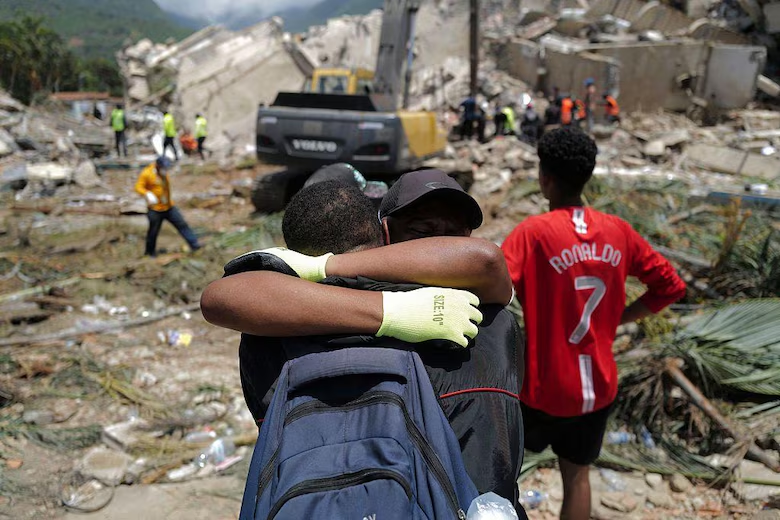
It was a great relief to see that my old building, the Alhelí, was still standing and that its friendly doorman, Pedro, was still outside chatting on the porch with the older neighbors. One of them had twisted his ankle going down the stairs. They all agreed that they couldn’t remember a similar tragedy in Venezuela in their entire lives. In the worst-affected areas—especially in the coastal city of La Guaira—the despair is even greater. The landscape, with more than 100 buildings reduced to rubble, is apocalyptic. And as hope fades, so does the outrage. “There are still people in there, we need machinery,” says affected neighbor Eileen Lada. “Please help us,” she pleads.
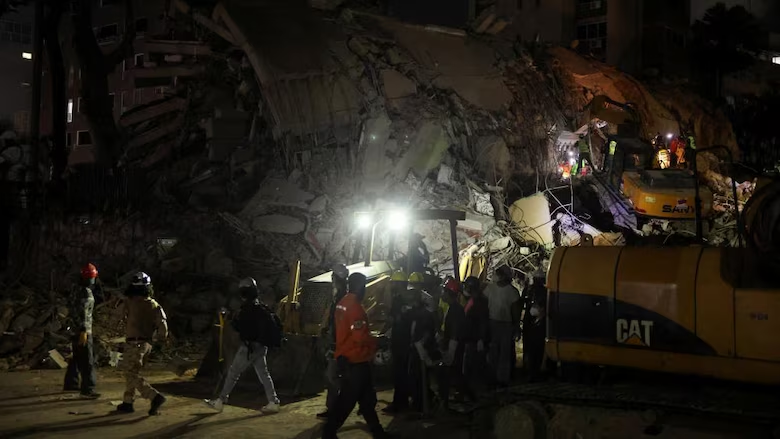
Rescuers spend their nights searching for survivors in the rubble of the buildings.
The Good Humor of Venezuelans
Rescue teams — both Venezuelan and international — have worked through another night with admirable resilience and focus to try to reach the trapped relatives. Videos circulating on social media show rescuers successfully pulling survivors out of the water, displaying the characteristic good humor and spirit of Venezuela, scenes that are deeply moving. Hospitals on the north coast are at their limit. A healthcare system that has been underfunded for decades is now trying to cope with a demand that would pose a challenge even for countries with far better infrastructure.
Doctors and nurses are doing everything possible in circumstances that, for many, will be the toughest of their lives. And the accounts from survivors in hospital wards are harrowing. “It was horrible, many people died and many family members disappeared,” María Vargas told AFP from her hospital bed. “I completely lost my house, but we are okay, thank God.” After an earthquake, rescue teams consider the first 72 hours crucial. That period has now passed. Now the feeling is that we are living through one of the toughest moments in the recent history of Venezuela, a country that in recent years has experienced far more difficulties than would seem fair.
La Guaira is the area most affected by the earthquakes.