Where Did the Decentralization Money Go? The Pandemic as an Excuse; Checks Without Justification; Phantom Projects
Anti-corruption prosecutor Digna Castillo pictured below is in charge of the investigation. The investigations by the Anti-Corruption Prosecutor’s Office began in 2025, after receiving the first audit reports from the Comptroller General of the Republic.
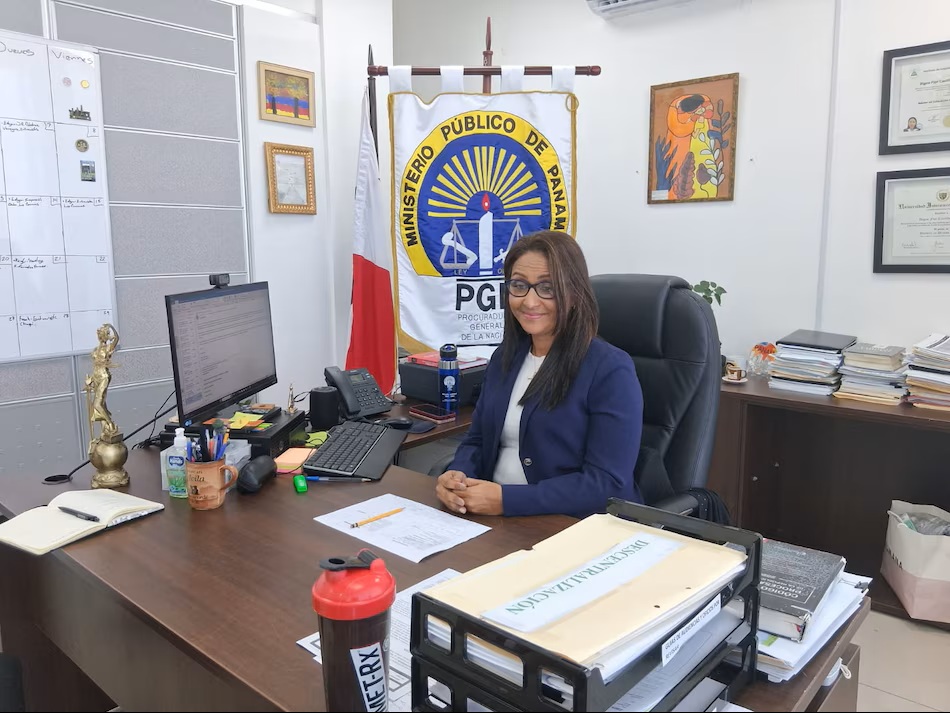
The whereabouts of $41.4 million granted by the National Decentralization Authority (AND), between 2019 and 2024, through the Development and Social Interest Program (PDIS), is a mystery. This is according to anti-corruption prosecutor Digna Castillo, who explains that in many of the investigations carried out to date by her office, no invoices, receipts or any document have been found to justify the destination of these resources that should have been used to alleviate the needs of communities and provide assistance to families in need. The COVID-19 pandemic became the perfect excuse for the shady handling of millions of dollars that were supposedly allocated to address a national emergency, but whose whereabouts remain unknown.
It was a scheme in which the money was transferred to local governments controlled by influential members of the ruling Democratic Revolutionary Party and its allies. The AND’s PDIS began operating and transferring resources in 2021, during the administration of Laurentino Cortizo (2019-2024). The program, which has been called parallel decentralization, operated until 2024. Prosecutor Castillo explained that so far her office has received a total of 72 audit reports and in 50 of them, community boards have been found to have some type of patrimonial damage that should be investigated.
Castillo bases her assertion on the fact that during the investigations related to these audits, no documentation detailing the destination of the funds has been found: that is, there is nothing to justify the delivery of the money, only the checks cashed by officials or businessmen to whom projects were supposedly assigned. She also explained that when judicial inspections are carried out on the projects, most are unfinished or were never carried out. So far, the prosecution has charged 97 people in 41 open cases, but these numbers may increase significantly, as that office has received a total of 334 complaints.
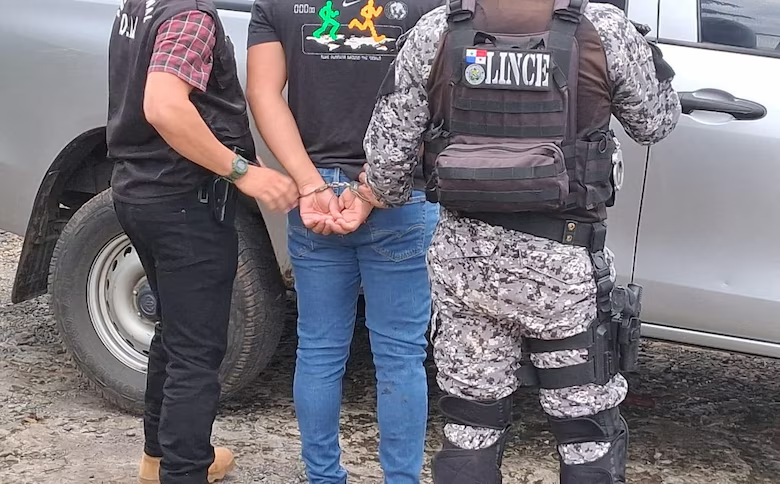
The proceedings are part of an investigation into embezzlement through the misuse of decentralization funds
Among those 97 defendants are representatives and former representatives of corregimientos, treasurers, former treasurers and private individuals who, for the most part, have not been able to justify the destination of the money delivered through the parallel decentralization. Prosecutor Castillo explained that these files or folders contain a multitude of situations, from funds that were supposedly given for social aid, others that were assigned to community projects or for management by the community boards themselves, for hiring or paying staff without justification.
Throughout the investigation, the prosecution has also found that, on occasion, the funds were sent to communities that did not belong to the district to which they were supposedly destined, meaning that there was no control or supervision over these resources. The traceability of the funds indicates that some of the money from parallel decentralization was used for the acquisition of goods and personal use. There were community boards, such as the Belisario Porras board, that received up to $8 million.
In this case alone, the prosecution maintains that the audit report from the Comptroller General of the Republic revealed that some officials of the community board received 80, 77, 74, 75, and 43 checks, respectively, for amounts ranging from $130,000, $117,000, $107,000, and $86,000, for alleged services rendered to the Belisario Porras Community Board. The audit alleges that $7 million was used entirely to pay for services for which there is no record. The prosecution maintains that there are no documents to support these disbursements. The prosecutor emphasized that in some cases there are approaches to reach plea agreements, but that this is conditional upon the return of the money given by the State and the acknowledgment of the crime.
She stated that the Public Prosecutor’s Office has assigned a team of officials and technical staff to carry out these investigations. Official data from ‘AND’ reveals that the delivery of $320 million without any kind of support was detected through PDIS, known as parallel decentralization. The 334 complaints filed with the Public Prosecutor’s Office to date, for the alleged misuse of funds, involve 257 community boards and 37 municipalities, and the amount investigated exceeds $213 million. ‘AND’ is working on gathering more information to hand over to the Public Prosecutor’s Office regarding the irregularities found in the management of parallel decentralization.