What Actually Makes Pay by Phone Bill Useful in an Era of Cards, Wallets, and Bank Transfers?
Guest Contribution – Pay by Phone Bill sounds like a payment method that should have disappeared a decade ago. Cards, e-wallets, bank transfers, and buy-now-pay-later all cover most online purchases in the modern payment ecosystem. Why does the option to add a charge directly to a mobile phone bill still exist as a widely offered payment method?
The answer is that Pay by Phone Bill has properties no other payment method matches. Those properties matter enough to a distinct customer segment that operators keep offering the option. They also matter for a distinct set of use cases where the alternatives do not work as well.
What Pay by Phone Bill Actually Is
Pay by Phone Bill, also called direct carrier billing, adds the cost of a purchase to the buyer’s mobile phone bill. Post-paid customers see the charge on their next monthly bill. Prepaid customers see the amount deducted from airtime, and the mobile network operator settles with the merchant separately.
The industry sits behind the scenes but at real scale. Mordor Intelligence’s analysis of the direct carrier billing market reports a market worth around $53 billion in 2026, growing at a compound annual rate of roughly 13 percent. Boku, Bango, DIMOCO, and Fortumo are the largest platforms globally, servicing partnerships with mobile network operators in over one hundred countries.
The mechanic works because mobile network operators already have a billing relationship with their customers. Adding a small charge to a bill that is already being sent is technically trivial. The customer authorises the payment on their device and the transaction completes in seconds without any card details or bank information being exchanged.
The Six Situations Where It Actually Beats Cards and Wallets
Six practical situations where Pay by Phone Bill genuinely beats the alternatives:
- Micropayments where card processing fees eat the transaction. A card payment on a £1 purchase can lose 15 to 30 percent to processing fees. Carrier billing has fixed cost structures that scale better at small transaction sizes.
- Purchases by users without a bank account or credit history. An unbanked user with a mobile phone can still complete transactions through carrier billing. This is why the method has such strong adoption in emerging markets where card penetration is lower.
- Purchases where the buyer does not want card details stored anywhere. Carrier billing never exposes card numbers to the merchant, and the payment identity is tied to the phone number rather than a financial account.
- Cross-network purchases where the buyer is roaming or overseas. Carrier billing works with any mobile plan that supports it, regardless of the country where the buyer is currently located. Cards can be blocked by fraud filters when used overseas.
- Emergency small deposits where no card is to hand. A user without their wallet, or without a card set up on the device they are using, can still complete a small payment via their phone number.
- Age-verified transactions where mobile carrier verification adds a layer. Carrier billing includes the mobile network’s own KYC and age verification, which adds a compliance layer that card payments do not naturally provide.
None of these situations is universal. Each one covers a particular slice of the payment market, and together they explain most of the demand that keeps carrier billing profitable at scale.
What the Trade-Offs Actually Are
Pay by Phone Bill has real costs alongside its advantages. Transaction fees paid to the mobile network operator are typically higher than card processing fees. Merchants pass through some of the cost or restrict the method to certain transaction sizes.
Per-transaction limits are usually much lower than card limits. Most carrier billing implementations cap individual transactions at £30 to £50, with monthly aggregate limits of £240 in the UK under the Phone-paid Services Authority framework. Larger purchases have to route through a different payment method.
Availability varies by mobile operator and by merchant. Not every mobile plan supports every carrier billing merchant, and the coverage matrix changes over time as new integrations come online. A user has to check with their operator or the merchant’s checkout page whether the option is available.
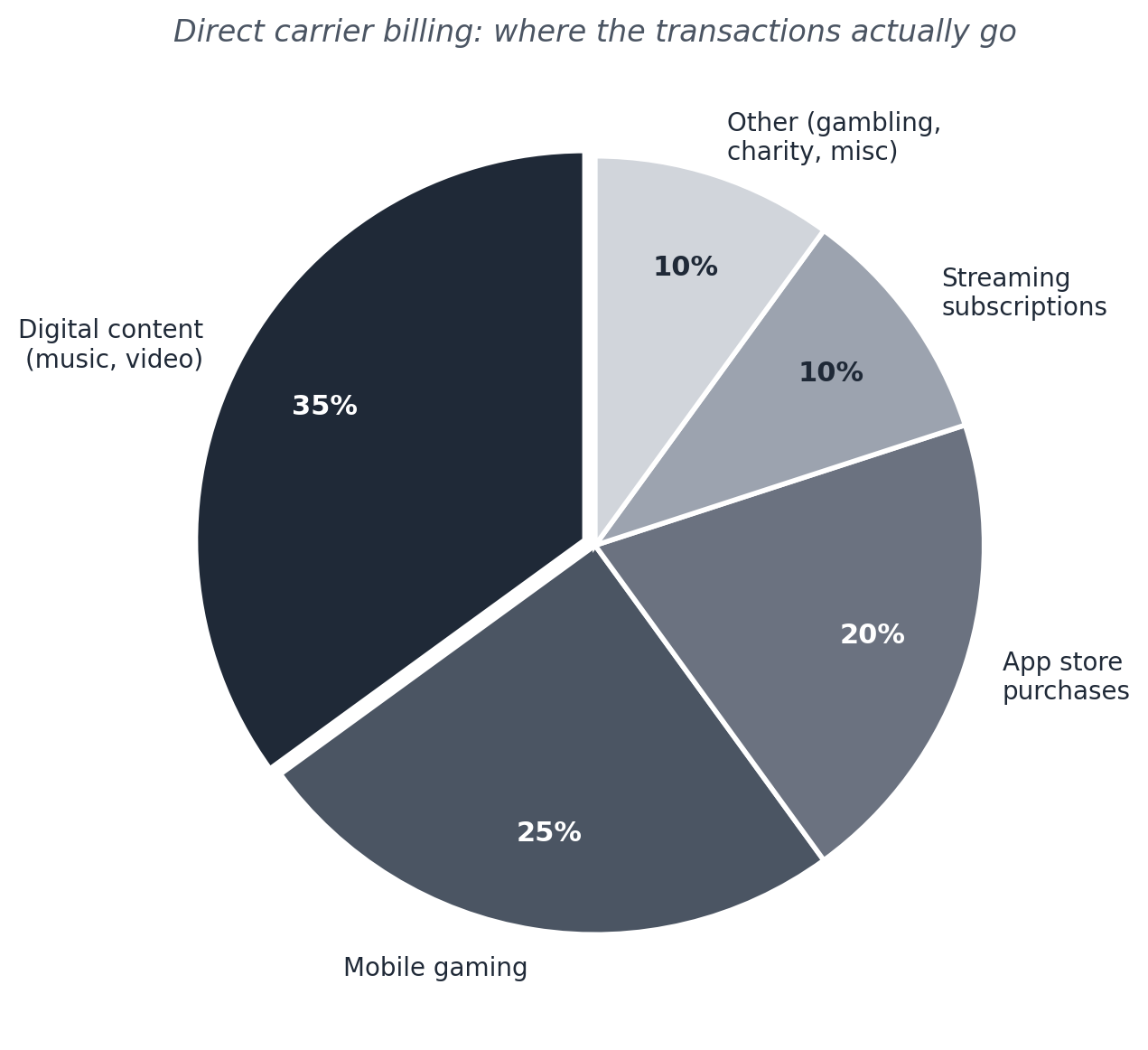
The category coverage is worth understanding in detail. Merchants offering carrier billing tend to cluster in mobile content, mobile gaming, streaming subscriptions, and a small number of adjacent verticals. UK gambling has become one of those categories, and the deposit options at Fruity King include the method as a standard route alongside cards and wallets.
Where It Sits in the Modern Payment Ecosystem
Pay by Phone Bill occupies a niche rather than a mainstream position. The niche is defined by small transaction sizes, mobile-first users, and categories where the particular properties of carrier billing genuinely matter. Outside those categories, cards and wallets win on convenience and cost.
The niche is not shrinking. Digital content, mobile gaming, streaming subscriptions, and app store purchases have all grown as smartphone penetration has grown, and carrier billing has kept its share of those categories in the double digits. The market is expanding rather than contracting, which is why the industry keeps attracting new platform entrants and telco integrations.
The unbanked demographic is another durable driver. Even in economies where card penetration approaches saturation, there remain populations that either lack access to formal banking or prefer not to use it. Carrier billing serves that segment better than any other payment method available at scale.
Why the Method Still Persists Despite Newer Alternatives
The persistence of Pay by Phone Bill is not a nostalgia effect. It is a product-market fit that survives because the alternatives do not solve the same problem set. Cards, wallets, and bank transfers all require existing financial infrastructure that carrier billing does not.
The trajectory looks stable rather than declining. Open banking and buy-now-pay-later are newer alternatives competing for the general online purchase market. Neither has meaningfully displaced carrier billing in the particular corners where it dominates, because the demographic and use-case reasons behind those corners do not disappear.
For anyone at checkout, the practical takeaway is straightforward. Pay by Phone Bill is worth using when the transaction is small, when card details are inconvenient, or when mobile carrier verification adds genuine value. Knowing when to pick it separates informed users from those who click through the first option that appears.
________________________________________________________________________________________________________________
Advertisements placed in our Guest Contribution sections are in no way intended as endorsements of the advertised products, services, or related advertiser claims by NewsroomPanama.com, the website’s owners, affiliated societies, or the editors. Read more here.