Police Officers Attacked in Colombia: Panamanian Government Strongly Condemns the Attack
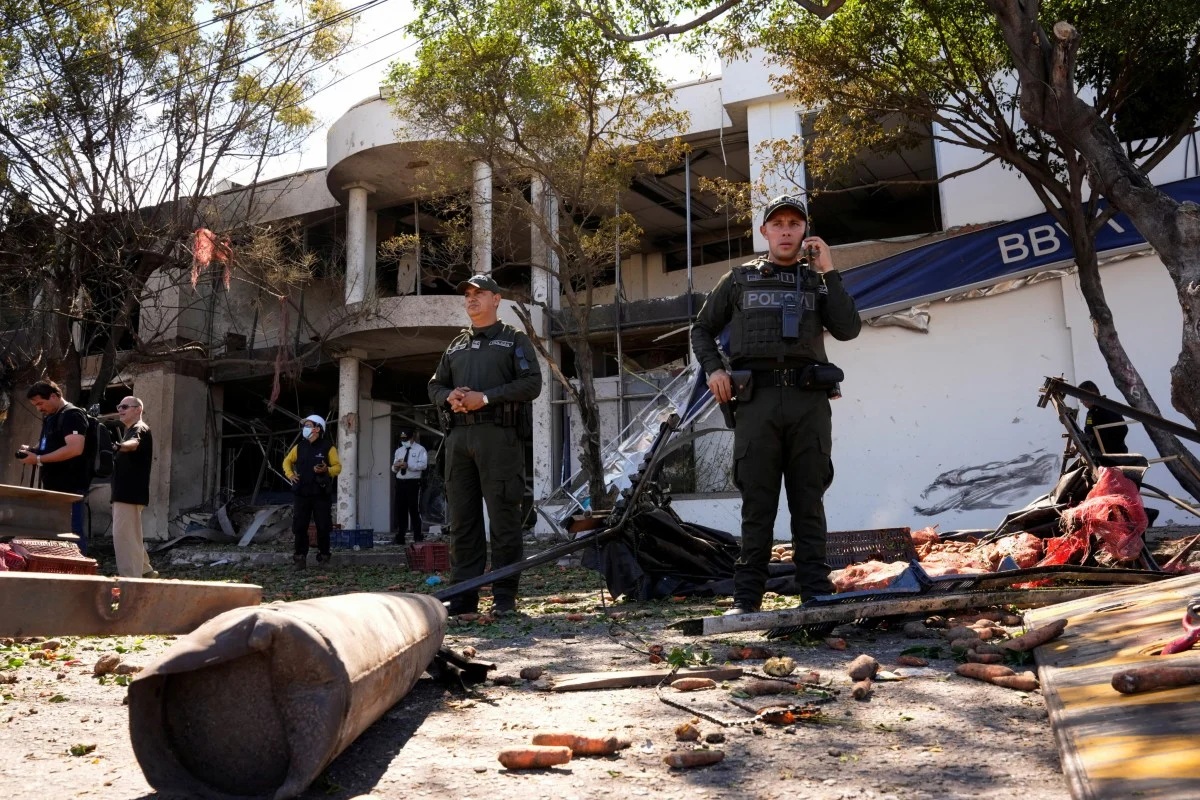
The Government of the Republic of Panama strongly condemned the attack against the National Police of Colombia in Norte de Santander, Republic of Colombia, and expressed its solidarity with the Colombian Government and people. The attack, classified as terrorist, left 11 people injured, including eight members of the Public Force and three civilians. In a statement, the Panamanian Foreign Ministry expressed its solidarity with the Colombian people and especially with the members of the security forces who work daily to protect their citizens and preserve democratic order. Furthermore, she reaffirmed her firm rejection of “all manifestations of terrorism and violence, convinced that these acts have no place in our societies and can only be confronted through cooperation, the strengthening of the rule of law and a shared commitment to peace, security and democracy.”
The explosion occurred early Saturday morning next to a police station in the city of Cúcuta, about 400 kilometers from Bogotá. AFP journalists documented the burning vehicle, destroyed facades, and members of the security forces, military personnel, and residents approaching the scene. The attack occurred near the border with Venezuela, six days before the inauguration of President-elect Abelardo de la Espriella, who strongly condemned the act of violence. “I condemn in the strongest possible terms the cowardly terrorist attack perpetrated in Cúcuta against our National Police. Terrorism will not intimidate Colombia nor will it break the will of Colombians to live in peace and security,” said De la Espriella on X.
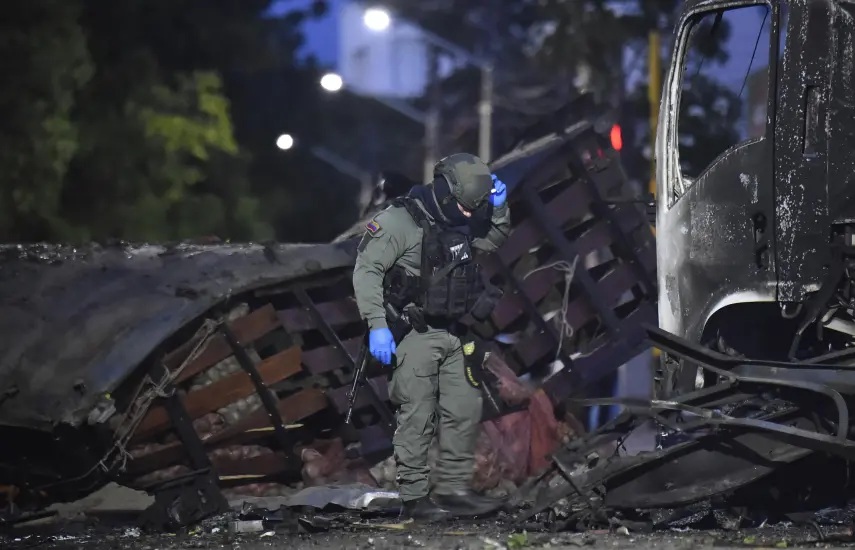
Colombia’s government on Saturday blamed the nation’s largest remaining rebel group for an explosion outside a police base that injured 11 officers and killed a police dog. The attack took place early Saturday in Cucuta, a city along Colombia’s border with Venezuela, where drug gangs and rebel groups have long fought for the control of smuggling routes. General William Rincon, the director of Colombia’s police, said the blast came from a truck that had been left outside a building that serves as the headquarters for police in Norte de Santander Province. The predawn explosion damaged much of the building’s roofing and shattered its windows.
“This was a vile terrorist attack,” Rincon said. “We will not rest until we find those who are responsible and have them prosecuted.” In a message on social media, Colombian Defence Minister Pedro Sanchez blamed the National Liberation Army rebel group for the attack, and offered a US$60,000 reward for information leading to those behind the car bombing. The attack comes as Colombia prepares to inaugurate a new president. Next Friday, Abelardo de la Espriella, an ultraconservative who has promised to cancel peace talks with the nation’s remaining rebel groups, will be sworn into office in Cali, another Colombian city where rebel groups have staged attacks recently.
The National Liberation Army, or ELN, has been fighting Colombia’s government for decades, and is believed to have 6,000 fighters operating in Colombia and neighbouring Venezuela. The group was founded in the 1960s by union leaders, students and peasants seeking social justice but has largely transformed into a criminal organisation that profits from illegal gold mining and drug trafficking, according to Colombian authorities, with President Gustavo Petro often accusing its leaders of acting as “drug lords dressed up as guerrilla fighters”. Under outgoing President Gustavo Petro, who was elected in 2022, Colombia staged peace negotiations with the ELN.
But the talks fell apart early last year, after the ELN staged attacks in the rural area north of Cucuta, in which an estimated 78 people were killed. At least 56,000 had to flee their homes. Incoming president de la Espriella has said he will confront the ELN and criminal groups in Colombia with greater military force, and will resume the aerial fumigation of coca crops, the raw material for cocaine. Petro attempted to launch peace talks with several armed groups during his tenure under a strategy known as Total Peace. But critics say many of these groups used ceasefires granted to them by the government to regroup, rearm and strengthen their grip over rural communities. A peace deal between Colombia’s government and the Revolutionary Armed Forces of Colombia led to the disarmament of more than 13,000 guerrilla fighters in 2016. That left a power vacuum in some rural areas that smaller groups like the ELN have tried to fill.