More than $44.2 Million will Be Spent on Renting 43 Ambulances for the Ministry of Health
Sorqui Company, Inc., which operates commercially as Alpha Ambulance Services, has held consecutive contracts with the Ministry of Health (MINSA) to provide ambulance services between 2022 and 2025. The contract will have a term of more than four years. The reference price was calculated based on contracts awarded between 2022 and 2025.

The Ministry of Health (Minsa) will allocate more than $44.2 million to the rental of 43 ambulances for 51 months (four years and three months). According to the Ministry of Health (Minsa), the reference price was calculated without receiving any bids during the market study. Therefore, to establish this amount, the agency adopted criteria from three similar contracts awarded between 2022 and 2025 to the supplier Sorqui Company, Inc., which operates commercially under the name Alpha Ambulance Services. This information is contained in a price management report, dated May 2026, and signed by the administrator of the Directorate of Health Service Provision, Juan Francisco Gómez.
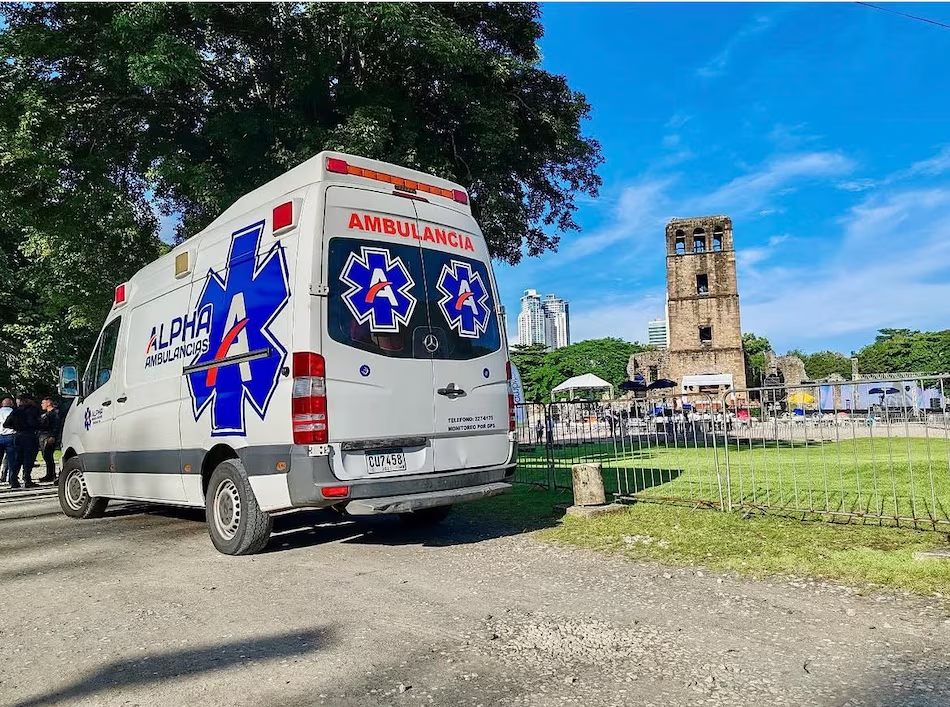
It was indicated that the document served as the basis for setting the reference budget for the new contract. The same company had already been awarded a contract by the Ministry of Health (Minsa) through an exceptional procurement process for the outsourcing of ambulance services during 2025. That contract amounted to $5.1 million and initially included 13 ambulances for the first half of the year. Subsequently, the service was expanded to 30 units for the second half. In a statement that year, the Ministry of Health indicated that this exceptional contract was used due to the “need to maintain ambulance service in the health regions and the lack of available resources for this item within the General State Budget, where only $25,655 was allocated for the 2025 fiscal year.”
Tender
The tender, published last Friday July 24, seeks to contract the rental service of operational land ambulances for the care and transfer of patients in urgent and emergency conditions throughout the country. The schedule for the public event establishes that the preliminary and homologation meeting will take place on August 17, 2026, while the submission of proposals was set for September 14. The price management report also notes that the Ministry of Health (Minsa) published a request for quotations on PanamaCompra on April 30, 2026. However, upon completion of the established deadline, it did not receive any proposals, so it resorted to previous contracts to prepare the reference budget.

Among the contracts analyzed is one with a monthly cost of $22,800 per ambulance and two others for $21,000 per unit, a value that was ultimately adopted to calculate the reference price for the new tender. According to the tender specifications, the contractor must supply 43 fully operational ambulances, equipped for pre-hospital care and patient transport, in addition to guaranteeing the minimum required personnel, including emergency medical technicians (EMTs). The ambulances will be distributed across 14 health regions. Coclé, Chiriquí, Los Santos, and Veraguas will each receive five units; Herrera, four; Bocas del Toro, Colón, and Panamá Oeste, three; Darién and the Ngäbe-Buglé region, two; while Panamá Metro will have two ambulances, and the regions of San Miguelito, Panamá Este, and Panamá Norte will each have one unit.
Criticisms of the Ministry of Health
“Enough with the millions being spent, the improvisation, and the direct contracting.” With that phrase, Janine Prado, a member of parliament from the Vamos party, questioned the Ministry of Health’s contracting practices during her speech in the National Assembly. Prado, who has a degree in Nursing and is also a lawyer, argued that the main question is who ends up benefiting from these processes. Although she acknowledged the need for ambulances in hospitals, health centers, and the SUME 911 emergency system, she stated that this need is not new. In her opinion, the Ministry of Health should not continue resorting to direct or emergency contracts to address a shortage that, she said, was known since the 2024 election campaign.