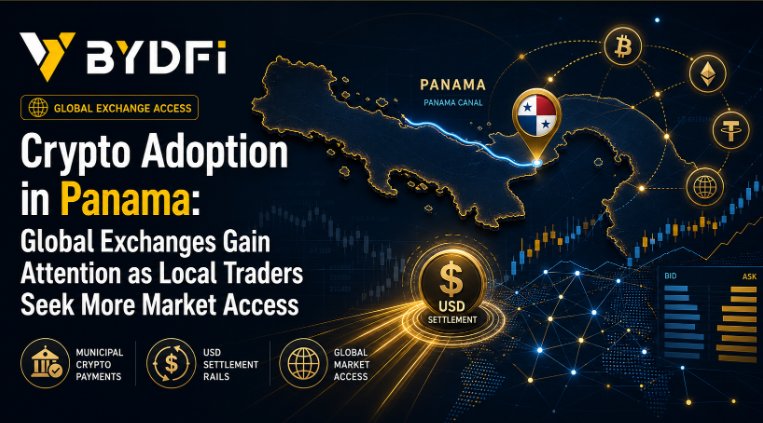
Crypto Adoption in Panama: Global Exchanges Gain Attention as Local Traders Seek More Market Access
Guest Contribution – In April 2025, the Municipality of Panama approved a mechanism allowing taxpayers to make municipal payments through cryptocurrencies, with an authorized intermediary converting the funds into U.S. dollars. The measure was voluntary and did not replace existing payment methods. This local development brought new attention to crypto adoption in Panama, but the ability to make selected payments does not automatically translate into broad access to locally focused trading services. CoinGecko’s Panama exchange page groups platforms that either support PAB deposits or are incorporated in the country, so it should be treated as an availability indicator rather than a definitive count of locally registered platforms.
Regulatory context also matters. In a 2018 public notice, Panama’s Superintendency of Banks stated that the exchange, investment, purchase, and general trading of Bitcoin and similar instruments did not fall within its supervisory competence at that time. Because the notice reflects a historical regulatory position rather than a current exchange-licensing framework, users should review newer laws and official guidance before drawing conclusions about present-day platform oversight.
More recent developments show that regulation remains under discussion. In January 2026, Panama’s National Assembly reported that an Economy subcommittee was reviewing Bill 326, which seeks to establish a legal framework for the supervision, registration, and control of virtual asset service providers in line with FATF standards. In July 2026, the Securities Market Superintendency also discussed crypto-asset regulatory scope and risks under Opinion 4-2025, including fraud, money-laundering, legal-certainty, user-protection, and regulatory-arbitrage concerns. These updates support the view that Panama’s market is active, but that a dedicated, fully enacted VASP framework should not be assumed unless confirmed through current official sources.
Why Broader Market Access Matters
For users evaluating crypto access from Panama, the practical question is less about whether the country is “crypto-friendly” and more about which services are actually reachable, usable, and transparent. A relatively limited set of locally focused platform listings may lead some users to consider global platforms that offer wider asset coverage, multilingual interfaces, and integrated payment providers. That does not remove the need for due diligence, but it does make platform access a central part of the market conversation.
Panama’s dollarized and internationally connected economy can make the idea of global access feel natural. Still, a dollar economy does not automatically solve onboarding. Card processing, bank-transfer coverage, third-party fiat providers, identity checks, account limits, and local payment preferences can all shape the user experience. Users comparing exchanges should therefore look beyond headline asset lists and review which deposit, withdrawal, and account services apply in practice.
Chainalysis reported that Latin America’s on-chain crypto activity grew 63% year over year in the 12 months ending June 2025. That regional figure should not be treated as a Panama-specific adoption rate, but it provides useful context for the wider demand for digital-asset access across the region.
Payment Channels and Regional Access
Payment access is one of the clearest differences between a locally focused exchange and a global platform. Some platforms emphasize card purchases, others route fiat transactions through third-party providers, and some rely mainly on crypto deposits. Fees, processing times, supported currencies, and verification requirements can vary by provider and jurisdiction. For Panama-based users, the important test is whether a platform’s available payment rails match the user’s account status and preferred method at the time of use.
What Traders Compare on Global Platforms
When users compare global exchanges, the decision often extends beyond basic spot buying. Common evaluation points include spot-market depth, perpetual futures tools, copy-trading features, automated strategy tools, mobile access, language support, published reserve information, and the clarity of risk disclosures. Broader access can be useful, but it also introduces more decisions: which products are suitable, which fees apply, and which risk controls are needed.
Fee information should be read with similar caution. Spot and derivatives fees may be listed in public schedules, while TradFi fees and promotional discounts may vary by product and campaign. Users should review the current fee schedule before trading. Reserve disclosures also require context: Proof of Reserves information can help users review selected platform data, but reserve ratios change over time, so readers should consult the most recent report rather than rely on historical percentages.
BYDFi as a Global-Platform Case Study
One example is BYDFi, a global trading platform founded in 2020 that offers spot trading, perpetual futures, copy trading, trading bots, and selected TradFi products. For readers researching BYDFi for Panama traders, the platform brings several trading workflows into one account. Product availability and account eligibility can still depend on regional terms, so users should confirm current access before registering.
Its automated strategy tools include Spot Grid and Spot Investment, giving users alternatives to placing every order manually. These tools do not remove market risk, but they can help users apply predefined trading rules more consistently.
In February 2026, BYDFi announced that selected precious-metal and tokenized-stock products had gone live on its platform. These products may broaden market access through a single account, although eligibility can vary by jurisdiction. The broader point is not any single product code, but the direction of global platforms toward wider market menus that combine crypto-native and traditional-market exposure.
More recently, BYDFi used its 2026 sixth-anniversary update to highlight the launch of Onchain Prediction, an event-based market feature within its broader onchain experience. The update also framed BYDFi’s product ecosystem as spanning spot trading, perpetual contracts, copy trading, automated bots, TradFi trading, BYDFi Card, and onchain modules. As with other platform features, availability may vary by jurisdiction and should be checked by Panama-based users before use.
Beyond product development, BYDFi announced a multi-year partnership with Newcastle United in August 2025. The partnership also supports BYDFi’s broader international brand expansion and visibility among global audiences.
BYDFi also publishes Proof of Reserves information that users can review through its latest platform disclosures and market-data profiles. The platform is listed on CoinMarketCap and CoinGecko, which allow readers to review selected market, reserve, and platform data independently. These sources do not replace a user’s own risk assessment, but they give readers a starting point for checking public information.
Availability and Risk Considerations
Regional availability remains an important part of evaluating any global platform, and Panama-based users should confirm which products and payment methods apply to their accounts. For leveraged products, copy trading, or automated strategies, position sizing and clearly defined risk settings remain relevant.
What Comes Next for Panama’s Crypto Market
Future legal developments, platform listings, payment access, and country-level datasets may provide clearer evidence of how Panama’s crypto market is developing. The 2025 Chainalysis Global Crypto Adoption Index illustrates why adoption should be evaluated through measurable activity and a transparent methodology rather than reputation alone. Global platforms may broaden the markets, payment channels, and trading tools available to users, while regional eligibility and current product terms still require review. BYDFi illustrates how exchanges are moving beyond basic crypto buying toward a wider range of trading and multi-asset tools.
________________________________________________________________________________________________________________
Advertisements placed in our Guest Contribution sections are in no way intended as endorsements of the advertised products, services, or related advertiser claims by NewsroomPanama.com, the website’s owners, affiliated societies, or the editors. Read more here.