
To Avoid Land Loss Near the Canal Panama Harvests Pineapples Perpendicular to the Ground.
Deforestation for livestock and agricultural exploitation, along with the climate crisis, is eroding the soils of the western area of the Panama Canal watershed, used to harvest one of the most famous products of the Central American country in the international market: the tropical pineapple.
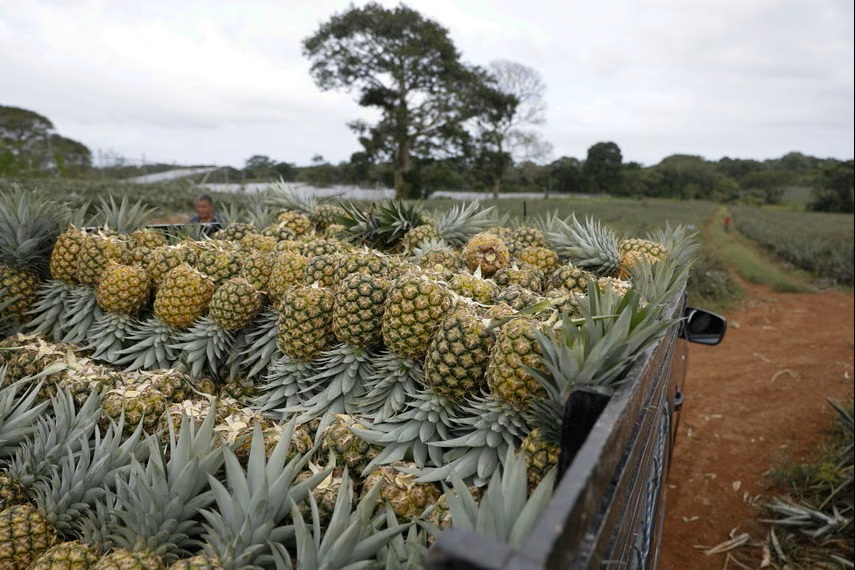
Pineapple Harvesting and Export.
Faced with the loss of up to 200 tons per hectare per year in deforested (“bare”) soils in that western area, Panama is implementing a package of measures with the help of Cuba and Spain to curb erosion, such as planting pineapples against the slope of the farm with the intention of supporting the land. This is a conservation agriculture technique proposed by a group of Cuban experts to Panama that consists of drawing the planting lines across the sloping hillsides, instead of following the slope.
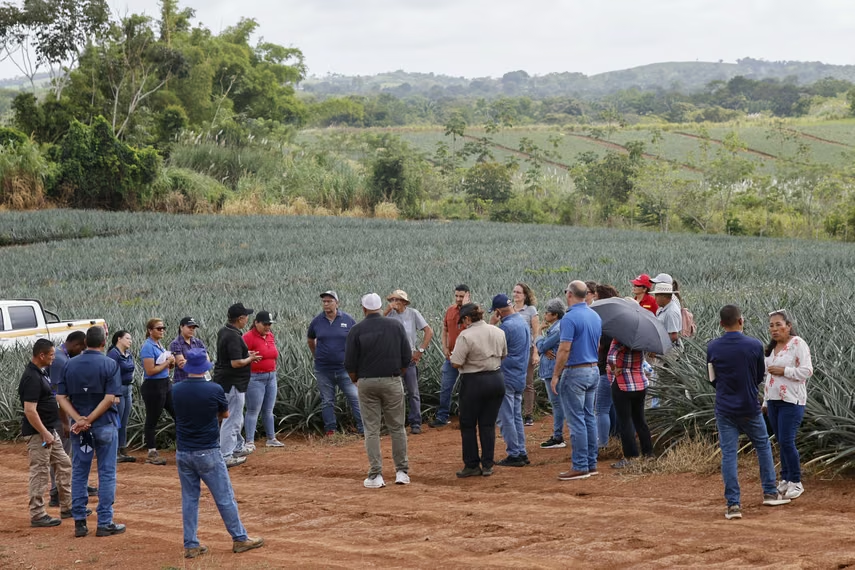
This aims to curb water erosion, since by arranging the rows of plants across the slope, the free flow of rainwater is interrupted, reducing the flow speed and preventing the washing away of the fertile surface layer and organic matter from the soil in that vulnerable area. “It degrades due to population pressure, deforestation, and loss of organic matter. Soil that is devoid of cover also loses organic matter, which is very important for giving it binding strength,” José Isaac Mejía, a researcher at the Institute of Agricultural Innovation of Panama (IDIAP), told reporters.
The Canal Watershed.
The Panama Canal watershed, with some 343,521 hectares, is a crucial environmental zone with numerous species of fauna and flora that supplies water to more than half of the country and sustains the operation of the waterway. In recent years, it has faced serious drought problems due to lack of rain, which has even led to a reduction in the number of daily ship transits at the worst times of crisis, in addition to severe soil degradation, especially in the western area used for agriculture and livestock.

One of the experimental farms in this area is that of producer Carlos Herrera near the community of La Zaguenza, within the Panama Canal watershed, with more than 60,000 pineapples planted for both local consumption and export. “These conservation projects are a resource that helps us because pineapple cultivation is a demanding crop in terms of soil. Nutrient depletion is often visible because it’s a crop that requires a large amount of nutrients to develop effectively. This helps prevent waterlogging because the soils in this region are clay,” his granddaughter, Gabriela Frías, told reporters.
Natural Barriers and Water Ponds.
Taking advantage of the slopes planted with pineapple, the leaves of the plant are also used to make organic fertilizer along with livestock waste to nourish the plots of land used for the next crop cycle, improving their cohesion. To curb degradation, “living barriers” of vetiver – a plant with deep roots to hold the soil – and intermediate ditches are also installed, in addition to implementing water reservoirs and establishing silvopastoral systems with protective wooded areas on their farms. All of this is done under the project ‘Strengthening R+P+P (Innovation+Promotion+Payment) capacities to restore degraded soils in the western region of the Panama Canal’ between the Soil Institute of Cuba, the University of Santiago de Compostela (Spain) and the Institute of Agricultural Innovation of Panama (IDIAP).

This project is coming to an end after being implemented in 2024 under the coordination of the Spanish Agency for International Development Cooperation (Aecid) to improve food security and food production, by mitigating soil degradation under a budget of about $110,000. “In this case, the offering country is Cuba, the receiving country is Panama, and a series of technical changes have been made to see how the productivity and fertility of the soil can be improved to have better harvests as well as a healthier relationship with the environment,” Itziar González, general coordinator of Spanish Cooperation in Panama, told reporters.