Panama and Europe: A Maritime Axis Takes Shape Around the Strait of Gibraltar
Amine LEHNA – President of Deep Blue, a university think tank at Université Paris 1 Panthéon-Sorbonne Specialist in maritime affairs.
In June 2026, port industry representatives from Spain, Panama and Colombia met in Algeciras to discuss supplying electricity to ships at berth. The subject sounds technical. It is also political: who will provide the energy and equipment that cleaner ships will need between the Americas and Europe? Panama’s Maritime Chamber was at the table.1 Months earlier, the European Union had identified Panama–Algeciras as one of its first pilot green shipping corridors in the region.2 The project is moving from announcement to feasibility studies and infrastructure decisions. It is not yet a decarbonized shipping route.
The maritime relationship between Panama and Europe has grown through trade, the Canal’s expansion and port networks. The green corridor now gives it a common objective. To understand its reach, one must also look across the Strait of Gibraltar. On the Moroccan shore, Tanger Med has links of its own with Panama and sits opposite Algeciras where rivalry and cooperation coexist.
A Relationship Older Than The Green Corridor
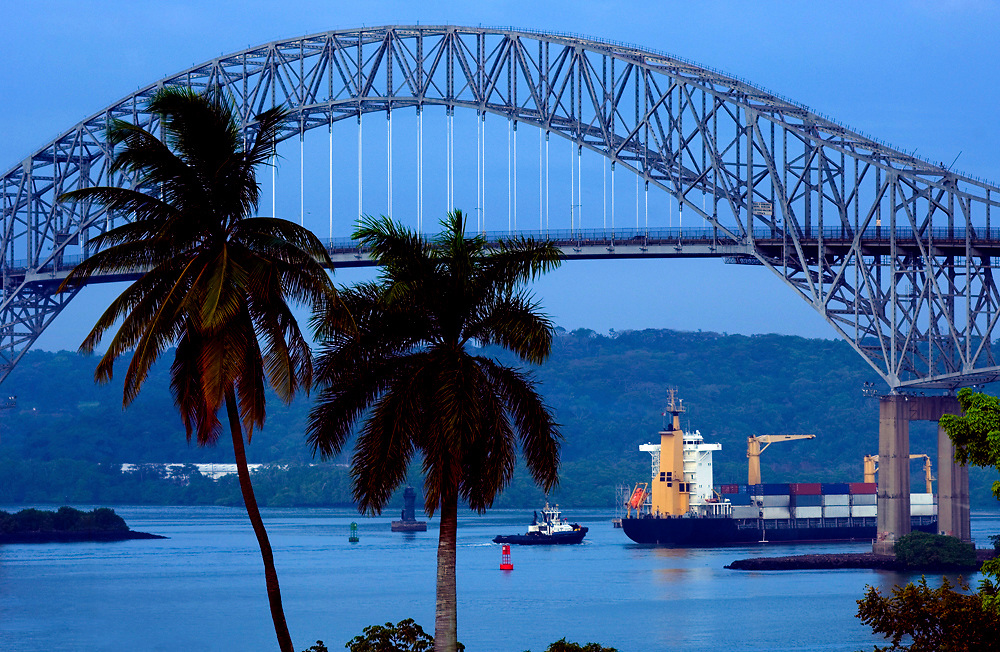
The Panama Canal’s value depends in part on the routes shipping lines choose. Its expansion, completed in 2016, opened it to larger vessels. In a study published in Maritime Policy & Management, Edwin van Hassel and his coauthors model the costs of selected cargo flows between the United States and Europe.3 Their results suggest that the expansion can affect the choice between ports in the Hamburg–Le Havre range and Mediterranean ports, although the modeled effect is stronger on the US side. Decisions made around the Canal can therefore reshape the geography of European port calls too.
Europe recognized that interest long before green corridors entered the vocabulary. The European Investment Bank provided a $500 million loan for the Canal expansion, noting that some of the cargo using the route originates in or is destined for the European Union.4 The trade pillar of the EU–Central America Association Agreement has applied to Panama since 2013.5 Neither the loan nor the agreement measures traffic on a specific Panama–Europe route. Together, however, they show a lasting economic relationship on which more focused port agreements can build.
The reliability of that route has become an urgent concern. Drought in 2023 and 2024 restricted Canal transits, while disruption at other strategic passages forced ships to change course. UNCTAD finds that these diversions increased distances, costs and emissions.6 For Panama, keeping the Canal attractive means offering a predictable crossing and coordinating effectively with ports at the other end of the journey.
Panama–Algeciras: From Agreement To Implementation
The Panama Canal Authority built ties with Algeciras well before the recent European initiative. The two authorities signed an initial agreement in 2010 to facilitate trade.7 In June 2025, they took another step. According to the Canal Authority’s sustainability report, their new memorandum calls for studying demand for low-carbon fuels, the facilities needed to store and supply them, and the digitalization of operations.8 A roadmap followed in September. Panama is setting out its own needs and priorities.
The Canal has also created the “NetZero Slot”: a weekly slot reserved for vessels capable of using specified lower-carbon fuels, with a guaranteed transit within 24 hours.9 At this initial stage, ships are not required to use those fuels during transit. The measure rewards a technical capability while supply catches up. It illustrates both Panama’s initiative and the gap between an incentive and a demonstrated reduction in emissions.
In October 2025, the European Commission brought Panama–Algeciras into its Global Gateway initiative.10 In January 2026, the EU delegation in Panama presented it as one of two regional pilot projects and announced support for a national maritime decarbonization strategy and an alternative-fuel hub.11 The project connects a European ambition to Panama’s decisions about its own maritime sector. It brings together authorities, ports, shipping lines and energy suppliers whose interests do not always align.
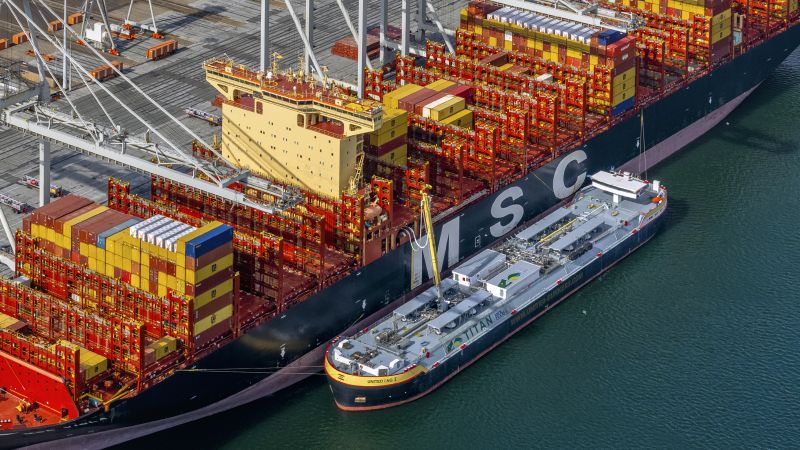
Implementation remains the real test. A green corridor needs suitable ships, fuels available at viable prices and facilities able to supply them safely. Its digital side is equally practical: sharing arrival times, planning port calls and cutting waiting times will improve coordination only if the systems actually communicate. The European project brief refers to feasibility studies, not to a green fleet already in service.12 The corridor should ultimately be judged by investments made, carriers committed and emissions reductions that can be verified.
Tanger Med: The Strait’s Other Dimension
Algeciras faces Tanger Med across the Strait on Morocco’s shore. The two ports compete for some container traffic while also handling vital exchanges between Africa and Europe. The Port Authority of the Bay of Algeciras itself acknowledges both sides of that relationship.13 Their cooperation, strengthened by a 2019 agreement, concerns the movement of goods and information between the two shores. The Strait is a shared space: each port defends its position, but neither can plan its connections without taking the other into account.
Tanger Med also has ties of its own with Panama. Its 2025 maritime connections guide lists services linking it with Balboa and Manzanillo in Panama.14 The Panama Canal Authority includes Tanger Med among its international partners.15 The Moroccan port is not a signatory to the Panama–Algeciras corridor. Its presence shows that a route towards Europe runs through a wider network of hubs, port calls and markets around Gibraltar.
The transition will be decided in day-to-day operations. Tanger Med exchanges port-call data with Rotterdam;16 in Algeciras, the June 2026 workshop examined shore power. These are distinct initiatives, but they point to what must be coordinated: schedules, equipment, energy supply and private investment.
The emerging Panama–Europe axis rests on established routes, connected ports and institutions learning to work together. Panama–Algeciras gives it a direction; Tanger Med shows how much wider the network is. For Panama, the question is what capabilities to develop at home so this cooperation creates value in its ports and contributes to genuinely cleaner shipping.
About The Author
Amine LEHNA is President of Deep Blue, a university think tank at Université Paris 1 Panthéon-Sorbonne. A specialist in maritime affairs, he writes on ocean governance, maritime strategy and the changing role of ports.
1. Panama Maritime Chamber, “CMP participa en workshop sobre corredores marítimos verdes en Algeciras,” June 11, 2026.
2. EU Delegation to Panama, “La Unión Europea impulsa la descarbonización del comercio marítimo desde Panamá,” January 27, 2026.
3. E. van Hassel et al., “The impact of the expanded Panama Canal on port range choice for cargo flows from the U.S. to Europe,” Maritime Policy & Management, 2020, DOI: 10.1080/03088839.2020.1718230.
4. European Investment Bank, “EIB helps to finance widening of Panama Canal,” 2008.
5. European Commission, “EU trade relations with Central America,” section on the agreement’s application from 2013.
6. UNCTAD, Review of Maritime Transport 2025.
7. Panama Canal Authority, “ACP y Autoridad Portuaria de la Bahía de Algeciras suscriben memorando de entendimiento,” 2010.
8. Panama Canal Authority, Sustainability Report 2025, “Green Maritime Corridors” section.
9. Panama Canal Authority, “Panama Canal Announces Implementation of the NetZero Slot,” 2025.
10. European Commission, “EU and partners accelerate maritime decarbonisation through Green Shipping Corridors,” October 10, 2025.
11. EU Delegation to Panama, “La Unión Europea impulsa la descarbonización del comercio marítimo desde Panamá,” January 27, 2026.
12. European Commission, Global Gateway Green Shipping Corridors, Global Gateway Forum infographic, 2025.
13. Port Authority of the Bay of Algeciras, Entre 2 mares y 2 continentes, section on Tanger Med and Algeciras.
14. Tanger Med Port Authority, Maritime Connections 2025, table of services with Panama.
15. Panama Canal Authority, “International Agreements,” list of institutional partners.
16. Tanger Med, “Co-leader of a global initiative for port data exchange,” June 16, 2025.