
The Uncertainty of Panama Families Affected by the Earthquake. ‘Where am I Going to Get Land if There Isn’t Any?’
This is how Mrs. Maria’s house looked after the earthquake.
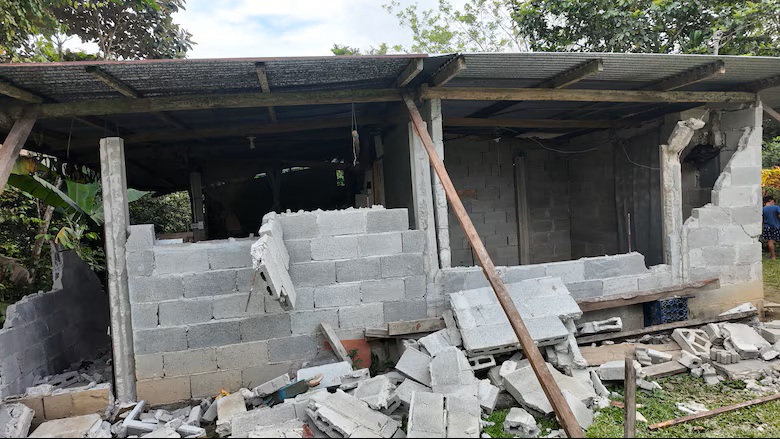
News reporters after the Earthquake have been travelling throughout Panama in recent days and have been reporting back. Here is one story. “To reach Lidia Gil’s house in Pozo Azul, north of Penonomé, I descended a steep hill into a valley surrounded by mountains. As I went down, I thought about the effort it must have taken to transport the building materials there. Now, after the earthquake, the family faces another challenge: finding land on which to rebuild their home. Lidia and her children had arrived home just five minutes before the earthquake began on October 9th. Her husband was at work. “What I did was grab my children and run away,” she said.
The House of Mr. Carlos Gordón in Pozo Azul After the Earthquake.
The house suffered serious damage. According to her, personnel from the National Civil Protection System (Sinaproc) and the Ministry of Housing and Territorial Planning (Miviot) told her that it was uninhabitable and that remaining there posed a risk. Since then, they have been staying at her mother’s house. During visits from the authorities, they suggested she find another plot of land to build on, but she hasn’t been able to find one. “They gave me the same answer, that I should look for national land, but where am I going to get national land if there isn’t any?” he questioned, recalling the guidance he received from the provincial authorities.
Eight days after the October 9 earthquake, families in Pozo Azul and Toabré, in Coclé, face the loss of their homes and the uncertainty of finding a place to rebuild their lives.
In Pozo Azul, some families are staying with relatives; others are reluctant to leave the land where they built their homes. The loss isn’t limited to the walls: they must also decide whether they can remain in the place where a significant part of their lives unfolded.
“Material things can be replaced, but the beautiful memories, the childhood of my babies that I have, are not easy to recover in another place. It’s not the same; I feel like I lost 23 years of being in my home.” says Maria Martinez Rivera, resident of Pozo Azul.
A House Built ‘Piece By Piece’.
Just a few meters away, María Martínez Rivera and her family face that same uncertainty. Twenty-three years ago, she and her husband began building their home. “Little by little my husband built the house, piece by piece,” she told reporters. Her sisters-in-law called her to warn her about the damage, but she did not imagine what she would find when she returned. “It was very painful to arrive home and see the structure like that,” she recalled. She is grateful that her husband and children were not inside when the earthquake struck. According to her account, Sinaproc personnel warned her that the land was unsafe for rebuilding and that she would have to find another location. For now, she is staying with her family at her father-in-law’s house.
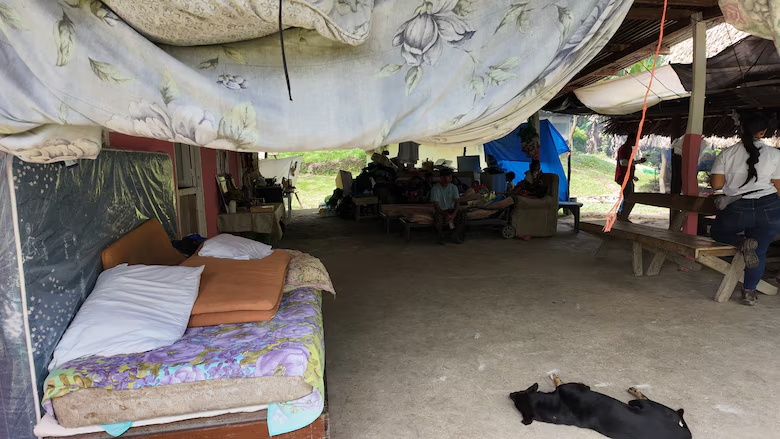
This house in Pozo Azul is home to 30 people, some of whom have chronic illnesses.
For Maria, getting the materials will not solve everything. Moving also means saying goodbye to the place where she watched her children grow up. The stories of these two women are part of the tally of nearly 3,000 homes with some type of damage reported by the government a week after the 7.5 magnitude earthquake. Authorities also reported that they had assessed some 6,800 families. Inspections are ongoing to determine which houses can be repaired, which require reconstruction, and which are unsafe.
Stay in Toabré.
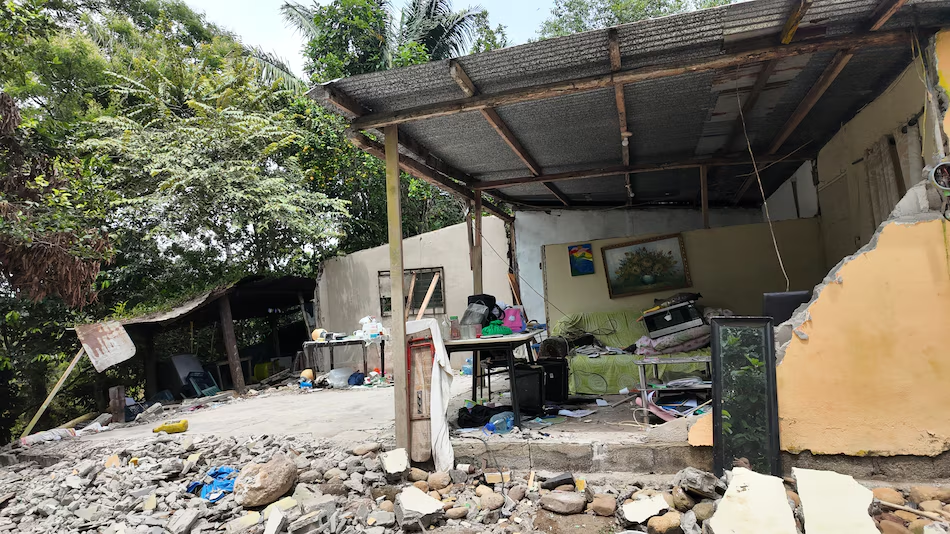
In Toabré, another area north of Penonomé, the house of María Olivia Elbeo González and Juan Antonio Morán had already been demolished when I arrived. It had been their home for 25 years; nine people lived there. Members of the community had helped remove the debris. Materials donated by neighbors, friends, and acquaintances for reconstruction remained on the site. The family said they received their first visit from Sinaproc a week after the earthquake. By then, the community’s solidarity had already become one of their primary sources of support. Maria Olivia’s children built a temporary roof for her to take shelter in. She wants to stay there, close to the animals she cares for. “I’m not going to leave here, where my children have already put up this little roof for me to take refuge in. I’m not going to leave because I have my animals and I’m not going to leave them alone,” she said.

Debris from a family’s house in Toabre, in the northern area of Penonomé.
María and Lidia need another plot of land to rebuild on. María Olivia is clinging to the one she has. For these families, regaining a home also means figuring out where they can continue their lives.