Former Officials in Limbo with and an Outstanding Debt and Seniority Bonuses Requested Amount to 182.2 Million Dollars.
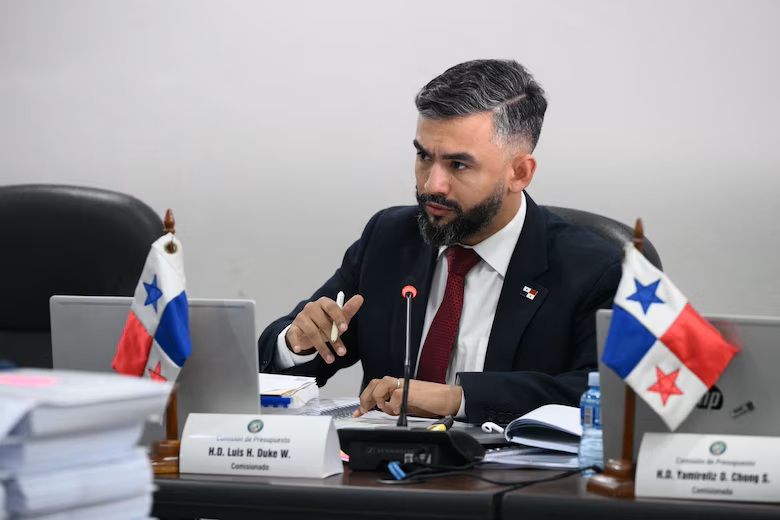
Pictured below is Luis Duke, Vamos party representative on the Budget Committee. The entities requested $182.2 million, but the MEF recommended $82.3 million for the payment of seniority bonuses in 2027. The total debt to the former officials has not yet been quantified.
The parade of entities through the Budget Committee of the National Assembly is revealing a debt that the State owes to thousands of its former employees: millions of dollars in seniority bonuses that remain unpaid. The figures appear scattered throughout the supporting documents of each institution, but together they paint a picture of a larger problem: people who left public service due to retirement, resignation, dismissal or other reasons and who, years later, are still waiting for the State to pay them an obligation that is theirs. At the Budget Committee, the Budget Director of the Ministry of Economy and Finance (MEF), Justo Botacio, put a figure to part of the debt: the 2027 budget proposal includes $48 million for seniority bonuses. But that amount does not represent the total amount the State owes.
Botacio acknowledged that the government does not yet have a complete inventory of outstanding obligations to former officials. Therefore, the Ministry of Economy and Finance (MEF) has requested an updated report from the relevant entities detailing the amounts owed and the number of people still awaiting payment. Botacio explained that one way to increase the resources allocated to this obligation is to use the savings generated by entities in their payrolls and transfer them to the payment of bonuses. As an example, he mentioned the Ministry of Economy and Finance itself, which plans to transfer approximately $3 million, the result of savings in its payroll. The official questioned why some institutions use those savings to create new positions and make appointments, instead of allocating them to former officials who are still waiting for payment.
Higher Amount.
In reality, the $48 million mentioned by Botacio is only a portion of the recommended amount to cover seniority bonuses. That figure corresponds to entities of the Central Government. Documents obtained by local media show that, when decentralized institutions, public companies, and financial intermediaries are included, the amount recommended by the Ministry of Economy and Finance (MEF) totals $82.3 million. Of that total, $25 million corresponds to decentralized institutions, $5.6 million to public companies, and $3.7 million to financial intermediaries. But the $82.3 million falls far short of what the state entities themselves requested to cover their obligations. Initial requests totaled $182.2 million, but the Ministry of Economy and Finance (MEF) recommended $82.3 million after applying a cut of $99.9 million. Although the $182.2 million requested for 2027 is a significant sum, it does not cover the total amount of the debt the State owes for seniority bonuses. The case of the Ministry of Security illustrates this: the institution requested $76 million to cover these obligations, but received an allocation of only $10 million. The difference will remain outstanding.
“Most institutions use those payroll savings to create new positions.” This said by Justo Botacio, Budget Director of the MEF.
Therefore, the MEF asked the entities to carry out an updated inventory —a kind of debt census— that would allow them to determine how much is actually owed and how many former officials are responsible for those payments.
The Analysis.
For Congressman Luis Duke of the Vamos party, the problem goes beyond the lack of a budget allocation. He maintains that the State must fulfill the economic rights of those who end their working lives in the public sector and questions why, for years, there has been no consolidated inventory of these obligations. In his view, the questions raised by members of parliament during the budget presentations led the Ministry of Economy and Finance (MEF) to request information from each institution regarding the amount owed and the number of former officials affected. “They haven’t had a complete picture of the problem in detail. They only see it at the level of each institution separately,” Duke said.
He also noted that some entities have begun to pay off debts that have been accumulating since 2011, but cautioned that the full extent of the obligation is still unknown. From the Otro Camino Movement, Representative José Pérez Barboni questioned the government’s continued debt for services already rendered while allocating funds to other expenses. He cited travel allowances, rent, and per diems as examples, and argued that priority should also be given to settling outstanding debts with former officials. “Many of them don’t live to see these commitments made to them by institutions fulfilled,” he stated. Pérez Barboni believes that the lack of a national census constitutes a failure in debt management and cited the Public Prosecutor’s Office as an example, which, he said, does keep track of the number of people it owes money to.

José Pérez Barboni above, representative for Moca.
Both deputies are part of the Budget Committee where this issue is being debated.
The Standard.
The seniority bonus in the public sector did not originate with the recent Supreme Court ruling. The benefit has a history spanning more than a decade and was initially recognized through Laws 39 and 127 of 2013, which established a benefit equivalent to one week’s salary for each year worked. The benefit has survived several legal changes and administrations. In 2014, just days before leaving office, Ricardo Martinelli’s government regulated, through Executive Decree 52, the payment of benefits to public servants. The decree was repealed shortly afterward by Juan Carlos Varela’s administration. In 2017, Law 23 again modified the system, but maintained the bonus as a right of public servants.
The next change occurred in 2021 with Law 241, which maintained the payment of one week’s salary for each year worked, but excluded officials in certain positions, including ministers, deputy ministers, and directors and deputy directors of autonomous and semi-autonomous entities. These restrictions reached the Supreme Court of Justice, which on July 21, 2026, declared nine of the ten sections establishing these exclusions unconstitutional. The Court considered that the restrictions violated the principle of equality and affected a right related to work. The ruling expanded the scope of the benefit again, but it did not create the debt the State now faces. For years, various institutions have accumulated millions of dollars in outstanding seniority bonuses owed to thousands of former employees. The problem now is determining the actual amount owed and how many people are entitled to them.
25
Millions that the Ministry of Education will pay in seniority bonuses in 2027.
10.7
Millions that the Ministry of Security will pay in seniority bonuses in 2027.
3.5
Millions that the Judicial Branch will pay in seniority bonuses in 2027.
2.5
Millions that the Ministry of the Presidency will pay in seniority bonuses in 2027.