This Day in Panama History: It Has Been 39 Years Since Black Friday
107 organizations that, at the time, comprised the National Civic Crusade called for a large “white” demonstration. The march never got off the ground; the people were ambushed by the riot police of the then-Defense Forces of Manuel Antonio Noriega pictured below.
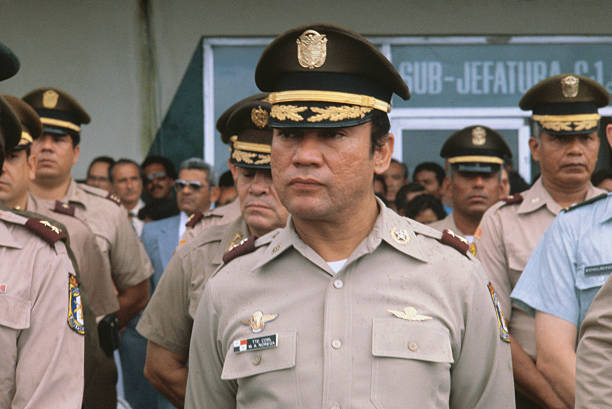
(Original Caption) Panama: Photo of Col. Manuel A. Noriega, the Panama National Guard Chief of Staff of Panama Intelligence.
Today, July 10, 2026, marks the 39th anniversary of El Viernes Negro (Black Friday) in Panama, the day in 1987 when Manuel Antonio Noriega’s dictatorship violently attacked peaceful civilian protesters. Thirty-nine years ago in Panama, Black Friday (“Viernes Negro”) referred not to a shopping holiday, but to one of the most violent days of the military dictatorship on July 10, 1987.
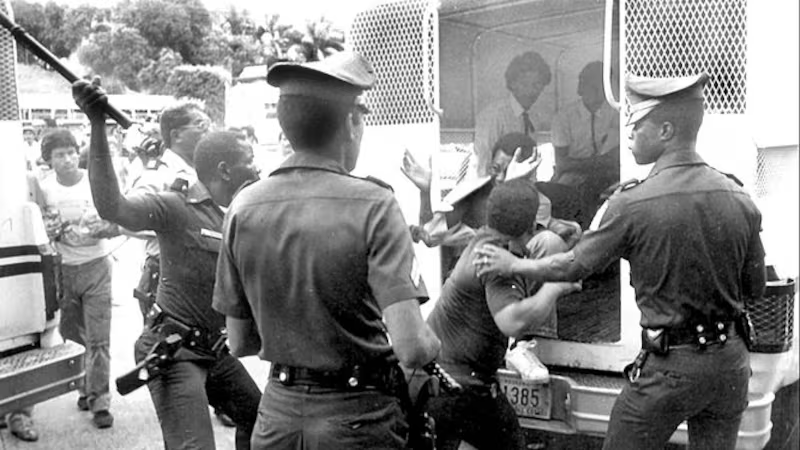
On that date, the Cruzada Civilista Nacional (National Civic Crusade) organized a massive, peaceful protest near the Iglesia del Carmen on Vía España in Panama City to demand democracy and an end to General Manuel Noriega’s regime. The government responded with overwhelming force. Armed units of the Fuerzas de Defensa (Defense Forces), widely known as the “Doberman” riot squad, along with regime loyalists, violently attacked the demonstrators. The crackdown resulted in:
- Over 600 individuals injured.
- Hundreds of arrests.
- Severe tear-gas exposure, beatings with batons, and property damage.
Rather than subduing the populace, the brutality of Viernes Negro galvanized the opposition. It became a major turning point in the Panamanian crisis, further isolating Noriega’s administration on the global stage until his eventual ouster during the U.S. invasion in December 1989. On July 10, 1987, the Cruzada Civilista Nacional (National Civic Crusade) called for a mass demonstration in Panama City, with citizens marching alongside Vía España holding white handkerchiefs and flags. The military regime responded with brutal force, deploying the “Dobermans,” a special heavily armed riot control unit.
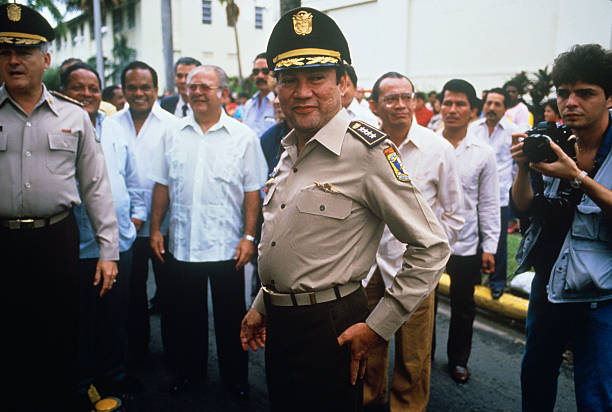
State forces fired on the crowds, used tear gas, and beat demonstrators indiscriminately. The crackdown left hundreds of people injured and approximately 600 arrested. Many of the detainees were taken to the Cárcel Modelo, where they suffered extreme abuse and human rights violations. However, instead of instilling fear and stopping the uprising, the brutality of Black Friday galvanized the Panamanian public. The protests escalated in the following years until the United States invaded Panama in December 1989 (Operation Just Cause) to overthrow Noriega.


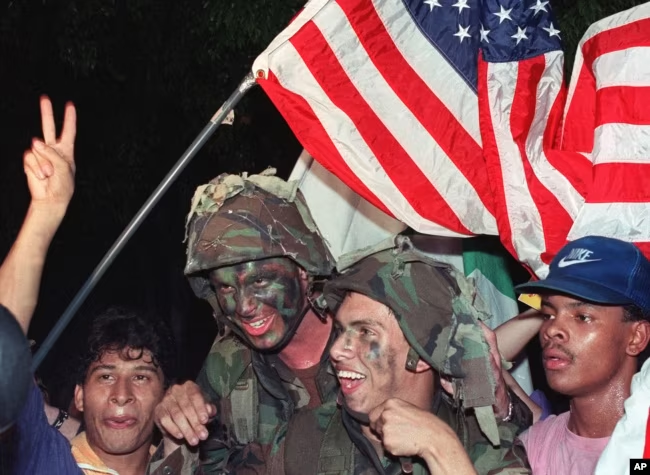
U.S. soldiers carry an American flag through the streets of Panama City as they celebrate with Panamanian citizens in Jan. 1990 following the surrender of Panamanian leader Manuel Noriega.
A story below from the year 2005 from a citizen who survived Black Friday in 1987 and lived to tell the tale. July 10th 2026 marks the thirty-ninth anniversary of “Black Friday.”
July 10th was the date on which the Noriega government, with its military and repressive apparatus, hand in hand with its political arm, the PRD, savagely and treacherously repressed the Panamanian people who were demanding justice, democracy, and freedom. I see that the media, with some very honorable exceptions, has ignored this memorable date. Perhaps it’s because some of them are playing a similar role today to the one they played during the military dictatorship, showing the pretty face of this government which, in collusion with the economic and ideological interests of the far right, intends to subject our people to a similar dictatorship, but in economic terms, disguised as a social one. The inevitable question is whether that sacrifice was worth it.
I leave that answer to you, who, like myself, made our share of sacrifices. That day I left my clinic, which was located in the El Cangrejo neighborhood, accompanied by my friends, Doctors Mario Chanis and Jorge Barriga. We headed to Vía Argentina in response to a call from the Civic Crusade. I was wearing my white sweater and a cap with the symbol of the 20-30 Active Club of Panama, as I served as its president, and the club itself was part of the Civic Crusade along with the other civic clubs. The repression began mid-afternoon after helicopters flew overhead, taking photos, dropping projectiles on the protesters, and after the presence of every informant we could identify infiltrated among the demonstrators (any resemblance to recent events is purely coincidental).
It all happened quickly, like a Nazi blitzkrieg. Suddenly, the police arrived, loaded with Dobermans, and we ran for cover. I tried to enter an apartment building where the Einstein Clinic was located, but found the door to the stairwell locked. I ran to the back of the building through the side alley when I felt the first burst of gunfire, which completely drenched me in pellets. The second burst lifted me up, knocked the wind out of me, and I fell to the pavement. The Doberman that shot me from about seven feet away presumably used a sawed-off shotgun; had he done it with a normal gun, I would not be telling you this story eighteen years later. I fell onto my side, covered in blood, and slowly lost consciousness; but suddenly images of my four children flashed into my mind, and I began to scream for help.
At that moment, I looked up and saw a blurry figure. It was a camera operator from a European news agency covering the events, and he said to me, “Friend, stay still, they’re coming for you… Don’t move, please…” After a while, once the first wave of barbarians had passed, some people who had taken refuge inside the clinic came out to help me. They carried me inside, leaving a trail of blood all the way. Inside, that unbearable pain began, which no injectable, oral, or topical painkillers could alleviate—nothing could. The sheer number of pellets in my body (more than 200) and the damage they caused were not enough; the sadists of the repression were also removing some of the pellets from their casings and refilling them with raw salt.
From my body, arms, and legs, the most superficial pellets were being torn away, along with shreds of skin and pieces of salt… There I remember the late Dr. Ricardo Angulo, my school friend, who helped so many people. I also remember René Gómez holding my hand to give me strength, and from my stretcher I would say to him: “René, this is unbearable, why me?…” They took me out of there around five in the afternoon, hidden in a car, after the late Archbishop McGrath intervened with the gendarmes to allow us passage to a hospital. Upon arriving at the emergency room for some tests, I learned that a platoon from the G-2 intelligence unit of the Defense Forces had arrived to take all the wounded, I suppose, to the Modelo Prison.
My tribute to the bravery of the doctors, nurses, and other staff at the San Fernando Clinic who stood firm and prevented these thugs from carrying out their orders. I spent a week confined and medicated. I remember my comrades from the 20-30 Active Club keeping a constant vigil around my bed to prevent them from taking me God knows where, as was the intention of the repressive apparatus. I remember my children crying around me (I saw them as if through a mist). The danger came from some pellets that lodged very close to my vertebrae, and since they were open wounds, if they became infected they could cause a problem in my spine. The shots were fired at close range.
After a week in the hospital, I left hidden in the truck of a friend, Edwin Fábrega Jr., since the G-2 (Chilean intelligence) had set up a permanent watch outside the hospital, waiting for those of us who left to take everything, as they put it. For quite some time, a car with tinted windows remained parked in front of my house. Of course, no one asked them who they were or if they needed anything.
From my point of view, I don’t believe my humble contribution to the democratization of the country was in vain, even though we inherited many ills from the dictatorship that weigh heavily; there is a lack of justice, there is hunger and extreme poverty that is growing exponentially, unfathomable differences between rich and poor, the practice of taking advantage of others at all levels as a national sport, the recurring disappointment caused by our politicians, the marked polarization between extremists in the political, social and even religious spheres, and even the fact that the Democratic Revolutionary Party only obtained political power through popular vote twice in “democracy”, thanks to the sacrifice of many, many people who, like me, were repressed by their military masters.
I see that the struggle in the streets has become cyclical when rulers forget the people who brought them to power and overwhelm them physically, morally, and in a thousand other ways. Eighteen years have passed, but the scars still hurt. Even more painful are the disappointments we face today after so much past suffering… I’m not sure if I’ll have the strength to endure another similar sacrifice, but I assure you I won’t turn the page.