France Insists that González Urrutia Have a ‘Central Role’ in the Venezuelan Transition
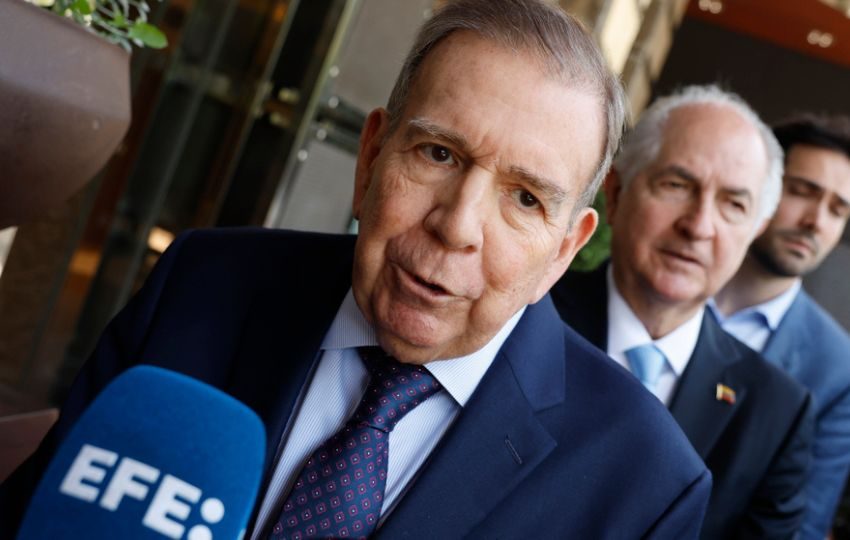
Venezuelan opposition leader Edmundo González Urrutia is pictured below.
French Foreign Minister Jean-Noël Barrot reiterated on Sunday President Emmanuel Macron’s position, expressed the previous day, that Edmundo González Urrutia, the candidate who ran in Venezuela’s controversial 2024 presidential elections, should have a “central role” in the political transition following Nicolás Maduro’s departure. Macron declared on Saturday France’s “ambition” for a “peaceful and democratic” transition in Venezuela, for which, according to Barrot in an interview on France 2 television, “the first step is the release of political prisoners, and the second is precisely a transition that takes into account that a year ago the Venezuelan people expressed themselves and elected a president of the Republic who must play a central role in this transition.”
In a message on his social media accounts in which he made no criticism or comment on the US military intervention that resulted yesterday in the capture of Maduro and his wife, Macron stressed that “the next transition must be peaceful, democratic, and respectful of the will of the Venezuelan people.” French Foreign Minister Jean-Noël Barrot reiterated on Sunday President Emmanuel Macron’s position, expressed the previous day, that Edmundo González Urrutia , the candidate who ran in Venezuela’s controversial 2024 presidential elections, should have a “central role” in the political transition following Nicolás Maduro’s departure.
Macron declared on Saturday France’s “ambition” for a “peaceful and democratic” transition in Venezuela, for which, according to Barrot in an interview on France 2 television, “the first step is the release of political prisoners, and the second is precisely a transition that takes into account that a year ago the Venezuelan people expressed themselves and elected a president of the Republic who must play a central role in this transition.” In a message on his social media accounts in which he made no criticism or comment on the US military intervention that resulted yesterday in the capture of Maduro and his wife, Macron stressed that “the next transition must be peaceful, democratic, and respectful of the will of the Venezuelan people.”
In this regard, he added that France hopes “that President Edmundo González Urrutia, elected in 2024, can ensure this transition as soon as possible.” In a subsequent message, after speaking with opposition leader María Corina Machado, the French president “fully” supported her call to release and protect “those imprisoned by the Nicolás Maduro regime.” Asked today about Macron’s lack of comment on the US military intervention, the French Foreign Minister maintained that “France’s position is, first and foremost, to affirm that Nicolás Maduro was an unscrupulous dictator who confiscated the freedom of Venezuelans and stole the elections from them.”
Therefore, Barrot emphasized that “his departure is good news for Venezuelans.” Secondly, he recalled that he himself had stated yesterday that “the method employed violated the principles of international law.” The minister clarified that the use of force is permitted under international law in some cases and cited as an example the attack carried out last night by France, together with the United Kingdom, against “Daesh terrorists” in Syria. He warned that, “without these rules, the world submits to the law of the strongest.” “If we consider that the sovereignty of states is not important enough to respect international law, we jeopardize global stability,” Barrot emphasized, urging the defense of the principles of international law because they are “the only ones that can guarantee long-term peace and stability.”
“France takes note of these increasingly frequent violations of the principles of international law, of respect for borders, of respect for the right of peoples to self-determination,” and “is preparing for a harsher, more brutalized world, so that it can defend itself, and condemnation alone is not enough,” he emphasized. Barrot stressed the need for France and Europe to strengthen themselves militarily and “economically to reduce the dependencies that currently place us in a position of servitude to other regions of the world” in order to defend themselves against “any threat we may face.” “And it is also a matter of rearming ourselves morally, of being prepared to resist this brutality that is taking hold,” he concluded. There are also consequences for Cuba.