
Canal Trivia (You May or May Not Know These Facts).
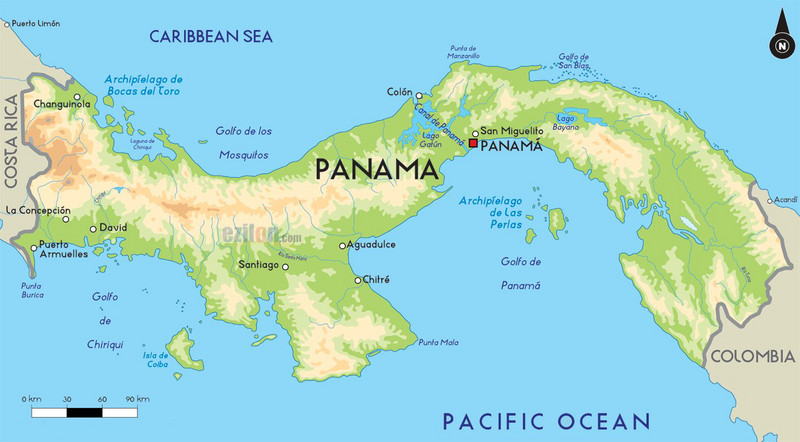
Most people have heard of the Panama Canal, whether or not you live in the country of Panama. However, you may not know all of these interesting facts associated with the canal.
The canal is an 82-kilometer (51-mile) artificial waterway connecting the Atlantic Ocean and the Pacific Ocean, cutting through the Isthmus of Panama to save ships thousands of miles of travel around South America. It is known as an engineering marvel.
The transit time takes an average of 8 to 10 hours for a ship to pass through.
Every large ship must have a specially trained Panama Canal pilot who takes command of the ship while the locomotive tractors assist.
It uses a series of water-filled locks (Gatún, Pedro Miguel, and Miraflores) that act as a “water staircase,” lifting vessels 26 meters (85 feet) up to Gatun Lake and then lowering them back down to sea level.
The system is entirely gravity-fed using fresh water from Gatun Lake fed by the Chagres River, with zero mechanical pumps. Specialized electric locomotive tractors run on tracks along the lock walls, using steel cables to keep large ships centered. Every ship that passes through the locks uses about 52 million gallons of water. Before being drained into the sea, a major portion of this same watershed water is treated and used for drinking water by millions of residents in Panama City, Colón, and surrounding areas
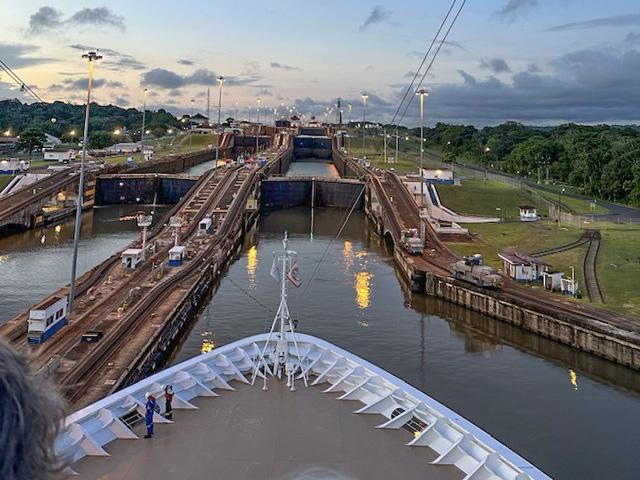
A third set of locks opened on June 26, 2016, allowing larger Neopanamax cargo vessels to transit. These locks use side-attached water-saving basins that capture and recycle about 60 percent of the water used during each lockage.
Over 25,000 workers died during the long construction history (spanning both French and American efforts), largely due to yellow fever and malaria before mosquito control measures took hold.
The canal actually runs north to south, not east to west due to Panama’s distinct geography.
The Panama Canal generates approximately $18 million per day in revenue.
While standard passages average around $150 thousand to $450 thousand, massive container ships can easily cost upwards of $1 million for a single transit, however, desperate shipping companies have paid $4 million to $5.3 million in a single auction just to jump the queue.
In 1928 Richard Halliburton swam the entire length of the canal and had to pay 36 cents as a fee. He was actually classified as the smallest ship, weighing in at 140 to 150 pounds with a length of 5 feet 10 inches. He was registered as a commercial vessel S S Richard Halliburton. It took him a total of 10 days to complete the adventure. To this day 36 cents is the lowest fee ever paid to traverse the canal.
The United States resumed construction in 1904 after helping Panama declare independence from Colombia, and controlled the Canal Zone for decades.
Under the 1977 Torrijos-Carter Treaties, control was gradually transferred until Panama assumed full ownership and management on December 31, 1999 and is operated by the Panama Canal Authority.
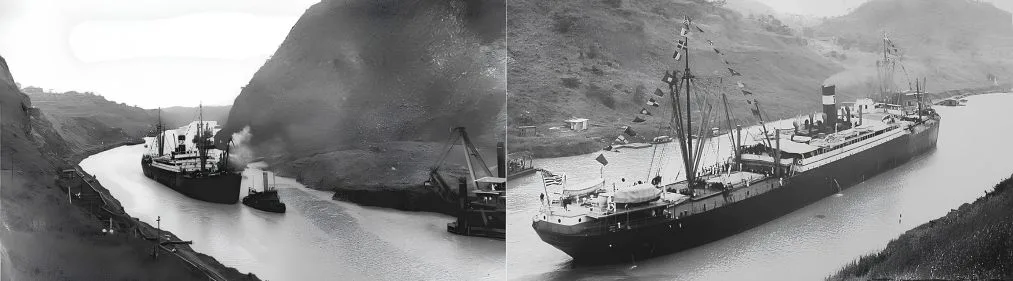
The first ship to pass through the canal was the SS Ancon, an American cargo and passenger ship on Aug 15, 1914. In 1919, the ship was commissioned to transport United States troops home from Europe after WW1.
Alongside the canal watershed thrives a rich ecosystem with birds, monkeys, reptiles, sloths, capybaras, and agoutis, to name some of the wildlife.