Panama’s First Lady in 2027 will have a Budget of $4.4 Million for Investments.
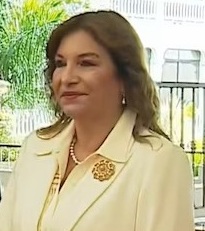
The Ministry of the Presidency will allocate $4,489,000 in 2027 to the office headed by the First Lady, Maricel Cohen de Mulino, according to the detailed budget that the Ministry of Economy and Finance (MEF) delivered to the National Assembly.
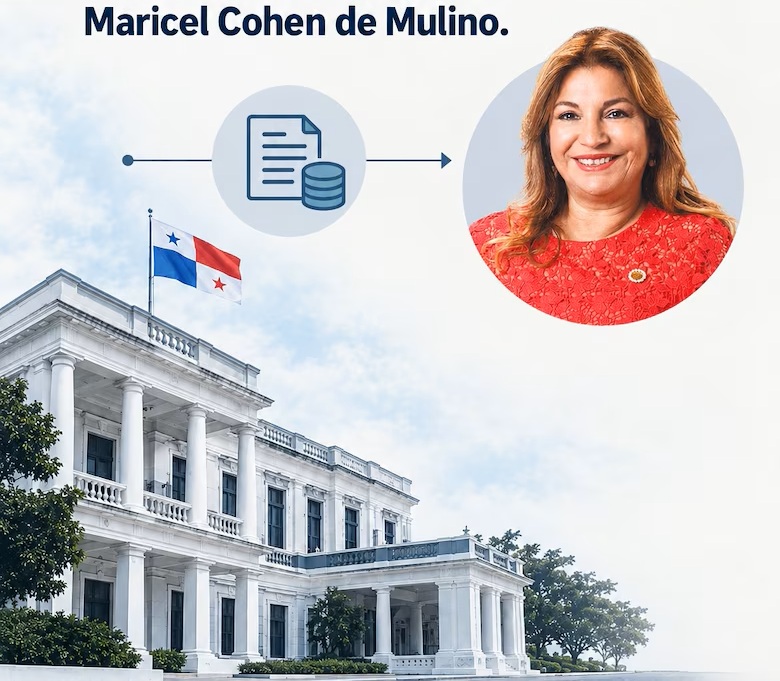
The Ministry of the Presidency will allocate $4,489,000 in 2027 to the office headed by the First Lady, Maricel Cohen de Mulino, according to the detailed budget that the Ministry of Economy and Finance (MEF) delivered to the National Assembly. The figure is equivalent to 34 times the investment budget of $131,050 that the MEF recommended to the National Authority for Transparency and Access to Information (Antai), the body in charge of monitoring the ethics of public servants and sanctioning nepotism and conflicts of interest in the State. By 2027, Antai reported a total budget, including operating expenses and investments, of $3,015,544.
This is How the Funds will be Distributed.
1
$159,400 will cover the Sonrisa de Mujer initiative, a free dental care program for women in vulnerable situations that the firm has maintained for more than a decade.
2
$2,184,600 will finance the rehabilitation of Omar Park and the conversion of the former Apostolic Nunciature into a Senior Citizens’ Home, a project that includes $480,000.
3
$2,145,000 will be allocated to social assistance.
The amount will also finance social assistance programs ($382,800), improvement of visual health ($200,000), the Love on Wheels Clinic ($338,600), support for the “Bio-community” ($895,100), a subsidy for social works ($308,500) and training of the “Light Brigade” volunteer ($20,000). Separately, in the operating budget of the Ministry of the Presidency, $1,873,307 is allocated for the operating expenses of the “Community Affairs Coordination”.
It is unknown whether that office corresponds to the First Lady’s office. If so, President José Raúl Mulino’s wife would have more than $6.3 million at her disposal next year. It is not new that the First Lady’s social services office is funded with public money. There is no public document that consolidates, year by year, the resources allocated and spent by these offices.
Therefore, the figures presented below correspond only to the amounts that news media has been able to document through previous publications and available budgets. The absence of a figure for a given year does not mean that resources were not allocated or spent, but rather that the corresponding amount is not available. In 2009, then-President Ricardo Martinelli formally allocated a budget of $2.5 million for 2010 to the office headed by his wife, Marta Linares de Martinelli. A similar or slightly larger amount was likely managed during the remainder of his presidential term, not including the cost of salaries for the staff who worked in that office.
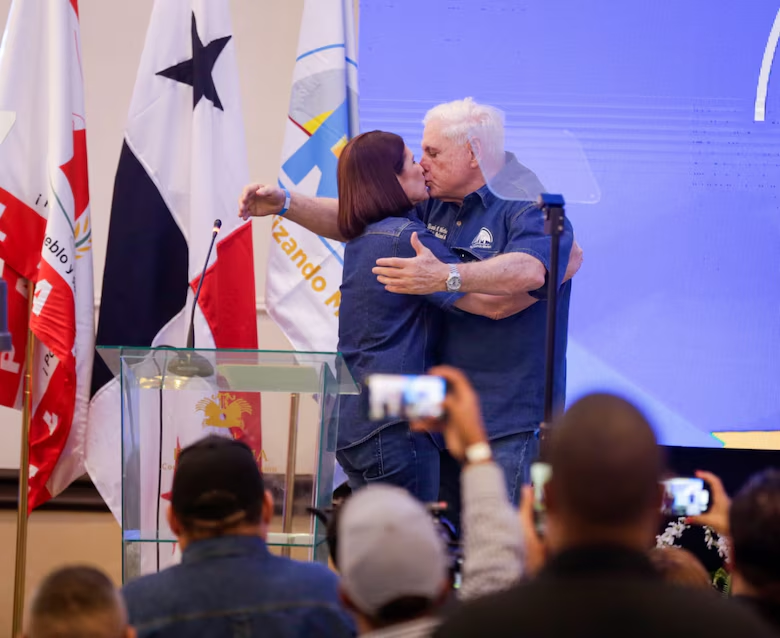
Marta Linares and Ricardo Martinelli show affection at the Realizando Metas board meeting.
Previously, Linares de Martinelli had criticized during the election campaign the handling of funds by her predecessor, Vivian Fernández de Torrijos, who managed at least $15.2 million during the five-year period in which her husband Martín Torrijos governed (2004-2009). Programs such as Sonrisa de Mujer and the maintenance of Parque Omar were already among the expenses of that time. The pattern repeats itself with every change of government. During the administration of Juan Carlos Varela (2014-2019), the office of the first lady Lorena Castillo received $3,255,501 in 2016, $2,372,410 in 2018 and $2,872,410 in 2019, her last full year in office.
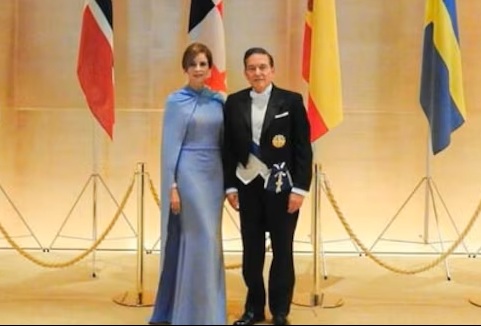
In the government of Laurentino Cortizo pictured above (2019-2024), his wife Yazmín Colón de Cortizo inherited an allowance almost identical to Castillo’s last one: $2,872,400 in 2020. The figure dropped to $2,699,485 in 2021 and $2,264,034 in 2022, before rising to $3,674,896 in 2023. In 2024, the year of the change of government, the allocation was $3,446,994.
The Legal Vacuum.
The role of First Lady, more than a public office, is usually assigned to the wife of the sitting president. This is not always the case: in the early years of Guillermo Endara’s government (1989-1994), the First Lady was his daughter Marcela, while during Mireya Moscoso’s (1999-2004) it was her sister Ruby. The Office of the First Lady does not exist as an autonomous entity under any law of the Republic. However, it operates through the Secretariat for the Coordination of Community Affairs, created by executive decree in 1983 and expanded in 1998, 2008, and 2010. In those decrees, the first lady is listed as coordinator, without holding a formal appointment as a public servant or having been elected to the position. This issue has generated questions among legal experts who have studied the figure over time.
In 1964, the First Lady, Cecilia Orillac de Chiari, wife of President Roberto F. Chari, was probably the first occupant of that position to be openly recognized in a nationally circulated newspaper for her active and outstanding work independent of her spouse’s management as the nation’s first leader. Ana Carolina Rodríguez in the investigation ‘On the office of the First Lady and its legal loopholes.’ “The legal problem lies in having a secretariat headed by someone who is neither an appointed official nor an elected authority. This person manages funds, appoints staff, and signs agreements that bind the State. Should the first lady be considered a public official for managing the budget and public works projects? Does the electoral law, which requires resigning from a public office to run for office, apply to her? Could a foreign first lady hold this position, considering that officials must be Panamanian?
What would happen if the president’s spouse decides to perform only a ceremonial role?” asks lawyer Ana Carolina Rodríguez, from the Foundation for the Development of Citizen Freedom, who also authored the research titled “On the Office of the First Lady and Its Legal Gaps.” Yazmín Colón de Cortizo herself, the first lady during the previous five-year period (2019-2024), summarized the limits of the position in an interview with news media. “The office cannot perform ministerial functions; it is not about assuming a portfolio of health, social development, or culture. But it can serve as a liaison and help people,” she noted.
The Role of Maricel Cohen.
Maricel Cohen de Mulino’s role in the current government is not limited to social causes. She also maintains a public profile on national and international issues. Proof of this lies in her accompanying her husband, the President of the Republic, to key meetings at the 81st United Nations General Assembly, held last week in New York.
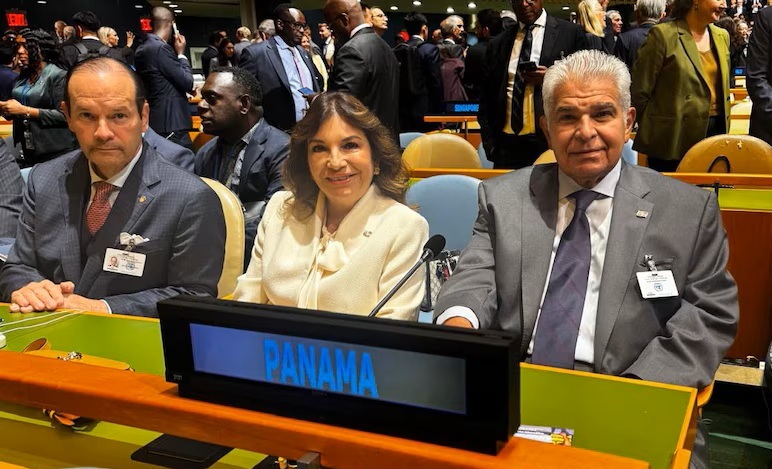
Last Friday, when the agenda with the United Nations ended, the presidential plane flew from New York to Guatemala to drop off the first lady, who had to participate in the Interregional Meeting of First Ladies and First Gentlemen, which took place in Antigua.
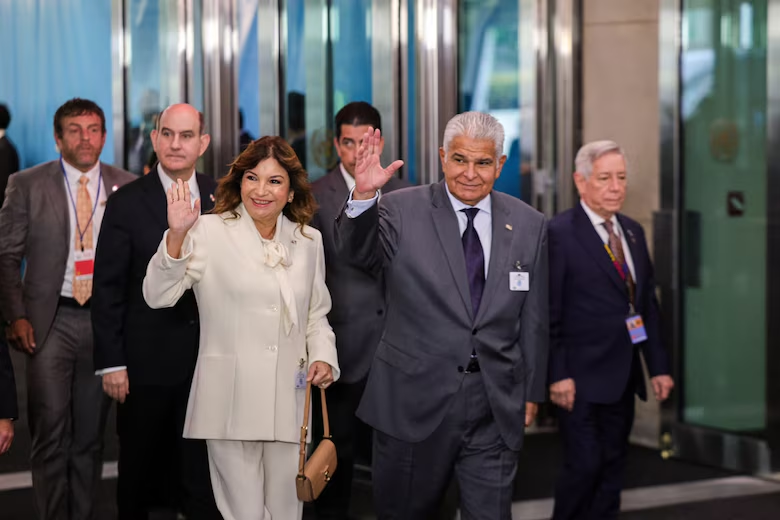
Maricel Cohen de Mulino, along with her husband, President José Raúl Mulino, and the Ministers of Economy, Felipe Chapman; of Canal Affairs, José R. Icaza; and the Ambassador to the United Nations,
Last March, Maricel Cohen de Mulino spoke about why she always accompanies the president. “If we are a couple, I think the right thing to do, and what I have always done with him, is to travel together,” she said. She added that previously, when the president practiced law privately, she often traveled with him. “I’ve accompanied him on many of his trips. It is normal for me, and for him too, that we travel together on any mission he has. This is part of being family,” she said. “At my house we travel together,” she said.
The Model in the United States.
The discussion about the size and nature of the president’s wife’s office is not unique to Panama, although few countries allocate investment budgets to them as is the case here. In the United States, the Office of the First Lady is funded with public money, but spending is primarily concentrated on personnel. The staff working with Melania Trump reported an annual cost of $634,200 in 2025 for five full-time assistants, according to data from the National Taxpayers Union Foundation.
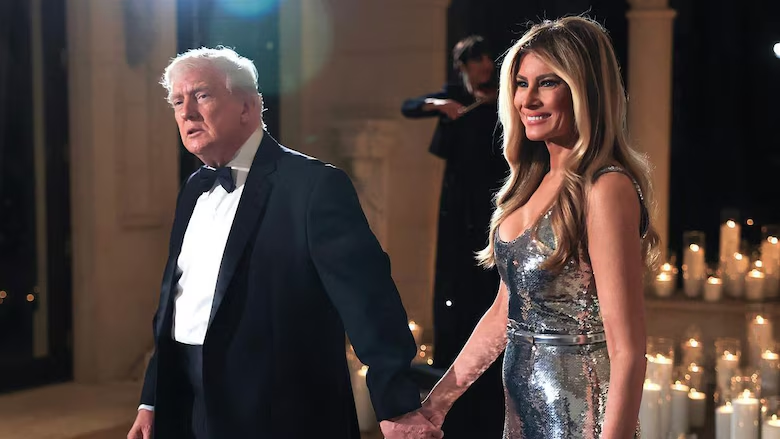
President Trump and his wife Melania Trump.
That money covers salaries, not programs or public works. The social programs that US first ladies—who do not receive a salary—typically promote are funded through private foundations, not with public funds. The Ministry of the Presidency, in accordance with the Budget Committee’s schedule of budget hearings, must present this Tuesday the figure it intends to work with in 2027.
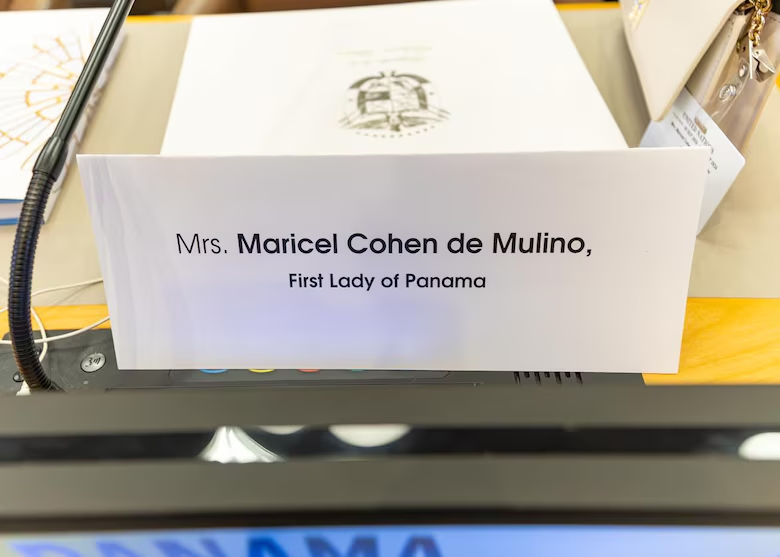
The Office of the First Lady does not exist as an autonomous entity under any law of the Republic. However, it operates through the Secretariat for the Coordination of Community Affairs.