Former Panama President Pérez Balladares: ‘We Don’t Have to Worry About Chinese Sanctions’
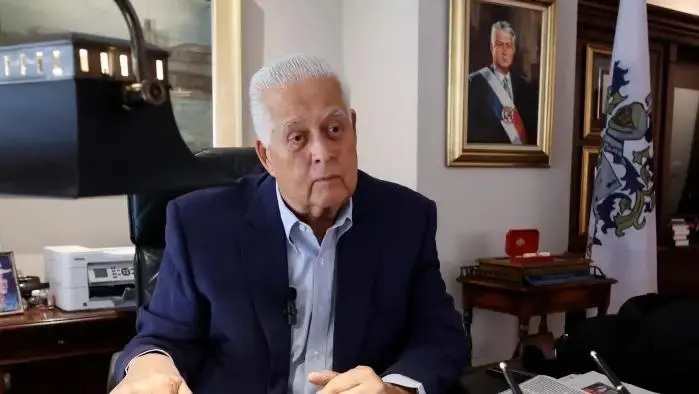
“What was done was to distort the original figure; the contract was completely changed,” he pointed out. Former President Pérez Balladares pictured below, commented that ‘they are absolutely right to try to support their company’, but that Panama must act in favor of its national interests. “What sanctions could they impose on us? Forbidden passage through the Canal?”
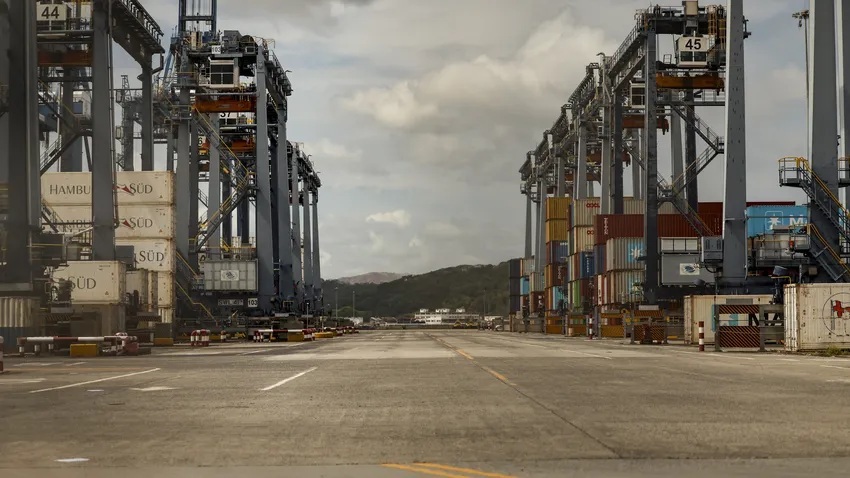
This was the response of former President Ernesto Pérez Balladares when questioned about possible reprisals from the Chinese government after Panama occupied the ports of Balboa and Cristóbal.
“We don’t think they’ll get to that point and we don’t have to worry about any sanctions,” he stated. Spokespeople for the Chinese government have stated that they will support Panama Ports Company, a subsidiary of Hong Kong-based CK Hutchison, in any legal action it takes against Panama. Former President Pérez Balladares commented that “they are absolutely right to try to support their company,” but that Panama must act in favor of its national interests. Balladares also acknowledged concerns about legal certainty and joked that perhaps in the future the Supreme Court should be the one to negotiate concession contracts. The original contract with Panama Ports was signed during the Balladares administration and was later modified during the Mireya Moscoso administration.
“What they did was distort the original agreement; they completely changed the contract,” he pointed out. “Since then, we’ve had a bad relationship with those people.” Balladares believes that the current situation is an opportunity to “start over and do things right.”
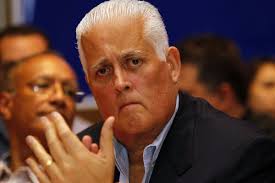
The former president of the Republic pictured above, spoke about how Panama should respond to Donald Trump and the story behind the privatization of the Cristobal and Balboa ports.
‘The Canal Either Belongs to Panama, or it Belongs to No One
It has been 26 years since Ernesto Pérez Balladares, better known as “El Toro,” held the presidency of the Republic. Decisions made during his administration, such as the privatization of the Balboa and Cristóbal ports, still have an impact on the nation. El Toro shared the story behind the arrival of Panama Ports and his vision of the challenges the country now faces.
How is the decision made to begin privatizing public companies in Panama?
This began during President Endara’s administration, as a result of the Washington Consensus, which meant that the banks that usually financed public companies received a mandate from Washington—the largest contributors to these banks, the World Bank and the Inter-American Development Bank—not to finance the expansion of state-owned enterprises, because the prevailing view at the time in the Washington government was that state-owned enterprises were somehow linked to nationalization and communism.
We inherited that mess, and there’s a commitment—not from the government, but from the Panamanian state—to privatize and sell off all state-owned companies outright. Seeing President Endara’s experience with the attempted sale of Intel, we devised a different model, which are now called public-private partnerships, and which at that time were called mixed enterprises.
Why is the concession granted for the ports of Cristobal and Balboa?
Those ports were always like an addendum to the Panama Canal. The American administrators of the Canal never gave them much importance or value. They were there for their own interests, which meant unloading equipment, unloading troops, whatever, but not as a commercial interest. Then, when the reversion of the Canal began to be implemented, they simply abandoned the ports, in the sense that they never maintained them again, nor invested in them. We received them in terrible condition; they were dangerous. So we decided to see how we could find an administrator who would be interested in rebuilding and managing the ports and the railroad, which was also abandoned.
We issued an international invitation, and two or three firms participated, including, I believe, two Japanese companies, and Hutchison of Hong Kong, which at the time was the largest port operator in the world. I traveled to Asia promoting investment in Panama, and on the way back we stopped in California. Foreign Minister Gabriel Lewis Galindo told me he had received a call from the CEO of Bechtel, and that this gentleman was asking for an opportunity to make us an offer. We were just a couple of weeks away from opening the envelopes from the other bidders. I called Hugo Torrijos and told him, “Look, I want to hear this offer.” We met with them; the head of Bechtel was there, and he told us that in a month they would give us a proposal we couldn’t refuse.
We waited a month, and the proposal was outrageous. They offered us one million dollars a year. We proceeded with opening the bids for the international tender, and the Hong Kong Company Hutchinson won with a fixed offer of 22 million dollars, reviewable every five years, plus 10% of gross revenue. In addition, the Panamanian government retained 10% of the companies’ profits. That worked. They started investing, they put in a lot of money, and we have to acknowledge that we have modern, competitive ports. The problem began when we also granted concessions for the construction of ports on the Atlantic coast. It’s one thing to receive a port in poor condition but functioning, and quite another to start from scratch.
The conditions of those ports that we granted concessions to other companies were different from those of Hutchinson’s concession. The resolution issued by President Moscoso’s government, signed by the Minister of Commerce, changed the terms of the contract. This was clearly illegal, because you can’t modify a binding contract with a resolution. It equated Hutchinson’s concession with that of the new ports. They eliminated the contributions they were required to make and created new ones. They also stipulated that the profits would be shared. That’s why this Hutchinson agency started creating satellite companies, for example, one for container handling, to bleed the main company dry, so that at the end of the fiscal year there would be very little profit left. That’s the reality. Martín Torrijos, during his administration, tried to rectify this.
He tried to overturn President Moscoso’s decree and return to the original law. But it was never published anywhere, it was never done. I don’t know why, but you can imagine. So the reform that was made remained in effect. And then, in my opinion, the worst thing that has happened with this whole issue is the renewal of the contract. That contract renewal was the perfect moment to tell them, you haven’t left a good impression on us, we’re not interested in renewing your contract, but we’re going to sit down and talk. And we must always have up our sleeve what we also need today, which is to return the ports to the Canal Authority, so they remain 100% state-owned, because we no longer have that problem. And on top of that, we get rid of the pressure from Agent Orange (Donald Trump), the pressure of having the Chinese.
Was there any interest in having it in the hands of a non-American company?
No, no, on the contrary. We weren’t concerned with who owned it, as long as it represented the best contribution from the State. The criterion was simply the best contribution from the State and the investment capacity to recover the ports.
What do you think of Hutchison’s intention to sell to BlackRock and TIL?
I understand it’s due to two things. First, to pressure from Mr. Trump. Pressure he must have put, I suppose, on the majority owners of Hutchison’s holding company. But look, BlackRock is among Hutchinson’s shareholders. The very same company that wants to buy it. What would be bought is the contract. That is, the concession contract would be transferred for a price X, which we don’t know. Because the mistake is made daily of saying we’re selling the ports. No, the ports aren’t for sale.
The ports belong to the Panamanian State. It’s a commercial transaction between two companies where one sells a concession to the other. Clearly, the Panamanian State has a stake in this. Because the original contract, the one we signed, clearly states that if there is a transfer, sale, or alienation of the contract, it must first be approved by the Cabinet Council. So that’s still pending. Now I see the Chinese government saying that this needs to be investigated. So, there are clearly conflicting interests, and unfortunately, we’re caught in the middle with a very poorly managed port from which we don’t receive the benefits we should.
That’s why I believe that if the audit proves what I think it will, it’s time to tell him, “Sir, your contract and your concession are terminated due to breach of contract.” If you want to sue him in court, let’s go to court. And proceed to give the administration of the Cristóbal and Balboa ports to the Panama Canal Authority. They, as the authority, can manage them. They can also, as the authority, seek an administrator.
What is your opinion of the strategy and actions taken by President Mulino’s current administration regarding President Trump’s threats and the tensions between the United States and China?
If there are strategies, they are very well kept secret. I am not aware of them and I cannot comment on what I don’t know. I can only comment on what I believe we should be doing. I believe that, first and foremost, we should have an internal campaign to disseminate the truth and what the Panama Canal means to us. Not only from the point of view of sovereignty, but also from an economic point of view. Because we are going to have the same negative perception that existed with the mine. We are paying for the mistake. Look, our growth has dropped from 10%-8% to 2.9%.
So I believe that the first thing I would do is launch an internal awareness campaign. And secondly, an international campaign. I convened a universal Canal congress where we presented everything we were doing and demonstrated our perfect capacity to manage it. As we have indeed shown. I told the president that it might be a good idea for him to convene a second congress now, taking advantage of this juncture of Panama’s 25th anniversary of administration. This second congress would clearly aim to seek the support of the international community for the Panamanian administration and Panamanian ownership of the Panama Canal.
How do you negotiate with someone like Trump?
Well, you have to confront him internationally as well. And I would tell him one thing: the Panama Canal belongs to Panama, or it belongs to no one. That needs to be made very clear to him.
What do you think the country’s priorities should be right now?
First, we have to resolve this issue of American aggression. I believe that issue is a priority for the entire country. Then, we need to focus on job creation by seeking investment and on a better redistribution of income. I think that as long as we don’t address what we’re suffering from—the poor quality of public and private education—the country won’t progress. So, we have to find a way to reinvent the education system, to reinvest in it. It’s not about computers; it’s about what you teach, what you instill in children’s minds. They have to compete with the best from all over the world because this world is globalized and integrated.
Do you have any political aspirations?
No, no, what the heck. I’m very content with my life.
Profile
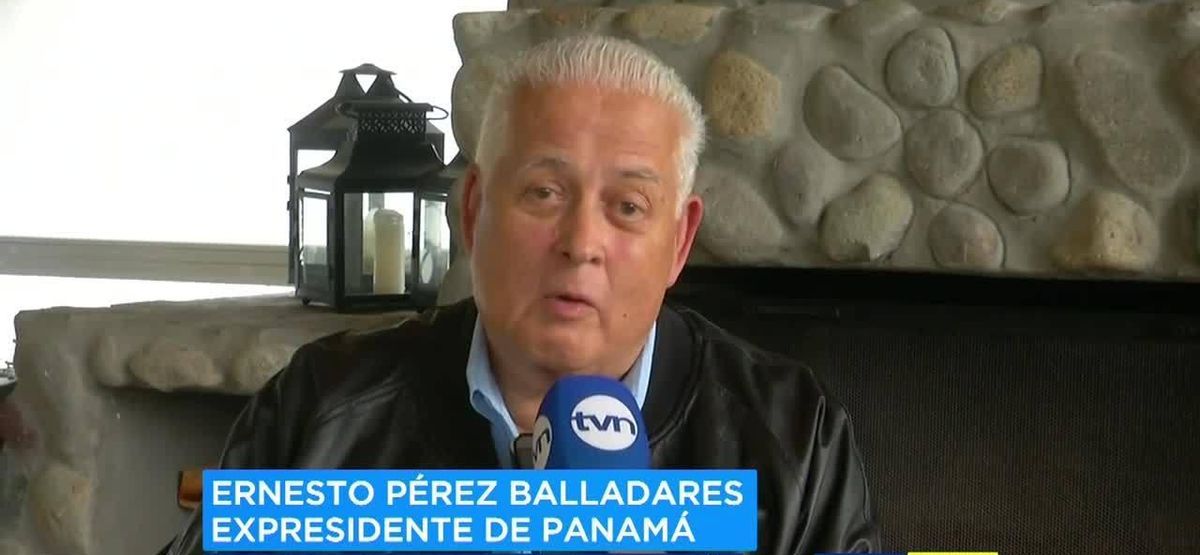
Ernesto Pérez Balladares has been a key political figure in the Democratic Revolutionary Party (PRD) and in the Dominican Republic. He holds a degree in Economics and Finance from the University of Notre Dame and the University of Pennsylvania. He served as Director of Citibank’s Official Credit Corporation for Central America from 1971 to 1975. He was Minister of Finance and Treasury during the regime of Omar Torrijos Herrera. He was a founding member of the PRD in 1979. He served as Director of the Institute of Hydraulic Resources and Electrification (IRHE) in 1983. He was President of the Dominican Republic from 1994 to 1999.