Government Begins Transition at the Ports of Balboa and Cristóbal: APM Terminal and Mediterranean Shipping Company’s TiL will Operate Temporarily
The announcement was made during a press conference, where authorities explained that the measure seeks to ensure an orderly transition following the recent Supreme Court ruling that declared the contract between Panama Ports Company and the State unconstitutional.
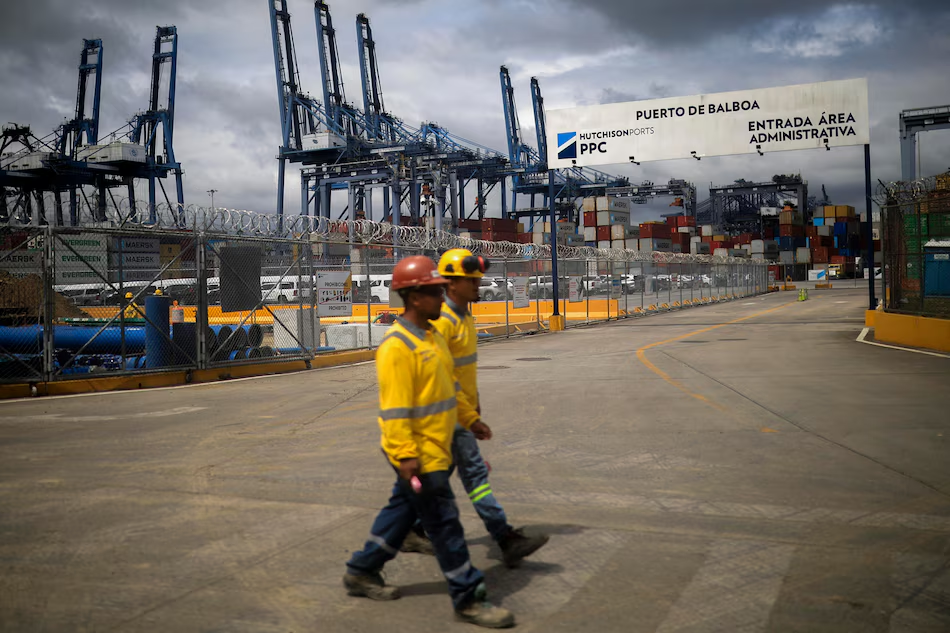
Panama City, Panama: The Board of Directors of the Panama Maritime Authority (AMP) could approve a transitional operating plan for up to 18 months for the port terminals of Balboa and Cristóbal, as part of the state strategy to guarantee the continuity of service, while a new long-term concession model is defined. The announcement was made during a press conference, where the government’s technical team, headed by the Ports Transition Coordinator, Alberto Alemán Zubieta, said that the measure seeks to ensure an orderly transition following the recent Supreme Court ruling that declared the contract between Panama Ports Company and the State unconstitutional.
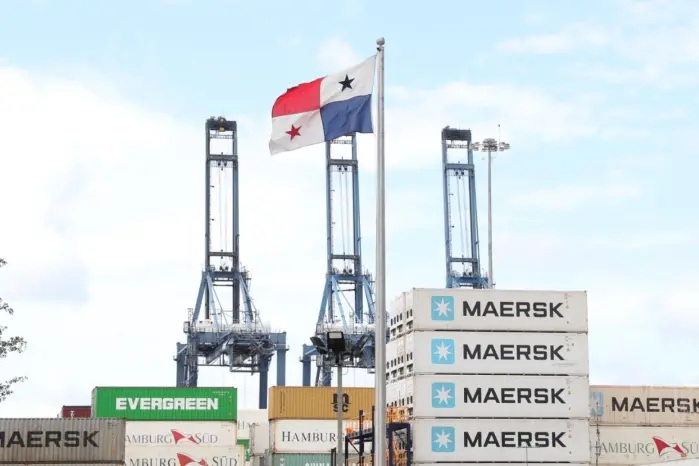
Alberto Alemán Zubieta reported that the AMP took possession of the ports through an executive decree of temporary occupation, a legal mechanism intended to guarantee the continuity of service. According to the information presented at the conference, APM Terminals, a subsidiary of AP Moller-Maersk, will temporarily operate the Port of Balboa on the Pacific coast, while Terminal Investment Limited (TiL), the operating and investment arm of Mediterranean Shipping Company, will operate the Port of Cristóbal on the Atlantic coast. Authorities described them as world-class operators whose participation would allow the Panamanian port system to maintain its efficiency during the 18-month transition period.
“At this time, it has been decided and is being presented to the AMP Board of Directors that two contracts will be awarded: one for the port of Balboa and one for the port of Cristóbal, instead of a single contract for both ports. We have sought out operators who handle the cargo. In the case of the Pacific port, it will be APM Terminals. This is to guarantee port stability for these 18 months,” said Zubieta.
TiL, based in Geneva, Switzerland, is one of the world’s largest port operators and manages more than 40 terminals on five continents; while APM Terminals, based in The Hague, Netherlands, has more than 60 container terminals located in ports around the world.
Two Separate Contracts
For his part, the national director of Ports, Max Flores, confirmed that the roadmap includes the temporary hiring of operators while the process to select definitive concessionaires is carried out. Authorities explained that, unlike the previous scheme, two separate contracts will be submitted:
- One for the Port of Balboa (Pacific).
- Another one for the Port of Cristóbal (Atlantic).
As explained, the goal is to improve management and enable differentiated operating models. Authorities indicated they have held talks with large-scale international operators to ensure stability during the transition period.
Possible Arbitrations
In response to inquiries from Newsroom Panama, Alemán Zubieta indicated that the companies involved could resort to international arbitration. However, the State asserted that it will defend itself with specialized law firms, as it has done in previous cases.
“We recognize that this is a state governed by the rule of law, that companies have the right to initiate arbitration proceedings, as they have already done, and that the Panamanian state will have the right to defend itself. For this purpose, we will also hire the best international law firms to defend Panama, as we have done in the past in various arbitrations that Panama has faced,” explained the former administrator of the Panama Canal.
It was also indicated that the occupation decree allows the use of port equipment to guarantee operational continuity, although economic agreements must subsequently be reached with the owning company.
“The occupation decree is to guarantee that this equipment can be used by Panama to continue the operation of the port, and the port operators that we are bringing in from the first world and of the highest quality also know how to operate this equipment, and it is the Panamanians who operate it here; these Panamanian workers are the ones who will continue operating this equipment and, obviously, it must be acknowledged that in due course these teams will have to reach agreements with the company to resolve the economic aspect of this ,” said engineer Zubieta.
Towards a New Port Model
During this period, the government will define the model Panama will adopt in a future international tender for long-term concessions. Alemán Zubieta indicated that the country is evaluating structures different from the current ones, in order to strengthen competitiveness and logistical connectivity.

For her part, Labor Minister Jackeline Muñoz pictured above, reiterated that there will be no layoffs and that the employer substitution process will be implemented gradually as temporary operators take over. According to authorities, more than 1,200 direct employees and approximately 3,000 employees linked to suppliers will retain their jobs during the transition.