For the First Time in 40 Years, Panama’s Deep Waters Did Not Rise and the Ocean System May Be Collapsing
A vital ocean current in the tropics suddenly stopped for the first time in decades, leaving scientists stunned. What unfolded off the coast of Panama in early 2025 could signal something far more disruptive than anyone anticipated. A familiar rhythm in the eastern tropical Pacific has gone suddenly quiet. Along the Pacific coast of Panama, a seasonal upwelling that has reliably sustained fisheries and cooled coral reefs for decades failed to occur in 2025. For marine ecosystems and coastal communities in the region, the silence is more than symbolic.
It marks a rare disruption in a system long considered stable. Each year, cold, nutrient-rich waters typically rise to the surface between January and April, fuelling productivity across the food chain. This time, the water stayed warm. The nutrients never arrived. The consequences are only starting to emerge. Research teams were already in the region when the disruption occurred, allowing them to document the event in near real time. The findings raise questions not just about local dynamics, but about broader changes in tropical ocean systems that have remained under-monitored and poorly understood.
Long-Standing Pattern Breaks for the First Time
For over 40 years, seasonal upwelling in the Gulf of Panama has followed a consistent pattern. Between the end of the calendar year and early spring, trade winds from the north push surface waters offshore, drawing cooler, deeper water upward. The process delivers nutrients that stimulate phytoplankton growth, forming the foundation of the marine food web.
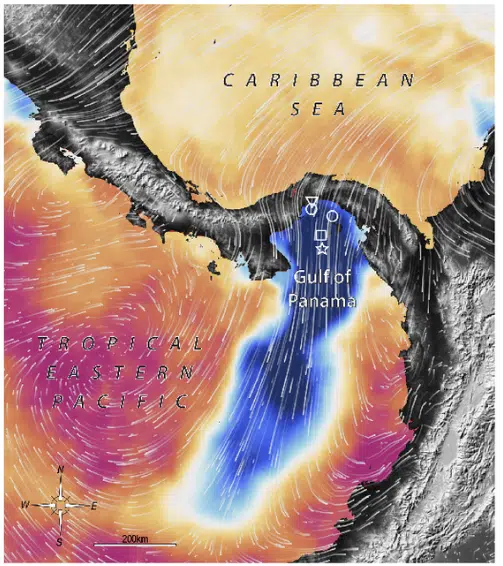
Typical wind vectors and SST through the topographic low in the Isthmus of Panama showing reduced sea surface temperatures in the Gulf (Feb 4, 2019).
In early 2025, that system failed. No cold water rose to the surface. No spike in surface chlorophyll was recorded. Ocean surface temperatures remained elevated through the season. According to data collected by scientists aboard the S/Y Eugen Seibold, a research vessel jointly operated by the Smithsonian Tropical Research Institute and the Max Planck Institute, the vertical movement of water that characterizes the upwelling was entirely absent. The study documenting the event, published in Proceedings of the National Academy of Sciences, confirms it as the first complete suppression of the upwelling in the observational record. Researchers noted that this shift eliminated a key stabilizing mechanism in the region’s marine ecosystem and exposed vulnerabilities in the broader ocean-climate system.
Winds Weaken, With Cascading Effects
At the center of the disruption was a collapse in atmospheric drivers. The northern trade winds, normally responsible for triggering the upwelling process, were significantly weaker in early 2025. As a result, surface waters remained in place, and the temperature differential needed to initiate vertical mixing did not materialize. The absence of cooler waters had immediate ecological effects. Without an influx of nutrients, phytoplankton production declined sharply. Satellite observations confirmed reduced chlorophyll-a concentrations throughout the Gulf of Panama during the period when biological productivity typically peaks.
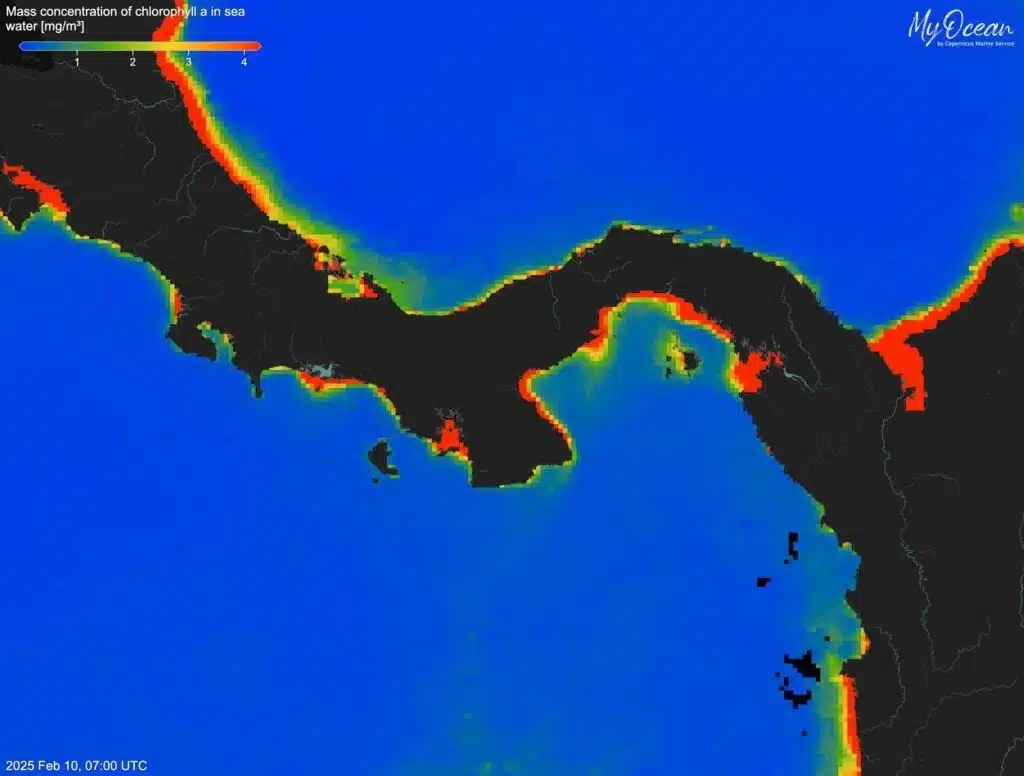
Very low chlorophyll levels around Panama in February 2025, indicating the absence of upwelling for the first time in 40 years.
This reduction affected key fish species, including sardines, mackerel, and squid, which support both artisanal and commercial fisheries. Although full economic impacts are still being assessed, preliminary data point to declining catch volumes in multiple coastal communities. Coral reefs in the region also faced increased thermal stress. Without the usual cooling influence of upwelling, conditions favored coral bleaching, which researchers note may become more frequent under warming scenarios, as highlighted in STRI’s official announcement. A visual analysis shared by the research team showed marked differences in ocean productivity compared to previous years. The imagery, based on chlorophyll concentrations, illustrated how the biological engine that normally activates during the dry season never switched on.
Sparse Monitoring Leaves Gaps in Visibility
One of the study’s most significant implications lies not in what was observed, but in how close it came to being missed. According to the research team, the event may have gone undocumented without their scheduled expedition. Tropical marine systems, despite their ecological and economic importance, remain underrepresented in global monitoring efforts. Unlike the Humboldt and California Current systems, which are tracked by long-standing observation networks, tropical regions like Panama rely heavily on intermittent field campaigns. The researchers argue that this imbalance leaves major blind spots in the global understanding of ocean variability.
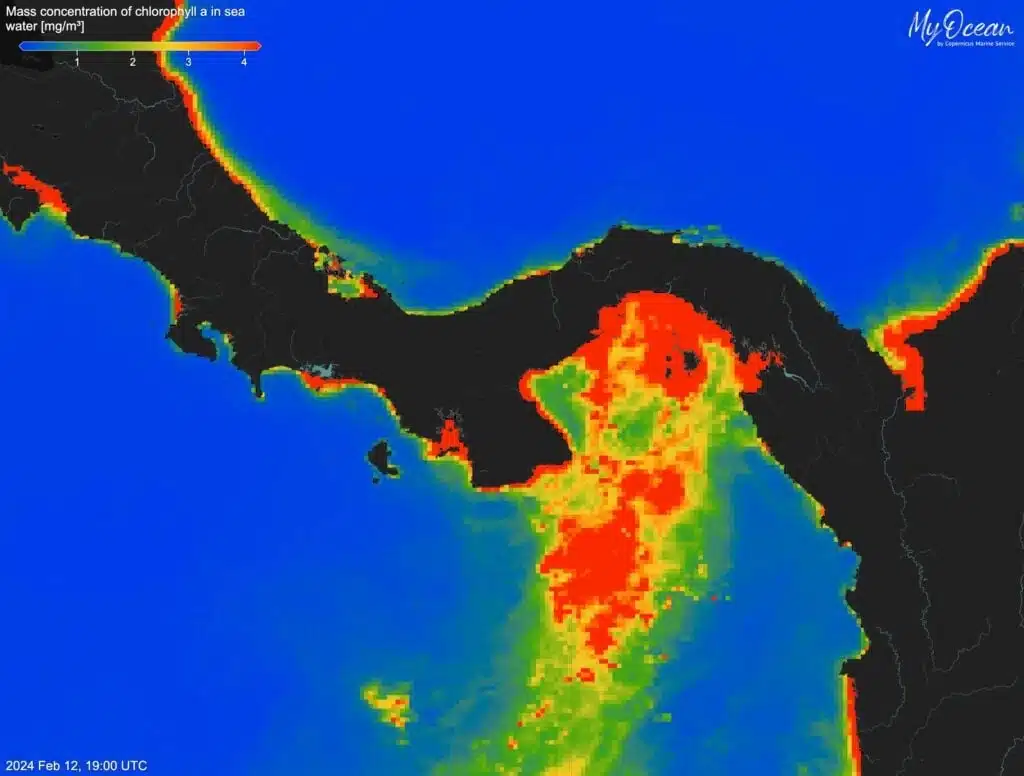
Chlorophyll-concentrations-in-the-oceans-around-Panama.
“If we hadn’t been there with a ship at the right time,” said co-author Hanno A. Slagter, “the whole event might have slipped under the radar.” That statement included in the full research release, points to an ongoing need for better data infrastructure in the tropics. The incident has been described by the Smithsonian Institute as a case highlighting the climate vulnerability of tropical ocean systems, where even relatively small atmospheric shifts can result in substantial ecological impacts.
Early Signals or Isolated Anomaly?
Whether the 2025 disruption represents a one-time breakdown or an early signal of systemic change remains unresolved. The study outlines two broad scenarios: one in which the anomaly reflects natural variability, potentially linked to multi-year patterns such as the Pacific Decadal Oscillation, and another in which anthropogenic climate change is modifying the tropical wind systems that sustain upwelling events. Atmospheric models used in the research indicate a correlation between weaker winds and altered pressure patterns over the eastern Pacific.
However, the authors stop short of attributing the breakdown to a single cause. Further data are needed to determine whether similar disruptions have occurred elsewhere or may be developing in parallel systems. The findings place renewed attention on the need for consistent, high-resolution monitoring across tropical ocean zones. Without baseline data and real-time observations, researchers say, it will remain difficult to detect early warnings or understand the thresholds at which long-standing oceanic processes begin to fail.