Chavismo Demands Maduro’s Release by Promoting a Letter Collection in Venezuela
People deposit letters in a box during a letter-collection drive in support of President Nicolás Maduro and his wife Cilia Flores.
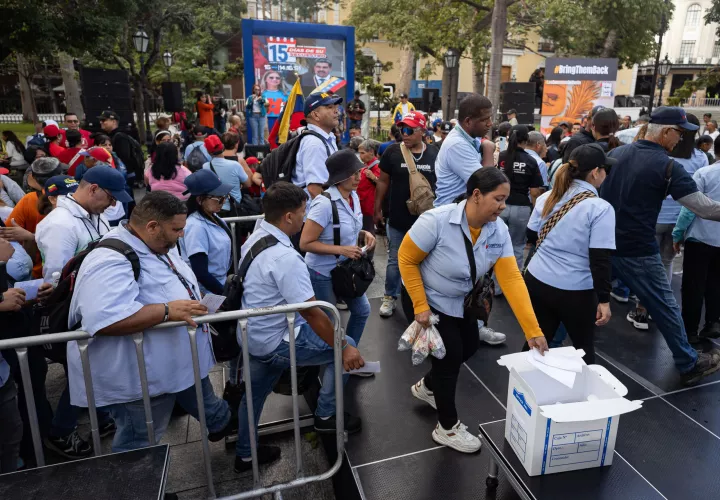
Chavismo promoted a national day of collecting letters in Venezuela to demand the release of Nicolás Maduro and Cilia Flores, detained in the United States, while pro-government militants reject the accusations and support Delcy Rodríguez as interim president. Chavismo launched a nationwide letter-collection campaign in Venezuela on Saturday to demand the release of President Nicolás Maduro and his wife, Cilia Flores, who were captured by the United States on January 3 in Caracas, in an operation that included simultaneous actions in different parts of the capital and surrounding states.
“Today we are writing letters for our president, who is being held captive in New York, with the conviction that he will soon be with us,” Wilkar Vallenilla, one of the attendees at the event. For his part, Kervin Montemayor, a member of the United Socialist Party of Venezuela (PSUV), expressed his support for Maduro and Flores, urging them to “resist” from the United States, just as —he affirmed— the Venezuelan people do. “They will soon be here with us. We will continue the revolution. Strength, Nicolás; strength, Cilia,” said Montemayor, who assured that the letters will be sent to the United States and “to the world.”
The leader also rejected the accusations against Nicolás Maduro, currently on trial in the United States for alleged drug trafficking offenses, stating that it is a political process. Since the capture of the Venezuelan president, Chavismo has intensified demonstrations and protests to demand his release and has reiterated that it will not stop until it achieves his return to the country. The protesters also reaffirmed their support for Delcy Rodríguez as acting president, a position she assumed on January 5 after being summoned by the Supreme Court of Justice. According to the state-run television channel Venezolana de Televisión, the collection of letters took place in several states, including Trujillo, Aragua, Anzoátegui and Sucre.