US-China Relations Analyst Leland Lázaros says ‘China needs Panama more than Panama needs China’
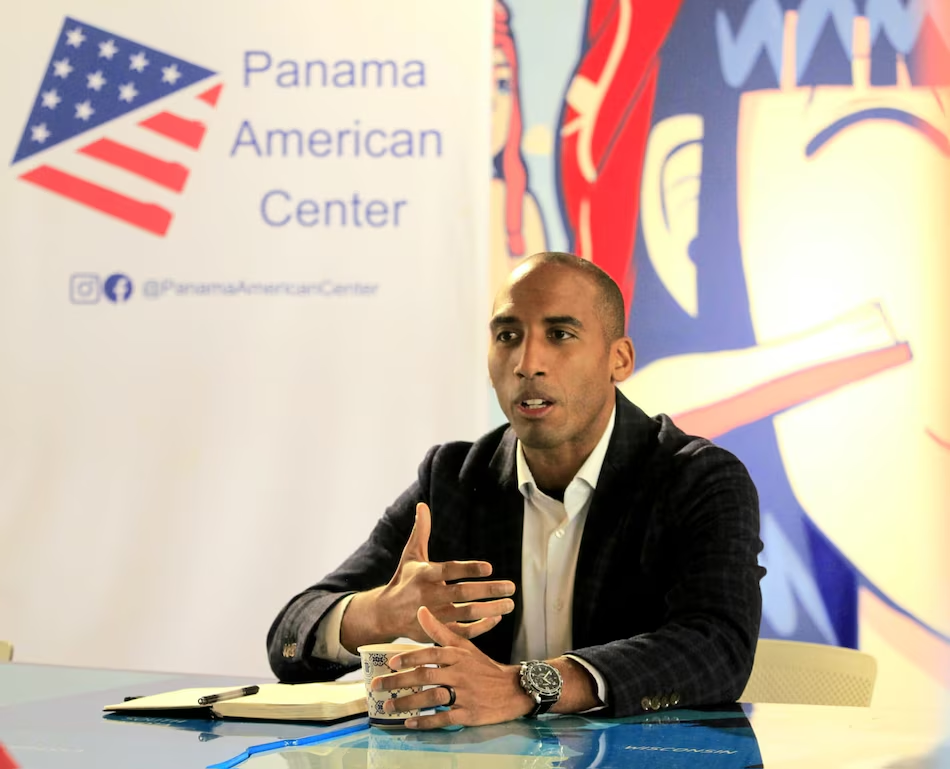
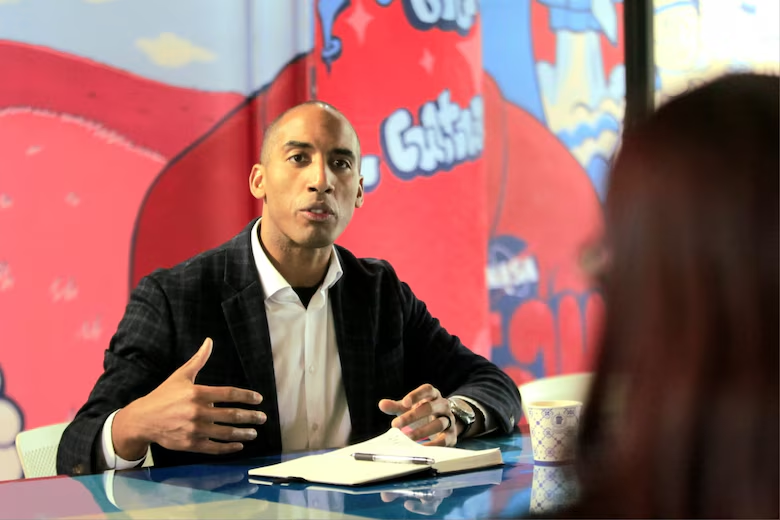
Leland Lázaros, an expert on US-China relations, discusses with reporters the complex dynamics of the China-Panama relationship, from the Canal to port tenders and the risks to sovereignty.

Speaking to a group of Panamanian journalists, Lázaros presented a critical analysis of Beijing’s influence in the country, the Canal, and strategic sectors such as ports.Panama wins when it diversifies, but loses when it lets its guard down. This is one of the conclusions of a conversation with Leland Lazarus, a researcher in US-China relations, a former State Department official, with Panamanian roots and more than 15 years of experience studying Chinese expansion in Latin America.

He identified specific risks to sovereignty and transparency. “China is currently Panama’s second most important economic partner. It is one of the most important users of the Canal,” he acknowledged at the beginning of the discussion. He cited access to inexpensive goods, a presence on digital platforms, and business diversification as positive elements. “All of that is very good,” he said. The problem, he warned, arises when that relationship operates as “a Trojan horse.”
The Canal, the 2017 Chinese Law, and the Ports
Lazarus focused his attention on the Panama Canal and the port operations associated with Chinese companies. He recalled that in 2017, China passed a national security and intelligence law that compels all companies, state-owned or private, to cooperate with the Communist Party when national security is invoked. “Articles 7 and 14,” he specified. Under this framework, he argued, a company like CK Hutchison cannot refuse to cooperate if the Chinese state demands it. He also mentioned the Panama Canal Neutrality Treaty. “Why haven’t the Chinese signed this treaty, when other countries have?” he asked. The absence of that signature, he said, leaves a significant void at a crucial point for Panama.
Corruption: Projects and a Conflict of Interest
Another key theme of his presentation was corruption. Lazarus spoke of “patrons” in projects financed by China and cited well-known cases in the Panamanian public debate: the Fourth Bridge, Margarita Island, and the container port in Colón. He mentioned the case of Jorge González, a member of the board of directors of the Panama Canal Authority, who obtained a consultancy from one of the companies in charge of the construction of the fourth bridge over the interoceanic waterway. He recalled the state-owned nature of China Harbour Engineering Company, part of the consortium building the fourth bridge over the Canal, and its direct ties to the Chinese political and military apparatus. “That is very worrying,” he stated. To illustrate the imbalance, he used a football metaphor: dealing with Chinese companies, he said, “is like playing a fixed match.”
Trade Relations with Taiwan
He raised a fundamental question: if mainland China could previously have a trade office in Panama, why can’t Taiwan even open one today? He pointed out that countries like the United States, Japan, and members of the European Union maintain diplomatic relations with Beijing and, at the same time, strong trade ties with Taiwan. “Panama, as a sovereign nation, can do business with any country,” he asserted. By differentiating between the “policy” and the “principle” of One China, Lazarus suggested that Panama has adopted a more restrictive version than that applied by other democracies.
Ports, Hong Kong and Rules
When asked about CK Hutchison’s global presence and why Panama seems like a particularly sensitive case, Lazarus rejected the notion that there are no concerns in other countries. He recalled the disruption caused by the national security law imposed on Hong Kong in 2019. “It stripped the city and the companies operating there of all independence,” he said. Since then, he asserted, it is no longer clear that Hong Kong conglomerates retain real autonomy from Beijing. Regarding the possibility of awarding new ports to Chinese state-owned companies like Cosco, he was direct: the problem isn’t trade, but the rules. “Doing business with a Western company is not the same as doing business with a Chinese company. They play by different rules.”
5G, Huawei and Data
The topic of technology came up with 5G and Huawei. Lázaros recommended reading the book House of Huawei and recalled the military background of its founder, Ren Zhengfei, as well as the lack of transparency surrounding data handling. “There is evidence that Huawei equipment is collecting personal data, and we don’t know where it’s going,” he stated. He then cited the 2017 law that requires companies in that country to provide information if the government requests it.
Panama on the Strategic Map
From the Chinese perspective, he explained, Panama is not just a trading partner. It is a geopolitical hub. He introduced the concept of “strategic support points,” used in Mandarin documents and studies to describe key locations where China seeks logistical support and global projection. He mentioned that Chinese analysts have described Cuba and Panama in this regard. “That is very worrying,” he insisted.
The United States, the Return to the Neighborhood, and Rhetoric
Lázaros also criticized Washington. He recalled that for years the United States neglected Latin America while focusing its attention on other regions. “It left a void that the Chinese and Russians tried to fill,” he said. He appreciated that the current administration of Donald Trump is once again turning its attention to the region, although he questioned the tone. He quoted Theodore Roosevelt and his phrase, “speak softly and carry a big stick.” “Today I see a lot of big sticks and very little soft speaking,” he remarked. He highlighted the recent strengthening of the US International Development Finance Corporation as a tool to offer real investment alternatives to the Belt and Road Initiative.
Visas, Sanctions, and Journalism
The expert was also asked about the US policy of revoking visas for people with ties to China or the Communist Party. He considers it legitimate to impose consequences if corruption is proven. “That benefits Panamanians,” he said. But he warned about the lack of transparency when the reasons aren’t explained. “If there is evidence, it must be said,” he insisted, and again emphasized the role of investigative journalism in documenting such cases.
A Warning Without Alarmism
Finally, he said that Panama needs options, mechanisms for evaluating foreign investment in critical infrastructure, and a vigilant press. “China needs Panama more than Panama needs China,” he stated, noting that the Canal is vital for Chinese trade. He argued that the benefits exist, but so do the costs. In his view, these should not be ignored.