Panama and Venezuela 36 Years Apart: How Bush and Trump Used Law to Break Law
George HW Bush invaded Panama after CIA agent Manuel Noriega turned against the US, while Donald Trump attacked Venezuela to remove Nicolás Maduro and seize its oil. Both attacks were illegal.
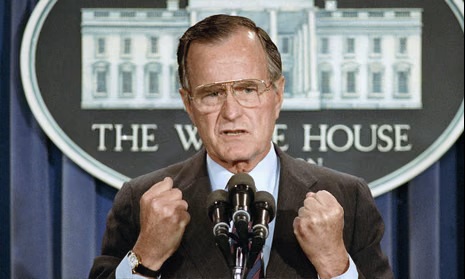
January 3, 1990, and January 3, 2026—36 years apart yet the same pattern. The leaders of two sovereign nations were captured under two different American imperialistic presidents, using the familiar flimsy excuses of the protection of US citizens and the war on drugs.
The same brazen display of American hegemony and superior firepower, flouting of international law, a swift, precise and coordinated attack on the sovereign nations and the handcuffing of their dictators dragged to its shores to face its unbiased and honest judicial system. And both attacks were illegal and conducted without Congressional authorization.
Whether George HW Bush or Donald J Trump, American imperialism is unabated—the pathetic excuses and the violent shock-and-awe tactics don’t matter; the results do. The international community, including the UN and Europe, is either shocked or in disbelief only to criticize the US mildly or remain mum.
The names of such blatant military operations, in the guise of the American way of implementing democracy and freedom in countries that are weak militarily and financially, smack of hypocrisy. Operation Just Cause in Panama in 1989. Operation Absolute Resolve in Venezuela in 2026. And the logic in attacking such nations, overtly and covertly, is based on the following three factors:
1) The dictator/president/prime minister is an American stooge-turned-traitor as in the case of Panama’s Manuel Noriega
2) The country has vast natural resources which can be obtained only through military intervention, like by removing Iraq’s Saddam Hussein and Venezuela’s Nicolás Maduro.
3) Install puppet leaders, like Augusto Pinochet in Chile in 1973, by orchestrating coups for strategic and military interests.
36 Years Ago, An Illegal Invasion
In Panama’s case, Noriega, a CIA spy for 30 years who assisted the US in its dirty wars against Communism in Latin America, especially in Nicaragua and El Salvador, during the Cold War and the country’s de facto ruler, became the Frankensteinian monster for Bush. Bush, a CIA director and two-term Veep to Ronald Reagan, was deeply involved in the Iran-Contra scandal. Noriega, promoted by his mentor and Panamanian military leader General Omar Torrijos, became a useful and highly paid CIA asset against Daniel Ortega’s left-wing Sandinista government in Nicaragua by helping the Contras and the rebels in El Salvador.
|
After Torrijos died in a mysterious plane crash, Noriega, with American help, consolidated power to become the de facto military ruler in 1983 and assisted the US in combating Soviet influence in the region. The ruthless Noriega oversaw a wave of torture, death squads and murders to silence his enemies. The strongman was also in cahoots with Pablo Escobar’s Colombian Medellin drug cartel. Reagan and Bush overlooked Noriega’s crimes, especially drug trafficking to the US, as he was a buffer against Soviet influence in the region.
He allowed Escobar to traffic tonnes of cocaine through Tocumen airport to the US in exchange for $1,000 per kilo. Soon, “Cara de Piña” (Spanish for “Pineapple Face”) became too big for his boots and challenged his creator. He covertly supported Fidel Castro and Muammar Gaddafi, threatened US personnel guarding the Panama Canal and declared a “state of war” with the US. From an asset, Noriega had turned into a liability for the US. On December 20, 1989, the US started bombing Panama—and on January 3, 1990, Delta Force and SEAL operatives forced Noriega to surrender.
The Panama Defense Forces (PDF) were dissolved and pro-US President-elect Guillermo Endara was sworn into office. The dictator was handcuffed, flown to the US and taken to Miami’s Federal Detention Center. In 1992, he was found guilty of 8 out of 10 counts of drug trafficking, racketeering and money laundering, and sentenced to 40 years, of which he served 17 due to good behavior at Miami’s Federal Correctional Institution. In 2010, Noriega was extradited to France, where he was convicted and sentenced to seven years for money laundering.
In 2011, he was extradited to Panama, where he was jailed for crimes committed during his dictatorship. He died in May 2017 after being diagnosed with a brain tumor. For years, the Reagan and Bush turned a blind eye to Noriega’s ties with Escobar and the trafficking of cocaine to the US—but when he turned dangerous, he became expendable. In fact, according to Noriega, the US targeted him after he refused to assist Lieutenant Colonel Oliver North, a central figure in the Iran-Contra affair, in providing weapons to the Nicaraguan rebels.
The Panama Invasion Was illegal
The UN’s Article 2 states: “All members shall refrain in their international relations from the threat or use of force against the territorial integrity or political independence of any state or in any other manner inconsistent with the purposes of the United Nations.” The UN can only intervene in matters within the domestic jurisdiction of any state under Chapter VII, which gives the Security Council the authority to “determine the existence of any threat to the peace, breach of the peace or act of aggression” and to take military and non-military action to “restore international peace and security”. The UNGA passed a resolution terming the Panama invasion a “flagrant violation of international law”.
A similar resolution proposed by the Security Council was supported by a majority of members but vetoed by the US, the UK and France. Even Articles 18 and 20 of the Charter of the Organization of American States prohibit the use of force by member states. No state or group of states has the right to intervene, directly or indirectly, for any reason whatever, in the internal affairs of any other state. Neither did Bush seek Congressional authorization despite Section 8 of Article I of the Constitution granting the power to declare war solely to Congress, not the president. He notified bipartisan leaders several hours before the invasion, but didn’t invoke the War Powers Act.
36 Years Later, another Illegal Invasion
Trump planned to oust Maduro way back in August, a month before the lethal airstrikes on boats in the Caribbean and the Pacific allegedly belonging to alleged narco-terrorists—the Venezuelan gang Tren de Aragua (TdA) and the Colombian guerrilla group National Liberation Army (ELN)—and carrying drugs. So far, 36 airstrikes have killed 115 people with Trump not providing an iota of evidence of the vessels trafficking drugs. All the Trump administration has told Congress is that the US is in an “armed conflict” against drug cartels and the victims are “unlawful combatants”. Moreover, the strikes are immune to judicial review due to a classified DoJ finding, which stated that Trump can order lethal strikes against members of drug cartels designated as enemy combatants threatening the US.
The US designated TdA as a foreign terrorist organization on February 20 and Cartel de los Soles, an informal Venezuelan criminal organization, as a specially designated global terrorist on July 25. Since the boat strikes started on September 2 and the US ordered the biggest naval deployment in the Caribbean Sea after the 1962 Cuban missile crisis, the Trump administration repeatedly denied that it wanted to remove Maduro and capture Venezuelan oil. In December, secretary of state and NSA Marco Rubio and defense secretary Pete Hegseth told the Senate the administration had no regime change intentions in Venezuela. In fact, according to Trump’s first-term NSA John Bolton, the president was “very interested in the Venezuelan oil” in 2018-19.
After Maduro’s capture, Trump clarified that the US will have “a presence in Venezuela as it pertains to oil”. “We’re going to have our very large United States oil companies, the biggest anywhere in the world, go in, spend billions of dollars, fix the badly broken infrastructure, the oil infrastructure, and start making money for the country,” he said. Now, Democratic lawmakers are livid. Senator Andy Kim senator tweeted: “I didn’t trust them then and we see now that they blatantly lied to Congress.” Senator Chris Murphy said, “When they came to Congress, and they literally lied to our faces. They said, ‘This is just a counter-narcotics operation.’ This seems to be mostly about oil and natural resources.”
Rubio and Hegseth lied to lawmakers in November as well. In a briefing, they said that the administration lacked a legal justification for striking targets inside Venezuela as the classified DoJ finding didn’t allow attacking land targets. However, considering how Trump has upended decades-old ties with Europe, sided with Russia in the Ukraine War and bombed Iran, the massive naval build-up and the boat strikes were the beginning of Maduro’s end. Trump not only attacked Venezuela but also didn’t seek Congressional authorization. Congress authorized the Iraq War in 2002 and the Global War on Terrorism in 2001 after 9/11.
Trump’s comments clearly hinted that he wouldn’t seek Congressional authorization for striking targets inside Venezuela, which meant Maduro’s removal. In the same month, when Hegseth and Rubio lied to lawmakers, Trump said that he didn’t need congressional authorization to attack targets inside Venezuela. So, how did Bush and Trump order the invasions without Congress’s approval? Both presidents used a DoJ legal opinion to justify the invasions. Reagan and Bush had planned the Panama invasion around six months before the bombardment. So did Trump.
In June 1989, then-assistant US attorney general (AG) William Barr, Bush’s future AG) and Trump’s AG in his first term, concluded that the DoJ’s 1980 opinion, ‘Extraterritorial Apprehension by the Federal Bureau of Investigation’, “erred in ruling that the FBI does not have legal authority to carry out extraterritorial law enforcement activities that contravene customary international law”. According to Barr, responding to the FBI’s request, the DoJ undertook “a comprehensive review” of 1980 opinion and concluded that the Bureau “may use its statutory authority to investigate and arrest individuals for violating United States law even if the FBI’s actions contravene customary international law”.
The 1980 opinion stated that under customary international law, it was considered an invasion of sovereignty for one country to carry out law enforcement activities within another country without that country’s consent. Per Barr’s legal opinion, the president, “acting through the attorney general”, can deploy the FBI to investigate and arrest individuals for violating US law in contravention of customary international law— even if “unexecuted treaties or treaty provisions, such as Article 2(4) of the United Nations Charter”, are contravened. “An arrest that is inconsistent with international or foreign law does not violate the Fourth Amendment.
Per Barr, US law enforcement agents frequently travel to foreign countries to conduct investigative activities or to meet foreign informants. “Formal consent cannot always be obtained from the foreign government, and indeed, in many cases, to seek such consent would endanger both the agents and their investigation,” Barr said, which basically means that the FBI can be deployed in a foreign nation without its consent. That’s precisely what Trump did in the Venezuelan attack—he also deployed the FBI along with the Delta Force. To make the case for the invasion watertight, the FBI’s elite Hostage Rescue Team (HRT), tasked with the arrest of high-risk individuals, undercover operations and surveillance, assisted the Delta Force in capturing Maduro.
Trump’s AG, Pam Bondi, had already framed Maduro’s indictment to ensure a maximum prison term, which provedthat the Venezuela operation was planned. The DOJ unsealed the indictment while Maduro was en route to the US, a superseding one based on his initial indictment in the Southern District of New York in Trump’s final year of his first term in 2020. The earlier indictment, based on criminal charges related to Venezuelan cocaine trafficking, first brought by the DoJ in 2011, charged Maduro and 14 current and former Venezuelan officials with narco-terrorism, corruption, drug trafficking and other criminal charges. Like the first one, the rewritten indictment, which adds the names of Maduro’s wife and son, two senior Venezuelan officials and an alleged TdA leader, also contains several charges that haven’t been proved.
The charges are on four counts: “narco-terrorism” conspiracy, cocaine importation conspiracy, possession of machine guns and destructive devices, and conspiracy to possess machine guns and destructive devices. First, per the indictment, Maduro, as a National Assembly member, foreign minister and president, in collusion with drug traffickers, moved thousands of tonnes of cocaine to the US. However, 84 per cent of the cocaine seized in the US is of Colombian origin, not Venezuelan, according to the US Drug Enforcement Administration’s March report, titled ‘DEA 2025 National Drug Threat Assessment’. The report doesn’t even mention Venezuela—it cites Ecuador, Central America and Mexico as the major trafficking hubs.
The top three cocaine producers are Colombia, Peru and Bolivia, accounting for 99 per cent of the world’s cocaine production, per the United Nations Office on Drugs and Crime (UNODC). Similarly, UNODC’s 2025 World Drug Report found that only five per cent of Colombian drugs are trafficked through Venezuela. Most US-bound cocaine is trafficked through the Pacific, not Caribbean, according to the UN—Venezuela does not have a Pacific Coast. Moreover, drug cartels operating in the Caribbean traffic most of the cocaine to Europe, not the US, due to much higher prices. According to a report funded by the Norwegian government, one kg of cocaine costs around $40,000 on average in Europe and $80,000 in some nations compared to only about $28,000 in the US.
A 2023 report by the Center for Strategic and International Studies, an American bipartisan nonprofit think tank, found that cartels operating in the Caribbean do use Venezuela to traffic drugs—but mostly to Europe, not the US. “To get to the Caribbean, drug traffickers favor transiting from Colombia through Venezuela.” The Colombia-Venezuela border in particular has “lax controls on the Venezuelan side and some members of the Venezuelan military are involved or support drug trafficking. Once cocaine reached Venezuela, it is then transported to the Caribbean through the Guajira and Paraguaná Peninsulas.
Cocaine leaves Colombia and Venezuela in small planes transiting through Guyana or the porous border with Suriname, where drug traffickers cross the Maroni River, a natural border between Suriname and French Guiana. Once in French Guiana, the cocaine departs in cargo vessels or by mules that take commercial flights to France, according to the report. Cocaine shipments from Venezuela enter the European Dutch territories via go-fast boats. From Aruba and Curaçao, cocaine is shipped directly to the Netherlands via sea or air or it continues its transshipment route to the eastern Caribbean. Second, Maduro, per the indictment, has “partnered with narco-terrorists” from Colombia’s FARC, ELN, the Sinaloa Cartel, the Zetas and TdA.
However, Mexican President Claudia Sheinbaum denied last August that Maduro had links to the Sinaloa Cartel as claimed by the US. “On Mexico’s part, there is no investigation that has to do with that,” she told reporters. An Office of the Director of National Intelligence (ODNI) memo last April concluded that Maduro “probably does not have a policy of cooperating with TdA and is not directing TdA movement to and operations in the United States”. “While Venezuela’s permissive environment enables [Tren de Aragua, or TDA] to operate, the Maduro regime probably does not have a policy of cooperating with TDA and is not directing TDA movement to and operations in the United States,” the report concluded.
Third, it’s true that in 2018, Maduro “declared victory in a disputed and internationally condemned presidential election in Venezuela”. It’s also true that in 2019, the Opposition-controlled National Assembly, led by President Juan Guaidó, declared that Maduro had usurped the presidency, and 50 countries, including the US, refused to recognize him as president. It’s again true that in the disputed 2024 presidential election, Maduro declared himself the winner. However, neither the US nor other Western nations have the right to question the election results or interfere in Venezuela’s internal matters.