Could 2026 Be the Make-or-Break Year of CK Hutchison’s Panama Ports Deal?
What began as a strategic exit for a Hong Kong conglomerate has devolved into a high-stakes stand-off between Washington and Beijing. Balboa Port was among the assets up for grabs in the sale. The saga prompted a clash between China and the US about the Panama Canal at a United Nations session in mid-August. Lau Siu-kai, consultant to the Chinese Association of Hong Kong and Macau Studies, has said he believes it will be a business-first decision if the BlackRock-led consortium withdraws.
Hong Kong conglomerate CK Hutchison’s US $22.8 billion global ports sale hung in the balance at the end of 2025, nearly 10 months after it was first announced, as a veteran political commentator said the most expensive terminal acquisition in history was unlikely to come to fruition amid geopolitical tensions. What began as a strategic exit for billionaire Li Ka-shing’s conglomerate devolved into a high-stakes geopolitical stand-off between Washington and Beijing over the control of global trade arteries. Professor Lau Siu-kai, consultant to the Chinese Association of Hong Kong and Macau Studies, a semi-official think tank, said he was skeptical about the future of the deal given the current geopolitical climate.
“If the US and China cannot reach a consensus on the sale of the port terminals, completing the sale will be difficult. Given the strategic value of the terminals to China, Beijing will not approve the sale if China’s interests are not protected,” he said. “The US is unlikely to agree to China holding majority shares in the terminals, particularly those on the Panama Canal. I am not optimistic about the sale’s successful completion at this time.” In March last year, CK Hutchison reached an in-principle agreement to sell an 80 per cent stake in its port assets to a Western consortium led by BlackRock and Terminal Investment Limited (TiL Group). TiL Group is the terminal arm of the world’s largest container shipper, Mediterranean Shipping Company (MSC).
The original deal would have encompassed 43 terminals in 23 countries and represented a massive shift in the ownership of global maritime infrastructure. The proposed sale was announced only a month after United States President Donald Trump embarked on a trade war with China at the beginning of his second term. Beijing denounced the deal just 10 days after it was revealed, with the Hong Kong and Macau Affairs Office (HKMAO) and the central government’s liaison office in Hong Kong reposting a series of critical articles, commentaries and remarks by officials on their websites. Critics cited in the articles and opinions labeled the divestment to Western capital as a “betrayal” of national interests, particularly in regard to China’s Belt and Road Initiative.
By late March 2025, China’s State Administration for Market Regulation (SAMR) had launched a comprehensive antitrust review, effectively halting the sale. The regulator later warned that “no concentration of undertakings shall be implemented without approval”, a move widely interpreted as a political intervention to prevent the sale of strategic assets from bypassing Beijing’s approval and falling under exclusive Western control. Following the expiration of the exclusivity period with BlackRock on July 27, 2025, CK Hutchison signaled a major strategic pivot. To appease Beijing and navigate the SAMR deadlock, the conglomerate said it was in negotiations to invite a “major strategic investor” from mainland China, identified by the media as Chinese state-owned firm Cosco Shipping, to join the buying consortium.
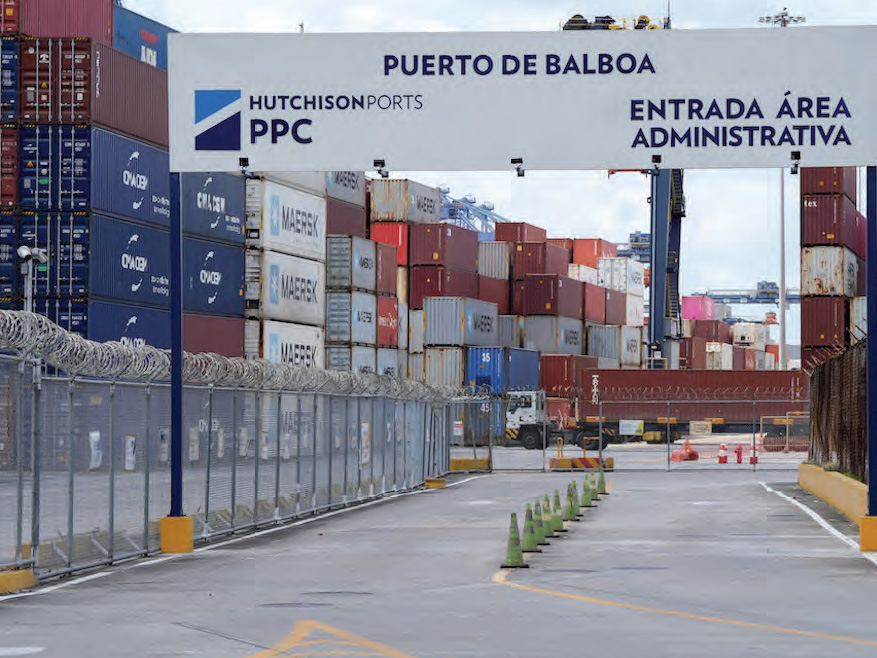
The focal point of the dispute remained the Panama Ports Company, a CK Hutchison subsidiary that operates the Balboa and Cristobal terminals at both ends of the canal. The Trump administration has framed the removal of “Chinese-linked” operators from the ports as a matter of hemispheric security. Kevin Marino Cabrera, the US ambassador to Panama, in early August slammed the Panama Ports Company’s performance and said Washington supported efforts to replace it. “Our position is that they are a bad operator. They have not done a good job,” he said. “It is a company of the Communist Party. We are enthusiastic that they will soon no longer be operating those ports. Cabrera’s remarks followed a series of political and legal developments surrounding the 25-year concession renewal granted to the company in 2021.
Panamanian Comptroller General Anel Flores in late July filed two lawsuits with his country’s supreme court to seek the contract’s annulment. The filings allege the renewal process violated constitutional procedures and included suspected financial irregularities. In a statement on August 1, the Panama Ports Company called for “respectful coordination” and emphasized that “respect for legal protection and the rule of law are essential” for providing investors with certainty that Panama remained a safe destination for investment. The saga preceded a clash between China and the US about the Panama Canal at a UN session in mid-August.
China’s ambassador to the UN, Fu Cong, said his country had always respected the neutrality of the Panama Canal. But US envoy Dorothy Shea raised concerns about China’s “outsized influence” over the region. Around the same time, CK Hutchison co-managing director Frank Sixt said at the company’s post-results briefing for the first half of last year that the deal’s completion would be delayed until 2026. “It is taking much longer than we had expected when we announced it in March, but frankly, that is not particularly troublesome,” Sixt said. “The ports group is having a very good year, generating stronger earnings and cash flow than we had expected.” Beijing has reportedly hardened its stance, demanding that Cosco obtain a majority stake and veto rights in the overall global portfolio as a condition for regulatory clearance.
Professor Lau said such scrutiny reflected a broader strategic shift. “Beijing is obviously determined to safeguard national strategic interests in a tough manner, particularly as China is confident it has many cards to play against the US,” he said. Negotiations remained deadlocked by late December. While CK Hutchison saw its stock price surge more than one-third since the day before announcing the deal, in addition to a potential US$19 billion cash windfall, the poisoned chalice of geopolitical competition now threatens the plan’s viability. Lau said he believed it would be a business-first decision if the BlackRock-led consortium withdrew.
“If they withdraw from the deal, I think it has more to do with their business calculations than with pressure from the US,” he said. If the BlackRock-led consortium and Beijing cannot agree on a bifurcated structure that potentially separates the Panama assets from the rest of the global portfolio up for grabs, the world’s largest port deal may face total collapse in the coming year. The ordeal stands to be a potential turning point for Li Ka-shing’s business empire. “Eventually, they have to take great care not to infringe on national interests and to consider geopolitics more in their future deals,” Lau said.
“In view of the new international situation, the Li family’s interests must align closely with national interests if they are to be better safeguarded.” The academic said that, despite the deal’s potential collapse, he believed the impact on Hong Kong’s reputation as an international shipping center would remain limited, as “geopolitical considerations are increasingly trumping economic calculations among countries these days”. “Even if the terminal sale cannot go through, people around the world won’t be surprised, as this is a regular pattern,” he said. When approached by the Post, BlackRock said it had no comment. The Post has also reached out to CK Hutchison, Cosco, MSC and TiL for comment on the progress of negotiation, but they have yet to reply.
China Signals It Won’t Give an Inch to the U.S. in Latin America
Beijing doubles down on its ambitions for the region just as Trump tries to assert dominance over the Western Hemisphere. Beijing has expressed anger at the destruction of a Chinese-built friendship park overlooking the Panama Canal.