Smithsonian Researchers Believe that the Panama-Costa Rica Corridor Would Protect Endangered Manatees

A bi-national corridor of nearly 1,000 kilometers between Panama and Costa Rica could be key to protecting manatees, which are endangered in Central America, the Smithsonian Tropical Research Institute (STRI) said Tuesday. This binational corridor, spanning 984 kilometers—220 kilometers in Costa Rica and 764 kilometers in Panama—and encompassing 2,631 square kilometers of coastal marine ecosystems and wetlands, is proposed by Smithsonian researchers who developed a study revealing the transboundary movements and habitat use of the Greater Caribbean manatee (Trichechus manatus manatus).
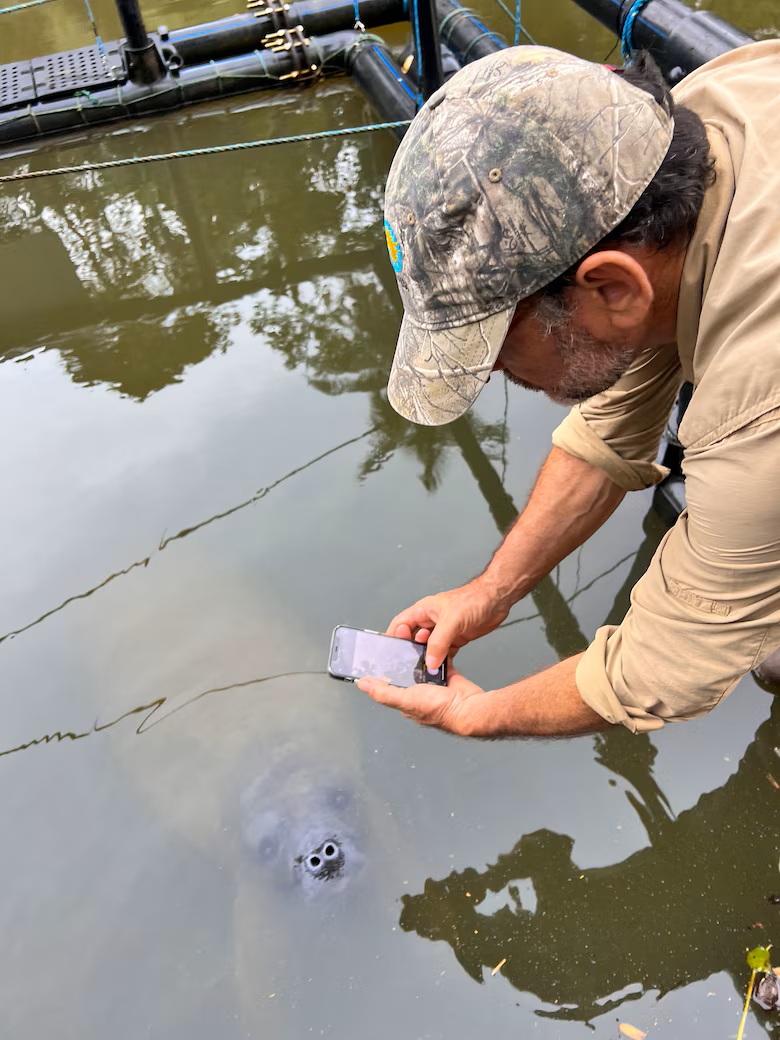
Photograph provided by Smithsonian scientist Héctor Guzmán showing him photographing a manatee for study
“With fewer than 2,500 mature individuals remaining and a projected population decline of 20% over the next two generations, this subspecies faces increasing threats due to habitat degradation, collisions with vessels, poaching, and entanglement in fishing nets,” the Panama-based scientific body stated. To support the long-term conservation of these herbivores, researchers propose the binational corridor, which includes 18 protected areas and four Ramsar sites: Northeast Caribbean Wetland and Gandoca-Manzanillo in Costa Rica, and San San-Pond Sak and Damani-Guariviara in Panama.
This gallery also encompasses “more than 57 rivers that reach the isobath (curve for the cartographic representation of points of equal depth in oceans and seas, as well as in large lakes) of 20 meters and aligns with the residence and movement patterns” of the manatees observed during the research. “It’s common to hear decision-makers say they need scientific information for natural resource management, and here it is. However, when we presented a Binational Agreement for the Protection of Manatees to the environment ministers of both countries, only Panama showed interest,” said Smithsonian scientist Héctor Guzmán, lead author and leader of the research.
Cross-Border Movements and Habitat Use

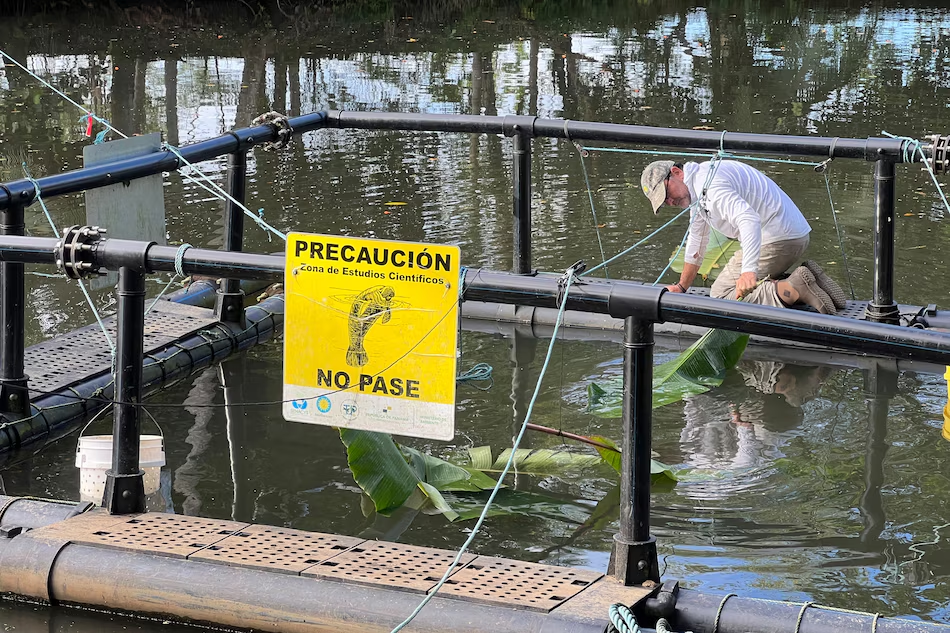
Photograph provided by Smithsonian scientist Héctor Guzmán showing him reviewing video footage after setting up night-vision cameras that detect when manatees enter a cage.
The new study developed by the Smithsonian and engineers from the Technological University of Panama (UTP, state-run) revealed new data on the movements, habitat use and conservation needs of the endangered Greater Caribbean manatee along the Caribbean coasts of Panama and Costa Rica. To monitor the presence and movement of manatees, researchers installed passive acoustic monitoring equipment at multiple wetlands and coastal sites in Panama and Costa Rica between 2015 and 2024. The Smithsonian explained that this approach made it possible to identify nine manatees traveling between Panama and Costa Rica, covering distances of up to 200 kilometers.
“We discovered that manatee movements northward coincide with periods of higher rainfall, warmer air temperatures, and lower sea levels. These patterns suggest a strong interaction between seasonal atmospheric dynamics and habitat use. This would allow us to predict their movements and guide conservation strategies that ensure seasonal ecological connectivity,” said STRI oceanographer and co-author Rocío Estévez. The scientific body stated that this study represents a “significant advance” in understanding the ecology of the manatee in Central America, and that it highlights the “urgent need” for coordinated policies and cross-border conservation efforts to safeguard the endangered manatee and the fragile ecosystems it inhabits.