Death at Cricamola: A Year Later the Tragedy was Repeated Due to a Lack of Bridges
The lack of infrastructure in rural and hard-to-reach areas has been, for years, the Achilles’ heel of the State, which has seen children, young people and adults drown in rivers and streams.
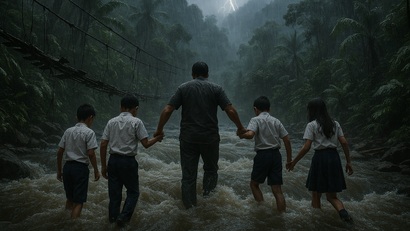
In late October 2025, Melissa became the most powerful storm to make landfall in 90 years. Its effects were devastating in Jamaica and Haiti, where at least 43 people lost their lives. Although Panama was not in the direct path of the storm, its indirect effects reached the Ngäbe Buglé region, where the impact came not from the hurricane’s wind or rain, but from the structural vulnerability that has plagued the indigenous communities for decades. Amid the flash floods that often accompany these weather events, two girls, ages 5 and 8, died while trying to reach their school. The tragedy once again exposed a painful pattern: the lack of safe bridges that forces hundreds of students to cross dangerous rivers and streams to access education.
This situation, far from being isolated, has been repeatedly denounced by teachers, community leaders and civil organizations, who point out that the combination of climate change, geographical isolation and lack of basic infrastructure has turned the rivers of the region into a recurring threat. Among those voices is that of Professor Armando Pineda, a multi-grade teacher in the Central Mountain Range, who knows firsthand the daily dangers his students face. “We are in a place where it constantly rains; we very rarely see the sun…..the lives of the students are still at risk.
Unless the authorities address this, we will unfortunately continue to lose the lives of innocent people,” he warned. For Pineda, each death is a reminder of a broken promise. In May 2024, he experienced one of the most painful moments of his career with the death of his student, Jorge Palacios, a 17-year-old. Pineda and other teachers, students, and family members searched desperately for seven days, until a resident of the Nomonoi community finally found him downstream, more than 40 kilometers from where the current had swept him away. The group walked for nearly ten hours to bring him back to his village in Rio Bueno for a Christian burial.
The loss deeply affected the educational community and reinforced their conviction to demand answers. “Remembering Jorge Palacios is like reliving that moment of tragedy and pain, especially because the government’s inaction caused all of this. And I will not tire of raising my voice demanding justice for the lives of our students and teachers who have been victims of the Cricamola River.” But Jorge’s death wasn’t the only one. In 2024, at least five children between the ages of eight and thirteen also died in the same circumstances. The news spread on social media and from there to the mainstream media, forcing the Ministry of Public Works to travel to the Central Mountain Range to determine how many temporary bridges would be built.