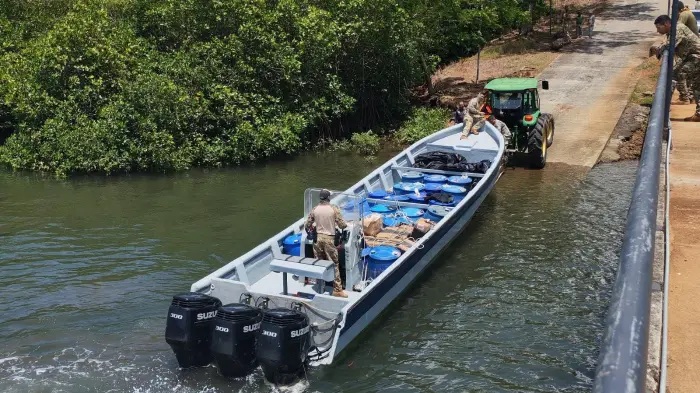
November is a Key Month as Water puts the Panama Canal Under Pressure Once Again.
For the second time in the history of the Canal, daily transits and the draft of neopanamax ships are reduced due to the levels of Gatun Lake which is pictured below.
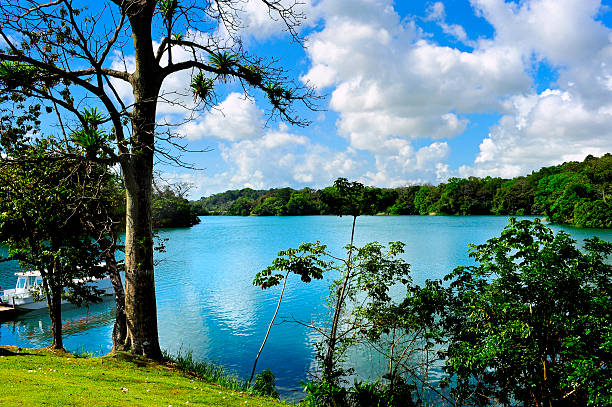
Gatun lake near the Panama canal
The Panama Canal is not yet facing a situation like the one in 2023-2024, when water shortages in the reservoirs forced a reduction of up to 40% in the average number of daily ship transits in January and February of 2024. However, recent rainfall patterns and forecasts for the coming months are beginning to raise concerns and prompt increased vigilance. The concern, for now, is whether the Gatún pictured below, and Alhajuela reservoirs will manage to recover enough water before next summer arrives, in four months. The problem is that the rainfall pattern that allowed the Canal to start the year with abundant reserves has changed in recent months.
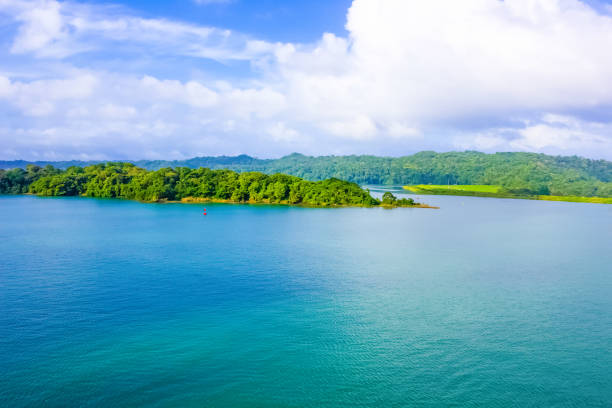
Although torrential downpours have been recorded in various parts of the country in recent days, these have been isolated incidents and have not necessarily occurred over the watershed that feeds the reservoirs. This gives rise to an apparent contradiction: how can it rain heavily in Panama and, at the same time, the Canal’s water reserves remain under pressure? Not all the rain falls within the watershed that feeds the Canal lakes, and not all the water that does arrive can be stored. Furthermore, high temperatures and winds increase evaporation.
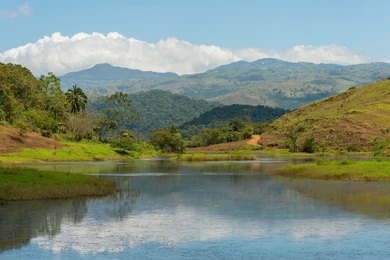
Alhajuela Lake in Panama.
The challenge, therefore, is not just that it rains, but that it rains in the right place, in the right amount, and at the right time to replenish the reserves that the Canal needs. In a country with abundant rainfall, but with a limited capacity to store it, dry periods once again highlight the need to build new reservoirs and strengthen water security for both the Canal and the population. To understand how close the Canal is to repeating a situation like that of 2023 and what are the warning signs that should be observed from now on, we spoke with engineer Jorge Luis Quijano pictured below, former administrator of the waterway.
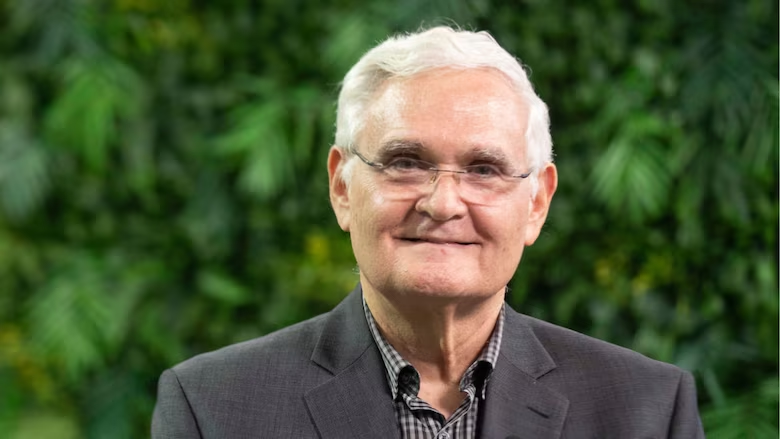
Jorge Luis Quijano, Former Administrator of the Waterway.
For Quijano, November will be a crucial month. “If the lakes aren’t full by the end of November, we’ll be in trouble in the summer,” he warned. Quijano explained that the forecasts from the U.S. National Oceanic and Atmospheric Administration (NOAA) combine information from between 25 and 30 internationally developed statistical and dynamic models. According to these projections, there is a 97% probability that El Niño pictured below, will persist until April 2027. Furthermore, the probability of the phenomenon reaching a very severe condition before the end of 2026 is around 90%, he said. For Quijano, the current scenario is atypical. Panama went from an exceptionally rainy start to the year to an August with one of the lowest rainfalls ever recorded in the history of Canal measurements.
Between January and March, rainfall accumulation over the basin was the second highest in 77 years, according to their review of records from the Panama Canal Authority (ACP). In contrast, between August 1 and 20, rainfall ranked fourth among the periods with the lowest records in those same 77 years. “It’s a very atypical situation,” Quijano reaffirmed. The former administrator emphasized that meteorology is not an exact science, so “we have to work with probabilities.” But those probabilities are already having consequences for the operation of the Canal. The route will reduce the number of daily transits from 36 to 34 ships starting September 4, and then, on the 15th of that same month, it will be set at 32, according to a statement from the ACP to customers.
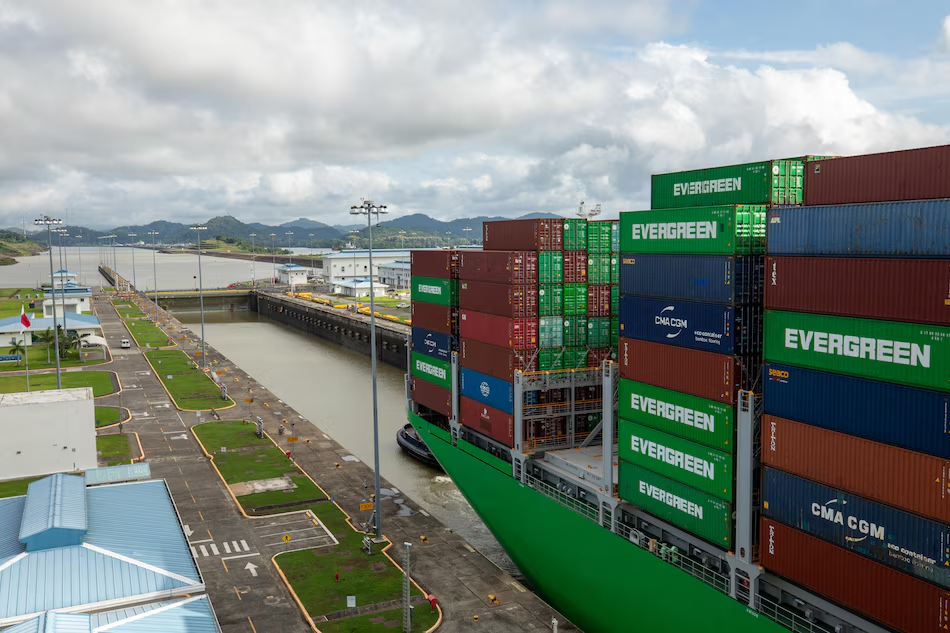
Cocolí Locks of the Panama Canal are Pictured Above.
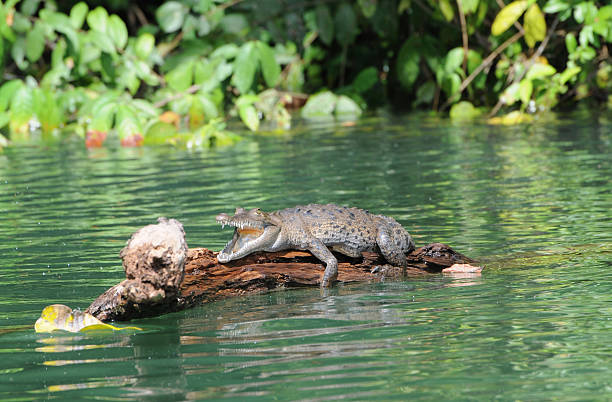
The Panama Canal has been operating with a draft of 48.5 feet (14.78 meters) in the Neopanamax locks since August 15. This draft was first reduced to 49.5 feet (15.09 meters) on July 3, then to 49 feet (14.94 meters) on July 24, and subsequently to the current 48.5 feet. The ideal draft is 50.0 feet. The program also includes further reductions to 48 feet (14.63 meters) on September 2, when it was originally August 26, and to 47.5 feet (14.48 meters) on October 1 instead of September 3. The logic behind these measures is simple: save water now to have a larger reserve when the dry season arrives. Alligators live in Gatun and Alhajuela lakes as pictured below. The water from the lakes must be divided between two main needs, and maybe 3 or more. On the one hand, there is the transit of ships through the Canal.
On the other, there is the supply of drinking water for the population. Between Gatun and Alhajuela, there are six water treatment plants that draw water from these systems, so the water needed for the population competes with the water required for the operation of the canal. Quijano explained that Alhajuela functions primarily as a water reservoir, while Gatún has two functions: accumulating water and serving as a navigation channel. Therefore, lowering Gatún’s water level directly impacts the draft that ships can maintain. Not all of Gatún’s accumulated volume is usable precisely because its main purpose is to allow ship traffic.
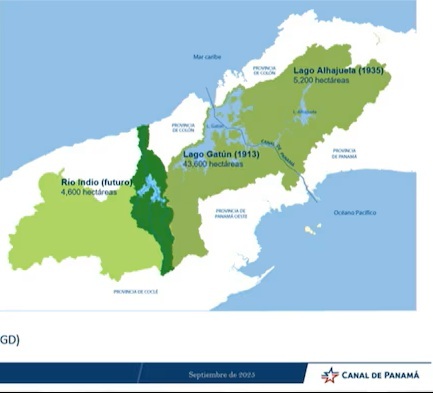
Currently, Alhajuela is at around 239 feet and Gatún at about 84.5 feet. According to Quijano, Gatún is already entering a critical zone, as evidenced by the reduced draft, although Alhajuela still maintains a much more favorable position than in 2023. Comparing it to that year puts the current situation into perspective. Around this time in 2023, Alhajuela was at approximately 209 feet. “We are better off than in 2023,” Quijano noted. However, he cautioned that forecasts point to a more prolonged and potentially more complicated scenario.
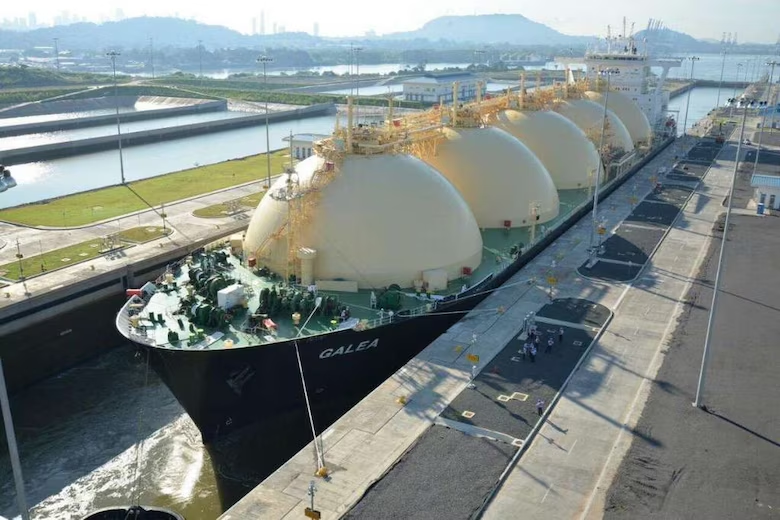
Gas Carriers such as these pictured above, do not need drafts greater than 40 or 41 feet.
November, the Key Month.
More than the current lake levels, Quijano identifies another indicator as the signal that will determine whether the Canal enters a critical situation again: how much it manages to recover its reservoirs before November. “If we don’t fill the lakes by November, we’re in trouble,” he said. If that scenario materializes, the Canal would have to simultaneously resort to the two tools it already used during the 2023 crisis: reducing the draft of ships and further decreasing the number of daily transits. An important point in the equation is understanding that draft reduction does not affect all types of vessels in the same way. Quijano explained that vessels traveling without cargo, cruise ships, car carriers, and most gas carriers do not need drafts greater than 40 or 41 feet. The greatest impact would be on container ships, which are the Canal’s main customers and typically require a draft of 47 to 48 feet when fully loaded. Although a few do reach a draft of up to 50 feet.
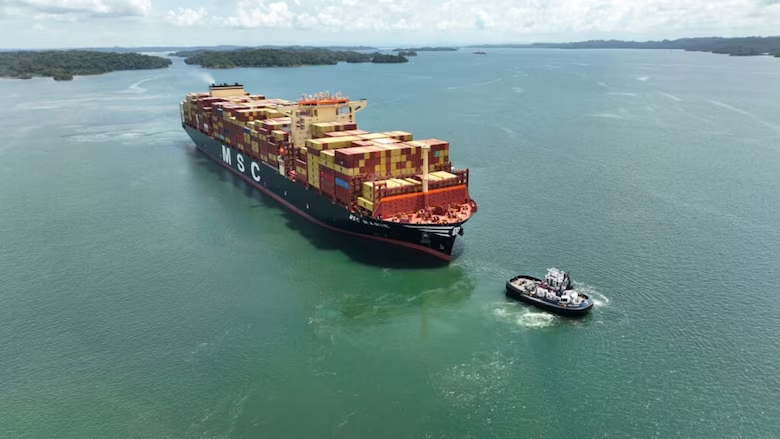
The MSC Marie container ship in Gatun Lake holds the record for the largest capacity vessel to transit the Panama Canal at 17,640 TEUs.
A reduction to 44 feet, as happened in 2023, would mean some of these ships would lose between five and six feet of draft capacity. Quijano estimates that for every foot of draft lost, a container ship could stop carrying around 200 containers. On a vessel of approximately 14,000 TEU, such a reduction could mean up to 1,200 fewer containers. This reduced capacity ultimately translates into higher transport costs, as the operator must distribute the cost associated with the unused capacity among the remaining cargo. The impact, therefore, is not limited to the operation of the Canal. A prolonged reduction in draft could ultimately increase the cost of moving goods between markets such as Asia and the United States.
Río Indio and the Need to Store Water.
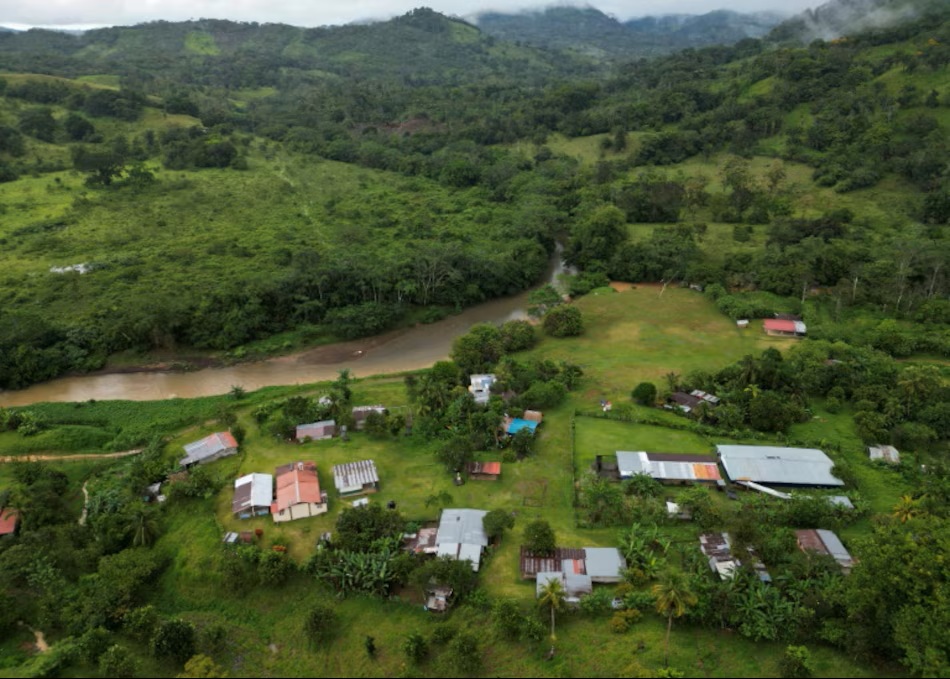
For Quijano, the current situation demonstrates once again that Panama needs to increase its water storage capacity and that the Río Indio project can no longer be postponed. “It must be accelerated.” In his opinion, if the project had been started 7 years ago, the Canal could now have an additional reserve that would allow it to face a strong El Niño phenomenon with a much greater margin. “Río Indio cannot be postponed. We have to do Río Indio, we have to expedite it,” he stated. According to their calculations, the new reservoir could provide enough water to allow around 12 additional daily transits during a water stress situation. The importance of Río Indio, however, would not be limited to the canal.
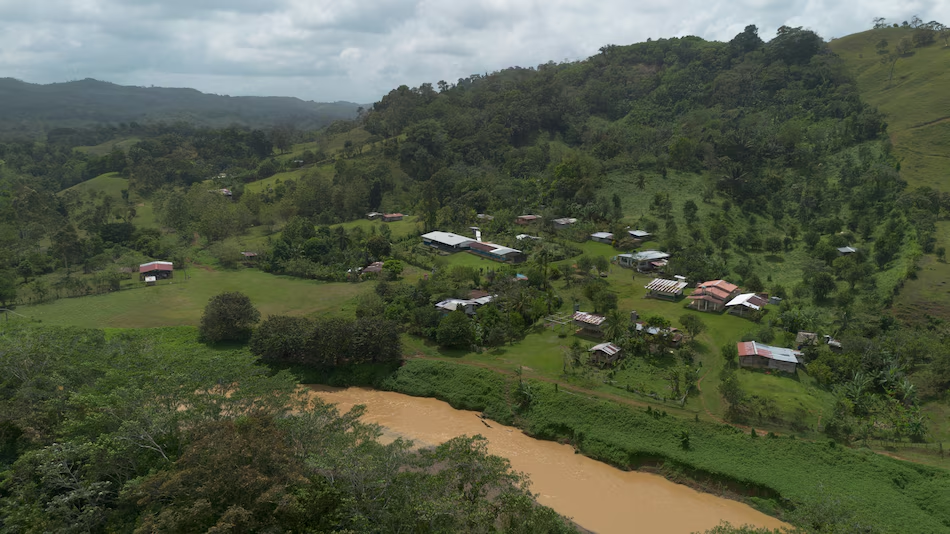
Quijano argues that a new lake would also provide an additional water source for the communities in the area and help guarantee supply during dry periods. The former administrator also warns that the problem should not be analyzed solely from the perspective of the Canal. The El Niño phenomenon is already affecting the central provinces and, according to the projections he cited, its effects could extend even to regions currently experiencing heavy rainfall, such as Bocas del Toro. Panama receives approximately 3,000 millimeters of rainfall annually, but only a portion can be captured and stored for later use. The rest eventually ends up in the sea.
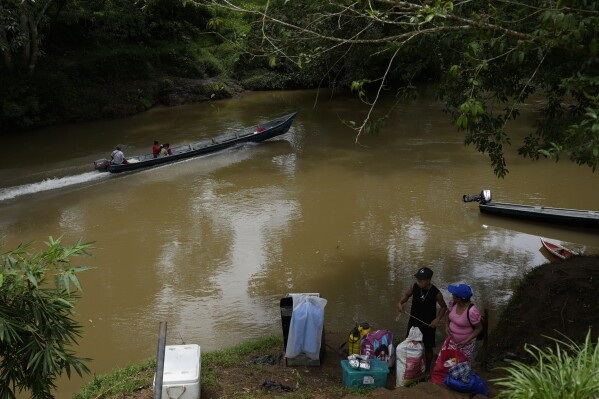
Therefore, rather than waiting for it to rain again, Quijano proposes increasing the country’s capacity to store water when rain is available and use it when drought arrives. The reason, he says, is that El Niño will return. In his experience, strong periods that used to be separated by more than a decade seem to be occurring more frequently. He recalled being at the Canal during the El Niño events of 1982 and 1997, and then again in 2015—three of the strongest episodes on record. Between those events, there were other periods of lesser intensity. Now, Panama is facing a new El Niño just three years after the last one. “El Niño events are going to return. This isn’t just a matter of this year,” he warned. In his view, the increased frequency of these events and the effects of climate change compel Panama to take measures to increase its water security before the next crisis arrives.
To Understand the Topic.
1. What are the Gatún and Alhajuela reservoirs?
These are large artificial reservoirs that store water. The water from both systems is essential for the Canal’s operations and also for supplying drinking water to more than 50% of the population concentrated between the provinces of Panama and Colón.
2. What is draft?
It is the depth a ship reaches underwater, from the waterline to the lowest part of its hull. In the Canal, the draft determines how much cargo a ship can carry. The greater the permitted draft, the greater the cargo capacity.
3. What does reducing the draft mean?
This is the number of ships that can cross the Canal in a single day. If the Canal reduces its transits from 36 to 32, it means four fewer ships will be able to cross daily. The Canal’s demonstrated capacity is 38 transits per day.
4. What are daily transits?
This is the number of ships that can cross the Canal in a day. If the Canal reduces transits from 36 to 32, it means that four fewer ships will be able to cross daily.
5. What is a Neopanamax vessel?
It is a vessel designed to take advantage of the maximum dimensions allowed by the new locks of the Canal. They are larger than Panamax vessels and include large container ships, gas carriers, bulk carriers, car carriers, tankers, and cruise ships (passengers).
6. Why does the level of the lakes affect the Canal?
Because each transit uses large quantities of water. When reservoir levels drop, the Canal has to manage the resource more carefully and may be forced to reduce the draft or the number of transiting vessels.
7. What is El Niño and why does it matter to the Canal?
It is a climatic phenomenon that can alter rainfall patterns. For the Canal, a prolonged El Niño could mean less water available to replenish reservoirs during the rainy season.